Laboratory of Computational Social Science, Networks Dept, IMT School for Advanced Studies, 55100 Lucca, Italy.
ISC-CNR Uos "Sapienza", 00185 Roma, Italy.
Sci Rep. 2017 Jan 11;7:40391. doi: 10.1038/srep40391.
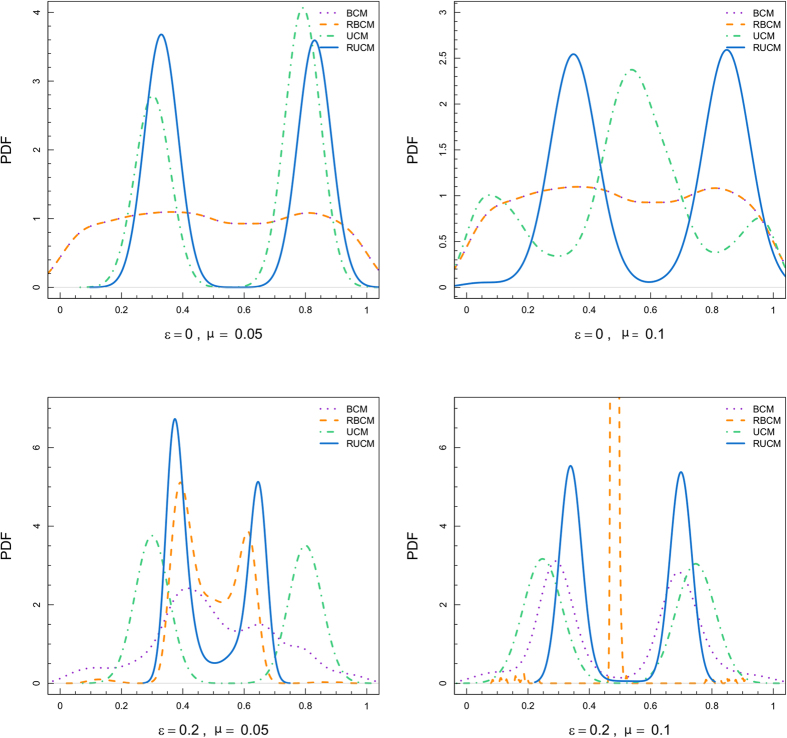
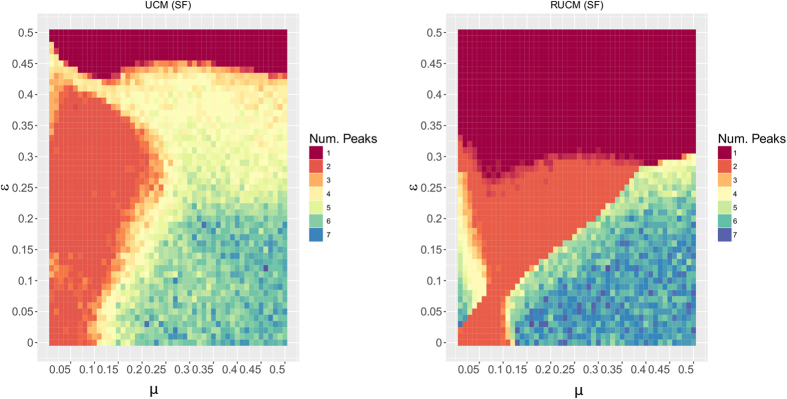
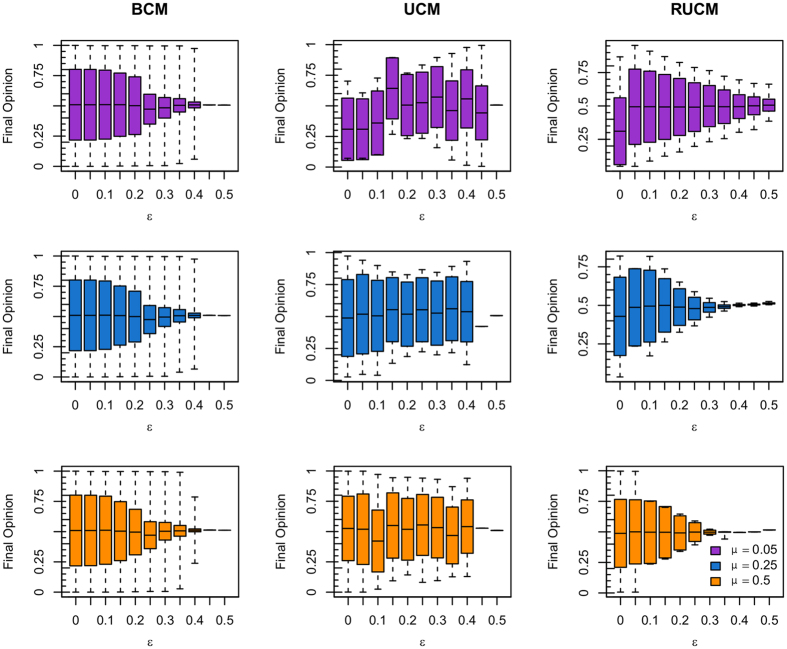
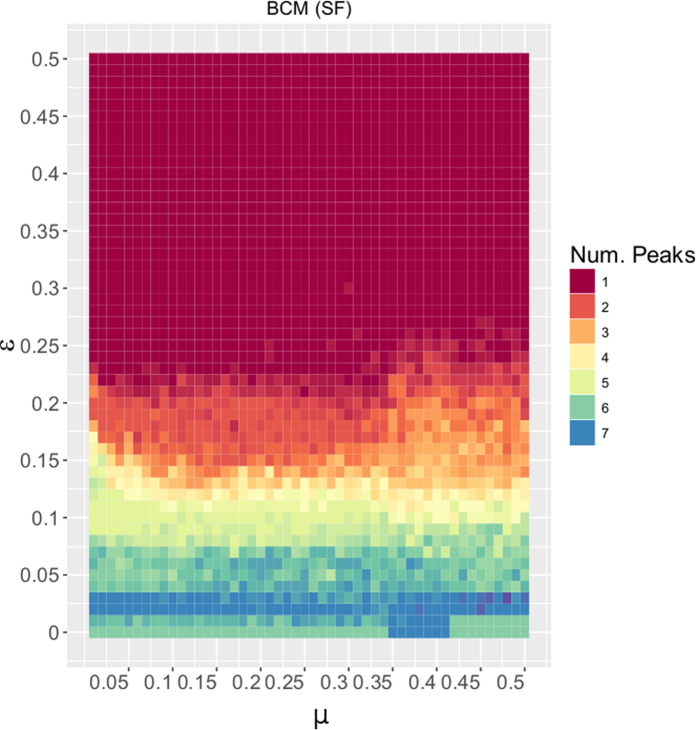
Online users tend to select claims that adhere to their system of beliefs and to ignore dissenting information. Confirmation bias, indeed, plays a pivotal role in viral phenomena. Furthermore, the wide availability of content on the web fosters the aggregation of likeminded people where debates tend to enforce group polarization. Such a configuration might alter the public debate and thus the formation of the public opinion. In this paper we provide a mathematical model to study online social debates and the related polarization dynamics. We assume the basic updating rule of the Bounded Confidence Model (BCM) and we develop two variations a) the Rewire with Bounded Confidence Model (RBCM), in which discordant links are broken until convergence is reached; and b) the Unbounded Confidence Model, under which the interaction among discordant pairs of users is allowed even with a negative feedback, either with the rewiring step (RUCM) or without it (UCM). From numerical simulations we find that the new models (UCM and RUCM), unlike the BCM, are able to explain the coexistence of two stable final opinions, often observed in reality. Lastly, we present a mean field approximation of the newly introduced models.
在线用户往往会选择符合自己信仰体系的说法,并忽略不同的信息。确认偏差确实在病毒现象中起着关键作用。此外,网络上内容的广泛可及性促进了志同道合的人的聚集,在这种情况下,辩论往往会加剧群体极化。这种配置可能会改变公共辩论,从而影响公众意见的形成。在本文中,我们提供了一个数学模型来研究在线社交辩论和相关的极化动态。我们假设基本的置信度限制模型(BCM)更新规则,并开发了两种变体:a)带置信度限制的重连模型(RBCM),其中不和谐的链接会被打破,直到达到收敛;b)无限制置信度模型,在这种模型中,即使存在负反馈,不和谐的用户对之间也可以进行交互,要么通过重连步骤(RUCM),要么不通过(UCM)。通过数值模拟,我们发现新模型(UCM 和 RUCM)与 BCM 不同,能够解释在现实中经常观察到的两种稳定最终意见的共存。最后,我们提出了新模型的平均场近似。