Jeon Sookyoung, Neuringer Martha, Johnson Emily E, Kuchan Matthew J, Pereira Suzette L, Johnson Elizabeth J, Erdman John W
Division of Nutritional Sciences, University of Illinois at Urbana-Champaign, Urbana, IL 61801, USA.
Oregon National Primate Research Center, Oregon Health and Science University, Beaverton, OR 97239, USA.
Nutrients. 2017 Jan 10;9(1):51. doi: 10.3390/nu9010051.
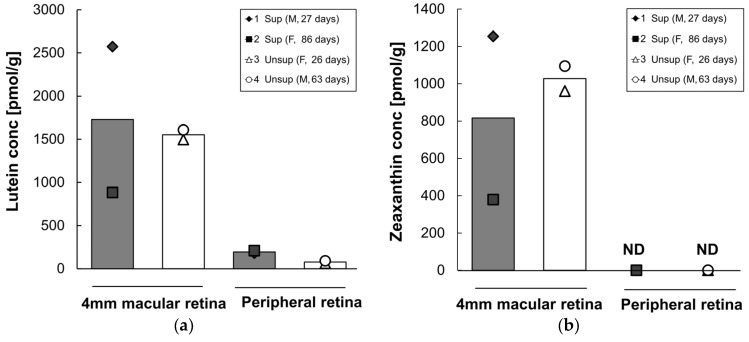
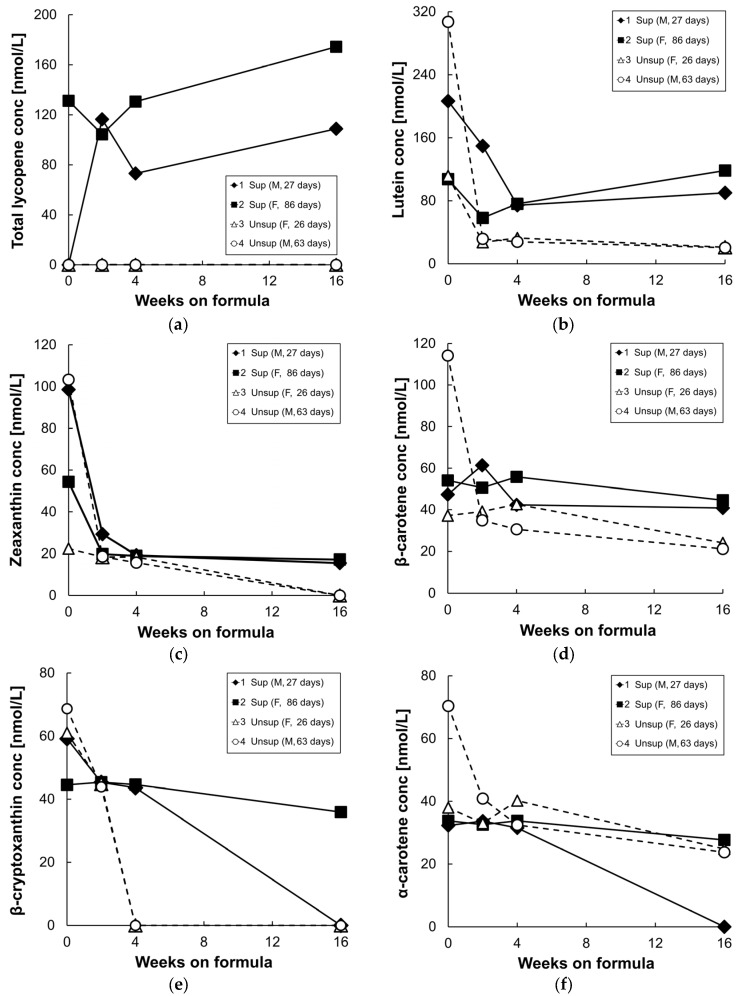
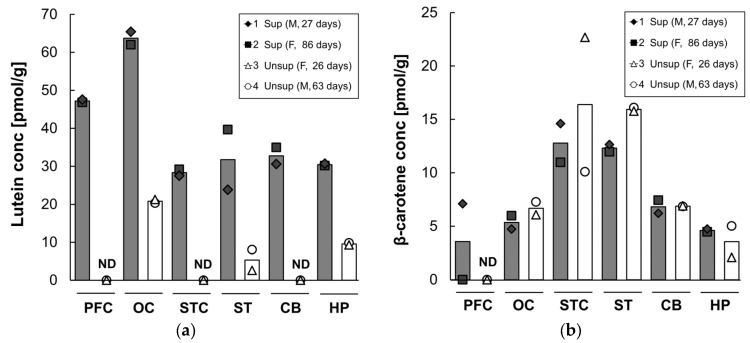
Lutein is the predominant carotenoid in the developing primate brain and retina, and may have important functional roles. However, its bioaccumulation pattern during early development is not understood. In this pilot study, we investigated whether carotenoid supplementation of infant formula enhanced lutein tissue deposition in infant rhesus macaques. Monkeys were initially breastfed; from 1 to 3 months of age they were fed either a formula supplemented with lutein, zeaxanthin, β-carotene and lycopene, or a control formula with low levels of these carotenoids, for 4 months ( = 2/group). All samples were analyzed by high pressure liquid chromatography (HPLC). Final serum lutein in the supplemented group was 5 times higher than in the unsupplemented group. All brain regions examined showed a selective increase in lutein deposition in the supplemented infants. Lutein differentially accumulated across brain regions, with highest amounts in occipital cortex in both groups. β-carotene accumulated, but zeaxanthin and lycopene were undetectable in any brain region. Supplemented infants had higher lutein concentrations in peripheral retina but not in macular retina. Among adipose sites, abdominal subcutaneous adipose tissue exhibited the highest lutein level and was 3-fold higher in the supplemented infants. The supplemented formula enhanced carotenoid deposition in several other tissues. In rhesus infants, increased intake of carotenoids from formula enhanced their deposition in serum and numerous tissues and selectively increased lutein in multiple brain regions.
叶黄素是发育中的灵长类动物大脑和视网膜中的主要类胡萝卜素,可能具有重要的功能作用。然而,其在早期发育过程中的生物积累模式尚不清楚。在这项初步研究中,我们调查了在婴儿配方奶粉中添加类胡萝卜素是否能增强猕猴幼崽体内叶黄素的组织沉积。猕猴幼崽最初进行母乳喂养;1至3个月大时,它们被喂食添加了叶黄素、玉米黄质、β-胡萝卜素和番茄红素的配方奶粉,或含有低水平这些类胡萝卜素的对照配方奶粉,为期4个月(每组n = 2)。所有样本均通过高压液相色谱法(HPLC)进行分析。补充组的最终血清叶黄素水平比未补充组高5倍。在所有检查的脑区中,补充组的婴儿叶黄素沉积均有选择性增加。叶黄素在不同脑区的积累存在差异,两组枕叶皮质中的含量最高。β-胡萝卜素有所积累,但在任何脑区均未检测到玉米黄质和番茄红素。补充组婴儿外周视网膜中的叶黄素浓度较高,但黄斑视网膜中的叶黄素浓度未升高。在脂肪组织部位中,腹部皮下脂肪组织中的叶黄素水平最高,补充组婴儿的该水平是未补充组的3倍。添加了类胡萝卜素的配方奶粉增强了其他几种组织中的类胡萝卜素沉积。在猕猴幼崽中,通过配方奶粉增加类胡萝卜素的摄入量可增强其在血清和多种组织中的沉积,并选择性地增加多个脑区中的叶黄素含量。