Zhang Han, Breeze Tom, Bailey Alison, Garthwaite David, Harrington Richard, Potts Simon G
Centre for Agri-Environmental Research, School of Agriculture, Policy and Development, University of Reading, Reading, Berkshire, United Kingdom.
Land Management and Systems, Faculty of Agribusiness and Commerce, Lincoln University, Christchurch, New Zealand.
PLoS One. 2017 Jan 11;12(1):e0169475. doi: 10.1371/journal.pone.0169475. eCollection 2017.
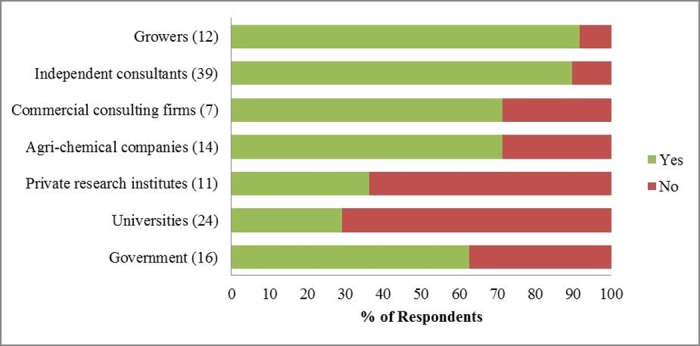
Oilseed rape (Brassica napus) is an important combinable break crop in the UK, which is largely protected from arthropod pests by insecticidal chemicals. Despite ongoing debate regarding the use of neonicotinoids, the dominant seed treatment ingredients used for this crop, there is little publicly available data comparing the efficacy of insecticides in controlling key arthropod pests or comparing the impacts on non-target species and the wider environment. To provide an insight into these matters, a UK-wide expert survey targeting agronomists and entomologists was conducted from March to June 2015. Based on the opinions of 90 respondents, an average of 20% yield loss caused by the key arthropod pests was expected to have occurred in the absence of insecticide treatments. Relatively older chemical groups were perceived to have lower efficacy for target pests than newer ones, partly due to the development of insecticide resistance. Without neonicotinoid seed treatments, a lack of good control for cabbage stem flea beetle was perceived. Wide spectrum foliar insecticide sprays were perceived to have significantly greater negative impacts than seed treatments on users' health, natural enemies, pollinators, soil and water, and many foliar active ingredients have had potential risks for non-target arthropod species in UK oilseed rape fields for the past 25 years. Overall, 72% of respondents opposed the neonicotinoid restriction, while 10% supported it. Opposition and support of the restriction were largely based on concerns for pollinators and the wider environment, highlighting the uncertainty over the side effects of neonicotinoid use. More people from the government and research institutes leaned towards neutrality over the issue, compared to those directly involved in growing the crop. Neonicotinoid restriction was expected to result in greater effort and expenditure on pest control and lower production (0-1 t/ha less). Alternatives for future oilseed rape protection were then discussed.
油菜(甘蓝型油菜)是英国一种重要的可轮作作物,在很大程度上依靠杀虫剂来抵御节肢动物害虫。尽管对于作为该作物主要种子处理成分的新烟碱类杀虫剂的使用一直存在争议,但几乎没有公开数据可用于比较杀虫剂在控制主要节肢动物害虫方面的效果,也无法比较其对非靶标物种及更广泛环境的影响。为深入了解这些问题,2015年3月至6月针对英国各地的农艺师和昆虫学家开展了一项专家调查。根据90位受访者的意见,如果不进行杀虫剂处理,预计主要节肢动物害虫会导致平均20%的产量损失。人们认为相对较老的化学类别对靶标害虫的防治效果低于较新的类别,部分原因是昆虫产生了抗药性。如果不进行新烟碱类种子处理,人们认为对甘蓝茎跳甲的防治效果不佳。人们认为,广谱叶面杀虫剂喷雾对使用者健康、天敌、传粉者、土壤和水的负面影响远大于种子处理,在过去25年里,许多叶面活性成分对英国油菜田中的非靶标节肢动物物种都存在潜在风险。总体而言,72%的受访者反对限制使用新烟碱类杀虫剂,而10%的受访者表示支持。对限制措施的反对和支持主要基于对传粉者和更广泛环境的担忧,这凸显了新烟碱类杀虫剂使用副作用的不确定性。与直接从事作物种植的人员相比,来自政府和研究机构的人员在这个问题上更倾向于中立。预计限制使用新烟碱类杀虫剂将导致在害虫防治方面付出更多努力和更高成本,产量也会降低(每公顷减少0至1吨)。随后讨论了未来油菜保护的替代方案。