Passos Giselle S, Santana Marcos G, Poyares Dalva, D'Aurea Carolina V, Teixeira Alexandre A, Tufik Sergio, de Mello Marco T
Departamento de Psicobiologia, Universidade Federal de São Paulo (UNIFESP), São Paulo, SP, Brazil.
Programa de Mestrado em Ciências Aplicadas à Saúde, Universidade Federal de Goiás (UFG), Regional Jataí, Jataí, GO, Brazil.
Braz J Psychiatry. 2017 Apr-Jun;39(2):183-186. doi: 10.1590/1516-4446-2016-2007. Epub 2017 Jan 9.
: To assess the interaction of chronotype with anxiety in patients with chronic primary insomnia.
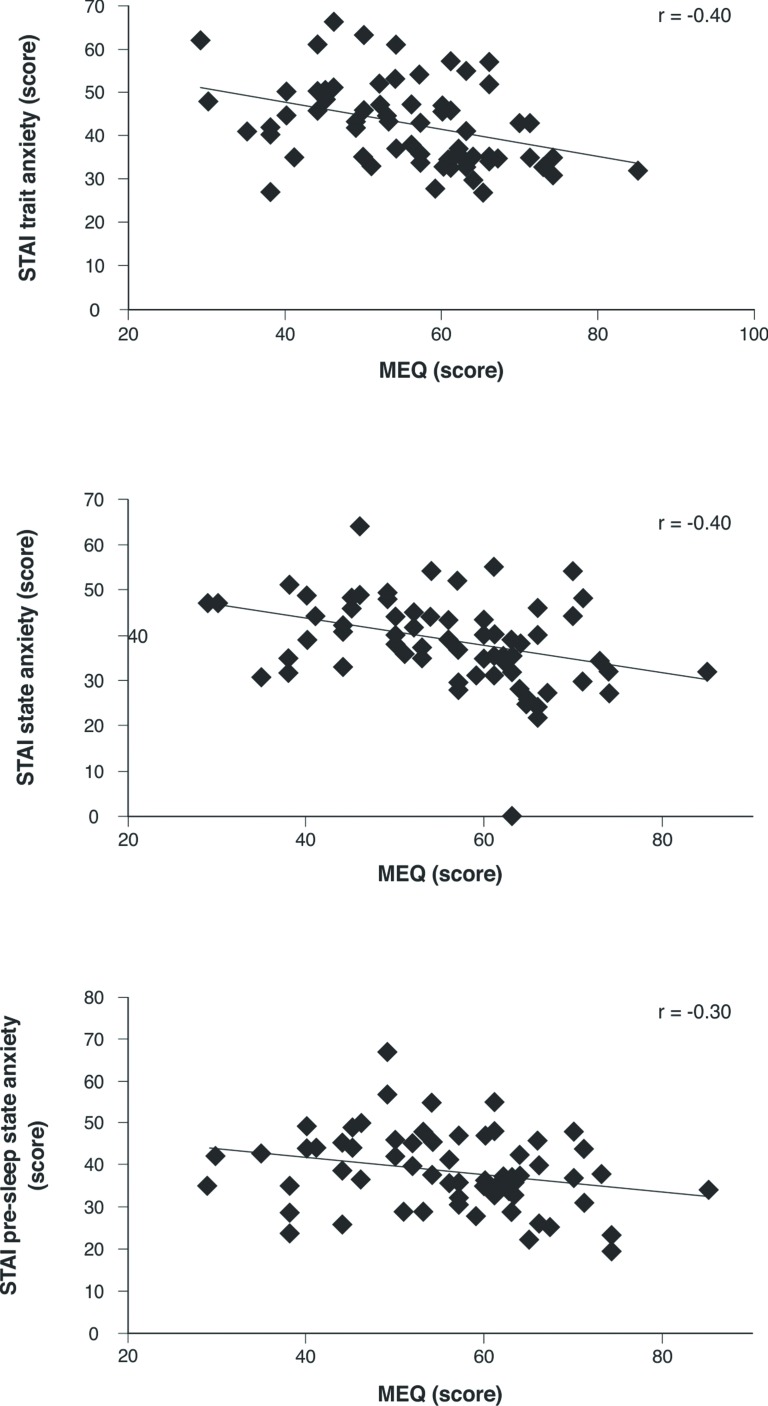
: Sixty-four patients (50 women) with mean age 43.9±8.1 years were investigated with the Horne and Östberg Morningness-Eveningness Questionnaire (MEQ) and State-Trait Anxiety Inventory (STAI).
: Significant negative correlations of chronotype-MEQ score with STAI state-anxiety (r = -0.40, p < 0.05), STAI trait-anxiety (r = -0.40, p < 0.05), and STAI pre-sleep state anxiety (r = -0.30, p < 0.05) were observed. Eveningness preference was associated with higher trait, state, and pre-sleep state anxiety.
: These results suggest that chronotype may be an important parameter to identifying the origin and significance of a vicious anxiety-insomnia-depression cycle in patients with chronic primary insomnia.
评估慢性原发性失眠患者的昼夜节律类型与焦虑之间的相互作用。
采用霍恩和奥斯特伯格晨型-夜型问卷(MEQ)及状态-特质焦虑量表(STAI)对64例患者(50名女性)进行调查,患者平均年龄为43.9±8.1岁。
观察到昼夜节律类型-MEQ得分与STAI状态焦虑(r = -0.40,p < 0.05)、STAI特质焦虑(r = -0.40,p < 0.05)以及STAI睡前状态焦虑(r = -0.30,p < 0.05)之间存在显著负相关。夜型偏好与更高的特质焦虑、状态焦虑和睡前状态焦虑相关。
这些结果表明,昼夜节律类型可能是识别慢性原发性失眠患者焦虑-失眠-抑郁恶性循环的起源和意义的一个重要参数。