Hansen Stefan N, Overgaard Morten, Andersen Per K, Parner Erik T
Section for Biostatistics, Aarhus University, Bartholins Allé 2, Aarhus C, DK-8000, Denmark.
Section of Biostatistics, University of Copenhagen, Øster Farimagsgade 5, Copenhagen K, DK-1014, Denmark.
BMC Med Res Methodol. 2017 Jan 11;17(1):7. doi: 10.1186/s12874-016-0280-6.
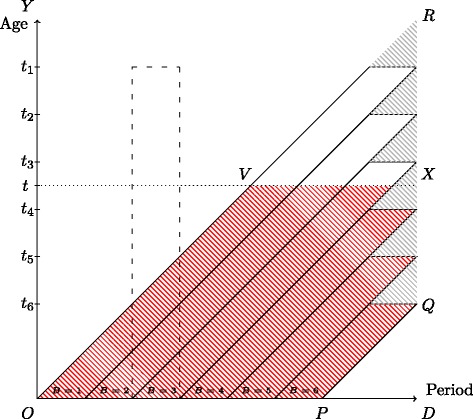
The risk of a disease or psychiatric disorder is frequently measured by the age-specific cumulative incidence. Cumulative incidence estimates are often derived in cohort studies with individuals recruited over calendar time and with the end of follow-up governed by a specific date. It is common practice to apply the Kaplan-Meier or Aalen-Johansen estimator to the total sample and report either the estimated cumulative incidence curve or just a single point on the curve as a description of the disease risk.
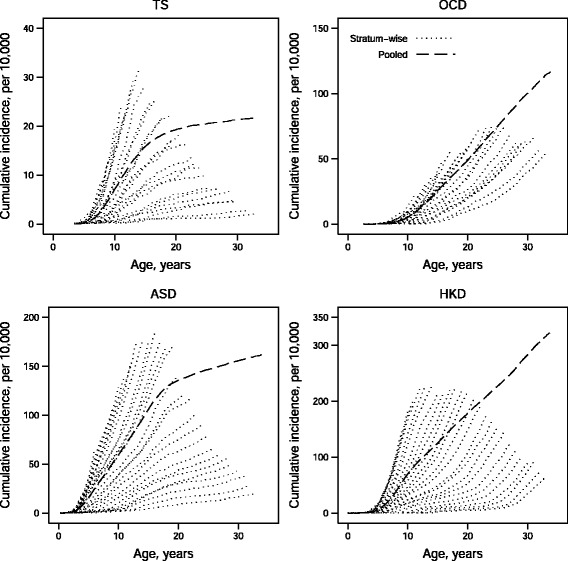
We argue that, whenever the disease or disorder of interest is influenced by calendar time trends, the total sample Kaplan-Meier and Aalen-Johansen estimators do not provide useful estimates of the general risk in the target population. We present some alternatives to this type of analysis.
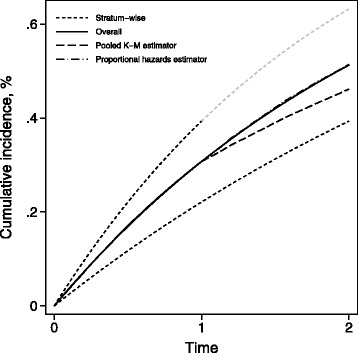
We show how a proportional hazards model may be used to extrapolate disease risk estimates if proportionality is a reasonable assumption. If not reasonable, we instead advocate that a more useful description of the disease risk lies in the age-specific cumulative incidence curves across strata given by time of entry or perhaps just the end of follow-up estimates across all strata. Finally, we argue that a weighted average of these end of follow-up estimates may be a useful summary measure of the disease risk within the study period.
Time trends in a disease risk will render total sample estimators less useful in observational studies with staggered entry and administrative censoring. An analysis based on proportional hazards or a stratified analysis may be better alternatives.
疾病或精神障碍的风险通常通过特定年龄的累积发病率来衡量。累积发病率估计值通常来自队列研究,其中个体是在日历时间内招募的,随访结束由特定日期决定。常见的做法是将Kaplan-Meier或Aalen-Johansen估计器应用于总样本,并报告估计的累积发病率曲线,或者仅报告曲线上的一个点作为疾病风险的描述。
我们认为,只要感兴趣的疾病或障碍受到日历时间趋势的影响,总样本的Kaplan-Meier和Aalen-Johansen估计器就无法提供目标人群总体风险的有用估计。我们提出了这种类型分析的一些替代方法。
我们展示了如果比例性是一个合理的假设,如何使用比例风险模型来推断疾病风险估计值。如果不合理,我们反而主张,对疾病风险更有用的描述在于按进入时间分层的特定年龄累积发病率曲线,或者可能只是所有分层的随访结束估计值。最后,我们认为这些随访结束估计值的加权平均值可能是研究期间疾病风险的一个有用汇总指标。
疾病风险的时间趋势将使总样本估计器在具有交错进入和行政审查的观察性研究中用处不大。基于比例风险的分析或分层分析可能是更好的选择。