Gassama Malamine, Bénichou Jacques, Dartois Laureen, Thiébaut Anne C M
Université Paris-Saclay, Biostatistics, Biomathematics, Pharmacoepidemiology and Infectious Diseases (B2PHI), Inserm, UVSQ, Institut Pasteur, 25 rue du Dr. Roux, Paris Cedex 15, 75724, France.
University of Rouen, Inserm, U 1219, 1 rue de Germont, Rouen Cedex, 76031, France.
BMC Med Res Methodol. 2017 Jan 23;17(1):10. doi: 10.1186/s12874-016-0285-1.
The attributable risk (AR) measures the proportion of disease cases that can be attributed to an exposure in the population. Several definitions and estimation methods have been proposed for survival data.
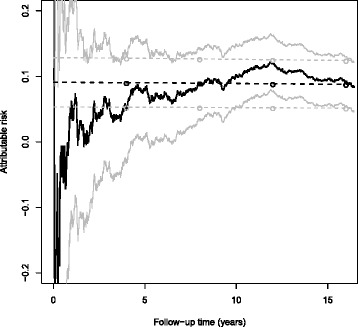
Using simulations, we compared four methods for estimating AR defined in terms of survival functions: two nonparametric methods based on Kaplan-Meier's estimator, one semiparametric based on Cox's model, and one parametric based on the piecewise constant hazards model, as well as one simpler method based on estimated exposure prevalence at baseline and Cox's model hazard ratio. We considered a fixed binary exposure with varying exposure probabilities and strengths of association, and generated event times from a proportional hazards model with constant or monotonic (decreasing or increasing) Weibull baseline hazard, as well as from a nonproportional hazards model. We simulated 1,000 independent samples of size 1,000 or 10,000. The methods were compared in terms of mean bias, mean estimated standard error, empirical standard deviation and 95% confidence interval coverage probability at four equally spaced time points.
Under proportional hazards, all five methods yielded unbiased results regardless of sample size. Nonparametric methods displayed greater variability than other approaches. All methods showed satisfactory coverage except for nonparametric methods at the end of follow-up for a sample size of 1,000 especially. With nonproportional hazards, nonparametric methods yielded similar results to those under proportional hazards, whereas semiparametric and parametric approaches that both relied on the proportional hazards assumption performed poorly. These methods were applied to estimate the AR of breast cancer due to menopausal hormone therapy in 38,359 women of the E3N cohort.
In practice, our study suggests to use the semiparametric or parametric approaches to estimate AR as a function of time in cohort studies if the proportional hazards assumption appears appropriate.
归因风险(AR)衡量的是人群中可归因于某种暴露的疾病病例比例。针对生存数据已提出了几种定义和估计方法。
通过模拟,我们比较了四种根据生存函数定义来估计AR的方法:两种基于Kaplan-Meier估计量的非参数方法、一种基于Cox模型的半参数方法、一种基于分段常数风险模型的参数方法,以及一种基于基线时估计的暴露患病率和Cox模型风险比的更简单方法。我们考虑了一种固定的二元暴露,其暴露概率和关联强度各不相同,并从具有恒定或单调(递减或递增)Weibull基线风险的比例风险模型以及非比例风险模型生成事件时间。我们模拟了1000个大小为1000或10000的独立样本。在四个等距时间点,从平均偏差、平均估计标准误差、经验标准差和95%置信区间覆盖概率方面对这些方法进行了比较。
在比例风险情况下,无论样本大小如何,所有五种方法都产生了无偏结果。非参数方法显示出比其他方法更大的变异性。除了样本量为1000时随访末期的非参数方法外,所有方法的覆盖情况都令人满意。在非比例风险情况下,非参数方法产生的结果与比例风险情况下的结果相似,而依赖比例风险假设的半参数和参数方法表现不佳。这些方法被应用于估计E3N队列中38359名女性因绝经激素治疗导致的乳腺癌归因风险。
在实践中,我们的研究表明,如果比例风险假设似乎合适,在队列研究中使用半参数或参数方法来估计随时间变化的归因风险。