Moniruzzaman Mohammad, Ahmed M S A Mansur, Zaman Mohammad Mostafa
Department of Community Medicine, Bangladesh University of Health Sciences (BUHS), Dhaka, Bangladesh.
Present Address: National Consultant for Injury and Disability Prevention, Noncommunicable Disease Unit, WHO Country Office for Bangladesh, United House (Ground to 3rd floor), 10 Gulshan Avenue, Gulshan-1, Dhaka, 1212, Bangladesh.
BMC Public Health. 2017 Jan 11;17(1):59. doi: 10.1186/s12889-016-4003-z.
Low level of physical activity (PA) has become an important public health problem even in low-income countries. The objectives of this study were to measure PA levels, determine the prevalence of low PA and identify socio-demographic factors associated with it in Bangladeshi adults.
Data from 792 (urban, 395; rural, 397) Bangladeshi adults (25-64 years) were included in this population-based cross-sectional study conducted in 2011. Global Physical Activity Questionnaire version 2 (GPAQ-2) was used to measure PA. The metabolic equivalent task (MET) in minutes per week was calculated to determine total PA. Participants were categorized into low, moderate and high PA groups. Logistic regression was used to assess socio-demographic factors associated with low level of PA.
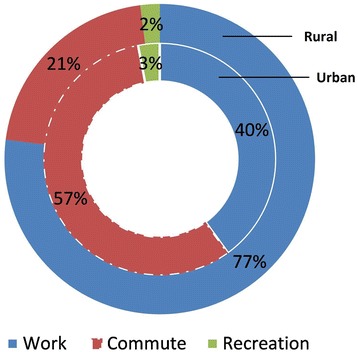
Median MET-minute of total PA per week was almost double in the rural area (1720) than the urban area (960). The overall prevalence of low PA was 50.3% (95% CI: 46.8-53.8), urban 59.5% (54.7-64.3) and rural 41.9% (37.0-46.8). Women in general were more inactive (women 63.1% [58.3-67.9], men 39.3% [34.6-44.0]). The main contributions to total PA were from work (urban 40.0%, rural 77.0%) and active commute (57.0%, 21.0%). Leisure-time PA represented a very small proportion (<3.0%). Multiple logistic regressions found a significant association of urban residence (OR = 2.2; 95% CI: 1.5-3.2), women (2.1; 1.4-3.9), oldest age group 55-64 years (15.6; 7.5-32.2) compared to youngest age group 25-34 years, graduation or further education (8.6; 4.1-17.7), and higher socio-economic class (2.4; 1.4-4.2) compared to poor with insufficient PA.
This study identifies low PA in a rural and urban population in Bangladesh and that further large-scale population studies are warranted.
即使在低收入国家,低水平的身体活动(PA)也已成为一个重要的公共卫生问题。本研究的目的是测量孟加拉国成年人的PA水平,确定低PA的患病率,并识别与之相关的社会人口学因素。
本基于人群的横断面研究于2011年开展,纳入了792名(城市395名,农村397名)年龄在25至64岁之间的孟加拉国成年人。采用全球身体活动问卷第2版(GPAQ-2)来测量PA。计算每周代谢当量任务(MET)的分钟数,以确定总的PA量。参与者被分为低、中、高PA组。采用逻辑回归分析来评估与低PA水平相关的社会人口学因素。
农村地区每周总的PA的MET分钟中位数(1720)几乎是城市地区(960)的两倍。低PA的总体患病率为50.3%(95%CI:46.8-53.8),城市为59.5%(54.7-64.3),农村为41.9%(37.0-46.8)。总体而言,女性的活动量更低(女性为63.1%[58.3-67.9],男性为39.3%[34.6-44.0])。对总PA的主要贡献来自工作(城市为40.0%,农村为77.0%)和主动通勤(分别为57.0%、21.0%)。休闲时间的PA占比非常小(<3.0%)。多项逻辑回归分析发现,与PA不足的贫困人群相比,城市居住(OR = 2.2;95%CI:1.5-3.2)、女性(2.1;1.4-3.9)、年龄最大的55-64岁年龄组(15.6;7.5-32.2)与年龄最小的25-34岁年龄组相比、毕业或接受过进一步教育(8.6;4.1-17.7)以及社会经济阶层较高(2.4;1.4-4.2)与PA不足之间存在显著关联。
本研究确定了孟加拉国农村和城市人口中存在低PA的情况,有必要开展进一步的大规模人群研究。