Liu Xiaojuan, Kwon Hyunwoo, Li Zihai, Fu Yang-Xin
Key Laboratory of Infection and Immunity of CAS, Institute of Biophysics, Chinese Academy of Sciences, Beijing, China.
Department of Pathology, UT Southwestern Medical Center, Dallas, Texas, USA.
J Hematol Oncol. 2017 Jan 11;10(1):12. doi: 10.1186/s13045-016-0381-z.
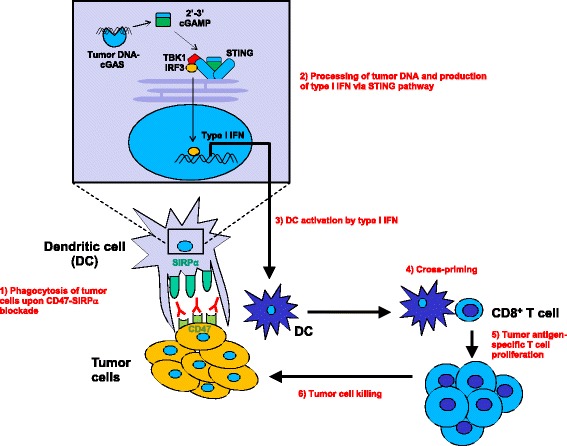
Cluster of differentiation 47 (CD47) (also known as integrin-associated protein) is a ubiquitously expressed glycoprotein of the immunoglobulin superfamily that plays a critical role in self-recognition. Various solid and hematologic cancers exploit CD47 expression in order to evade immunological eradication, and its overexpression is clinically correlated with poor prognoses. One essential mechanism behind CD47-mediated immune evasion is that it can interact with signal regulatory protein-alpha (SIRPα) expressed on myeloid cells, causing phosphorylation of the SIRPα cytoplasmic immunoreceptor tyrosine-based inhibition motifs and recruitment of Src homology 2 domain-containing tyrosine phosphatases to ultimately result in delivering an anti-phagocytic-"don't eat me"-signal. Given its essential role as a negative checkpoint for innate immunity and subsequent adaptive immunity, CD47-SIRPα axis has been explored as a new target for cancer immunotherapy and its disruption has demonstrated great therapeutic promise. Indeed, CD47 blocking antibodies have been found to decrease primary tumor size and/or metastasis in various pre-clinical models. In this review, we highlight the various functions of CD47, discuss anti-tumor responses generated by both the innate and adaptive immune systems as a consequence of administering anti-CD47 blocking antibody, and finally elaborate on the clinical potential of CD47 blockade. We argue that CD47 is a checkpoint molecule for both innate and adaptive immunity for tumor evasion and is thus a promising target for cancer immunotherapy.
分化簇47(CD47)(也称为整合素相关蛋白)是免疫球蛋白超家族中一种广泛表达的糖蛋白,在自我识别中起关键作用。各种实体癌和血液系统癌症利用CD47的表达来逃避免疫清除,其过表达在临床上与不良预后相关。CD47介导的免疫逃逸背后的一个重要机制是,它可以与髓系细胞上表达的信号调节蛋白α(SIRPα)相互作用,导致SIRPα细胞质基于免疫受体酪氨酸的抑制基序磷酸化,并招募含Src同源2结构域的酪氨酸磷酸酶,最终产生抗吞噬的“别吃我”信号。鉴于其作为先天免疫和随后适应性免疫的负性检查点的重要作用,CD47-SIRPα轴已被探索作为癌症免疫治疗的新靶点,其破坏已显示出巨大的治疗前景。事实上,在各种临床前模型中,已发现CD47阻断抗体可减小原发性肿瘤大小和/或转移。在本综述中,我们强调了CD47的各种功能,讨论了由于施用抗CD47阻断抗体而由先天免疫系统和适应性免疫系统产生的抗肿瘤反应,最后阐述了CD47阻断的临床潜力。我们认为,CD47是肿瘤逃逸的先天免疫和适应性免疫的检查点分子,因此是癌症免疫治疗的一个有前景的靶点。