• 文献检索
  • 文档翻译
  • 深度研究
  • 学术资讯
  • Suppr Zotero 插件Zotero 插件
  • 邀请有礼
  • 套餐&价格
  • 历史记录
应用&插件
Suppr Zotero 插件Zotero 插件浏览器插件Mac 客户端Windows 客户端微信小程序
定价
高级版会员购买积分包购买API积分包
服务
文献检索文档翻译深度研究API 文档MCP 服务
关于我们
关于 Suppr公司介绍联系我们用户协议隐私条款
关注我们

Suppr 超能文献

核心技术专利:CN118964589B侵权必究
粤ICP备2023148730 号-1Suppr @ 2026

文献检索

告别复杂PubMed语法,用中文像聊天一样搜索,搜遍4000万医学文献。AI智能推荐,让科研检索更轻松。

立即免费搜索

文件翻译

保留排版,准确专业,支持PDF/Word/PPT等文件格式,支持 12+语言互译。

免费翻译文档

深度研究

AI帮你快速写综述,25分钟生成高质量综述,智能提取关键信息,辅助科研写作。

立即免费体验

丹麦患者“费用激增”的预测:一项基于人群的纵向研究。

Predicting patient 'cost blooms' in Denmark: a longitudinal population-based study.

作者信息

Tamang Suzanne, Milstein Arnold, Sørensen Henrik Toft, Pedersen Lars, Mackey Lester, Betterton Jean-Raymond, Janson Lucas, Shah Nigam

机构信息

Department of Medicine, Stanford University School of Medicine, Stanford, California, USA.

Department of Clinical Epidemiology, Aarhus University, Aarhus, Denmark.

出版信息

BMJ Open. 2017 Jan 11;7(1):e011580. doi: 10.1136/bmjopen-2016-011580.

DOI:10.1136/bmjopen-2016-011580
PMID:28077408
原文链接:https://pmc.ncbi.nlm.nih.gov/articles/PMC5253526/
Abstract

OBJECTIVES

To compare the ability of standard versus enhanced models to predict future high-cost patients, especially those who move from a lower to the upper decile of per capita healthcare expenditures within 1 year-that is, 'cost bloomers'.

DESIGN

We developed alternative models to predict being in the upper decile of healthcare expenditures in year 2 of a sample, based on data from year 1. Our 6 alternative models ranged from a standard cost-prediction model with 4 variables (ie, traditional model features), to our largest enhanced model with 1053 non-traditional model features. To quantify any increases in predictive power that enhanced models achieved over standard tools, we compared the prospective predictive performance of each model.

PARTICIPANTS AND SETTING

We used the population of Western Denmark between 2004 and 2011 (2 146 801 individuals) to predict future high-cost patients and characterise high-cost patient subgroups. Using the most recent 2-year period (2010-2011) for model evaluation, our whole-population model used a cohort of 1 557 950 individuals with a full year of active residency in year 1 (2010). Our cost-bloom model excluded the 155 795 individuals who were already high cost at the population level in year 1, resulting in 1 402 155 individuals for prediction of cost bloomers in year 2 (2011).

PRIMARY OUTCOME MEASURES

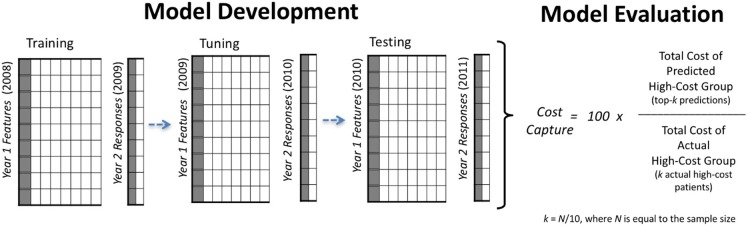
Using unseen data from a future year, we evaluated each model's prospective predictive performance by calculating the ratio of predicted high-cost patient expenditures to the actual high-cost patient expenditures in Year 2-that is, cost capture.

RESULTS

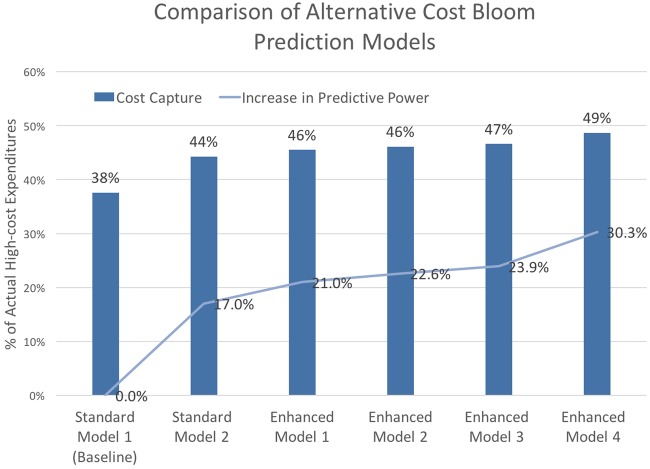
Our best enhanced model achieved a 21% and 30% improvement in cost capture over a standard diagnosis-based model for predicting population-level high-cost patients and cost bloomers, respectively.

CONCLUSIONS

In combination with modern statistical learning methods for analysing large data sets, models enhanced with a large and diverse set of features led to better performance-especially for predicting future cost bloomers.

摘要

目标

比较标准模型与增强模型预测未来高成本患者的能力,尤其是那些在1年内从人均医疗保健支出的下十分位数跃升至 上十分位数的患者,即“成本激增者”。

设计

我们基于第1年的数据开发了替代模型,以预测样本第2年医疗保健支出处于上十分位数的情况。我们的6个替代模型范围从具有4个变量的标准成本预测模型(即传统模型特征)到具有1053个非传统模型特征的最大增强模型。为了量化增强模型相对于标准工具在预测能力上的任何提升,我们比较了每个模型的前瞻性预测性能。

参与者与设置

我们使用了2004年至2011年丹麦西部的人口(2146801人)来预测未来的高成本患者并描述高成本患者亚组。使用最近的2年期间(2010 - 2011年)进行模型评估,我们的全人群模型使用了1557950名在第1年(2010年)有全年活跃居住记录的个体。我们的成本激增模型排除了在第1年人群层面已经是高成本的155795名个体,从而得到1402155名个体用于预测第2年(2011年)的成本激增者。

主要结局指标

使用未来一年的未见过的数据,我们通过计算第2年预测的高成本患者支出与实际高成本患者支出的比率来评估每个模型的前瞻性预测性能,即成本捕获。

结果

我们最好的增强模型在预测人群层面高成本患者和成本激增者方面,相对于基于标准诊断的模型,成本捕获分别提高了21%和30%。

结论

结合用于分析大型数据集的现代统计学习方法,具有大量多样特征增强的模型表现更佳,尤其是在预测未来成本激增者方面。
https://cdn.ncbi.nlm.nih.gov/pmc/blobs/d45c/5253526/ad038cbf8f07/bmjopen2016011580f05.jpg
https://cdn.ncbi.nlm.nih.gov/pmc/blobs/d45c/5253526/528667110bc6/bmjopen2016011580f01.jpg
https://cdn.ncbi.nlm.nih.gov/pmc/blobs/d45c/5253526/ada67357f896/bmjopen2016011580f02.jpg
https://cdn.ncbi.nlm.nih.gov/pmc/blobs/d45c/5253526/d500af0f45f5/bmjopen2016011580f03.jpg
https://cdn.ncbi.nlm.nih.gov/pmc/blobs/d45c/5253526/cccaa06ec3b4/bmjopen2016011580f04.jpg
https://cdn.ncbi.nlm.nih.gov/pmc/blobs/d45c/5253526/ad038cbf8f07/bmjopen2016011580f05.jpg
https://cdn.ncbi.nlm.nih.gov/pmc/blobs/d45c/5253526/528667110bc6/bmjopen2016011580f01.jpg
https://cdn.ncbi.nlm.nih.gov/pmc/blobs/d45c/5253526/ada67357f896/bmjopen2016011580f02.jpg
https://cdn.ncbi.nlm.nih.gov/pmc/blobs/d45c/5253526/d500af0f45f5/bmjopen2016011580f03.jpg
https://cdn.ncbi.nlm.nih.gov/pmc/blobs/d45c/5253526/cccaa06ec3b4/bmjopen2016011580f04.jpg
https://cdn.ncbi.nlm.nih.gov/pmc/blobs/d45c/5253526/ad038cbf8f07/bmjopen2016011580f05.jpg

相似文献

1
Predicting patient 'cost blooms' in Denmark: a longitudinal population-based study.丹麦患者“费用激增”的预测:一项基于人群的纵向研究。
BMJ Open. 2017 Jan 11;7(1):e011580. doi: 10.1136/bmjopen-2016-011580.
2
Diagnostic, pharmacy-based, and self-reported health measures in risk equalization models.诊断、药学和自我报告的健康措施在风险均衡模型中。
Med Care. 2010 May;48(5):448-57. doi: 10.1097/MLR.0b013e3181d559b4.
3
The utility of extended longitudinal profiles in predicting future health care expenditures.扩展纵向概况在预测未来医疗保健支出方面的效用。
Med Care. 2006 May;44(5 Suppl):I45-53. doi: 10.1097/01.mlr.0000208200.31206.38.
4
The performance of administrative and self-reported measures for risk adjustment of Veterans Affairs expenditures.退伍军人事务部支出风险调整的行政措施和自我报告措施的绩效。
Health Serv Res. 2005 Jun;40(3):887-904. doi: 10.1111/j.1475-6773.2005.00390.x.
5
Risk-adjusted capitation based on the Diagnostic Cost Group Model: an empirical evaluation with health survey information.基于诊断成本组模型的风险调整后按人头付费:一项基于健康调查信息的实证评估
Health Serv Res. 1999 Feb;33(6):1727-44.
6
Comparison of Rx-defined morbidity groups and diagnosis- based risk adjusters for predicting healthcare costs in Taiwan.比较 Rx 定义的发病组和基于诊断的风险调整器,以预测台湾的医疗保健费用。
BMC Health Serv Res. 2010 May 17;10:126. doi: 10.1186/1472-6963-10-126.
7
Short-term persistence of high health care costs in a nationally representative sample of children.全国代表性儿童样本中高医疗成本的短期持续性
Pediatrics. 2006 Oct;118(4):e1001-9. doi: 10.1542/peds.2005-2264.
8
Predicting high-cost pediatric patients: derivation and validation of a population-based model.预测高成本儿科患者:基于人群模型的推导与验证
Med Care. 2015 Aug;53(8):729-35. doi: 10.1097/MLR.0000000000000391.
9
Predicting pharmacy costs and other medical costs using diagnoses and drug claims.利用诊断和药品报销数据预测药房费用及其他医疗费用。
Med Care. 2005 Jan;43(1):34-43.
10
Risk adjustment using automated ambulatory pharmacy data: the RxRisk model.使用自动门诊药房数据进行风险调整:RxRisk模型。
Med Care. 2003 Jan;41(1):84-99. doi: 10.1097/00005650-200301000-00011.

引用本文的文献

1
Longitudinal trajectories of healthcare costs among high-need high-cost patients: a population-based retrospective cohort study in British Columbia, Canada.高需求高成本患者医疗费用的纵向轨迹:加拿大不列颠哥伦比亚省一项基于人群的回顾性队列研究。
BMJ Open. 2025 Apr 25;15(4):e089693. doi: 10.1136/bmjopen-2024-089693.
2
Developing and Applying the BE-FAIR Equity Framework to a Population Health Predictive Model: A Retrospective Observational Cohort Study.将BE-FAIR公平性框架开发并应用于人群健康预测模型:一项回顾性观察队列研究。
J Gen Intern Med. 2025 Aug;40(11):2537-2547. doi: 10.1007/s11606-025-09462-1. Epub 2025 Mar 14.
3

本文引用的文献

1
A Machine Learning Framework for Plan Payment Risk Adjustment.用于计划支付风险调整的机器学习框架。
Health Serv Res. 2016 Dec;51(6):2358-2374. doi: 10.1111/1475-6773.12464. Epub 2016 Feb 19.
2
Machine Learning and the Profession of Medicine.机器学习与医学职业。
JAMA. 2016 Feb 9;315(6):551-2. doi: 10.1001/jama.2015.18421.
3
Big data analytics and machine learning: 2015 and beyond.大数据分析与机器学习:2015年及以后。
Machine learning algorithms to predict treatment success for patients with pulmonary tuberculosis.
机器学习算法预测肺结核患者的治疗成功率。
PLoS One. 2024 Oct 16;19(10):e0309151. doi: 10.1371/journal.pone.0309151. eCollection 2024.
4
Transforming health care systems towards high-performance organizations: qualitative study based on learning from COVID-19 pandemic in the Basque Country (Spain).向高绩效组织转型的医疗保健系统:基于西班牙巴斯克地区从 COVID-19 大流行中学习的定性研究。
BMC Health Serv Res. 2024 Mar 21;24(1):364. doi: 10.1186/s12913-024-10810-w.
5
Reasons for hospitalisation and cumulative mortality in people, 75 years or older, at high risk of hospital admission: a prospective study.75 岁及以上、有高住院风险人群的住院原因和累积死亡率:一项前瞻性研究。
BMC Geriatr. 2024 Feb 20;24(1):176. doi: 10.1186/s12877-024-04771-2.
6
The application of machine learning to predict high-cost patients: A performance-comparison of different models using healthcare claims data.机器学习在预测高费用患者中的应用:使用医保索赔数据对不同模型进行性能比较。
PLoS One. 2023 Jan 18;18(1):e0279540. doi: 10.1371/journal.pone.0279540. eCollection 2023.
7
Multivariable prediction models for health care spending using machine learning: a protocol of a systematic review.使用机器学习的医疗保健支出多变量预测模型:一项系统评价方案
Diagn Progn Res. 2022 Mar 24;6(1):4. doi: 10.1186/s41512-022-00119-9.
8
Health Savings Accounts: Consumer Contribution Strategies and Policy Implications.健康储蓄账户:消费者缴费策略及政策影响
MDM Policy Pract. 2018 Dec 20;3(2):2381468318809373. doi: 10.1177/2381468318809373. eCollection 2018 Jul-Dec.
9
Prediction Models for Future High-Need High-Cost Healthcare Use: a Systematic Review.未来高需求高成本医疗保健使用的预测模型:系统评价。
J Gen Intern Med. 2022 May;37(7):1763-1770. doi: 10.1007/s11606-021-07333-z. Epub 2022 Jan 11.
10
Application of Bayesian network and regression method in treatment cost prediction.贝叶斯网络和回归方法在治疗成本预测中的应用。
BMC Med Inform Decis Mak. 2021 Oct 16;21(1):284. doi: 10.1186/s12911-021-01647-y.
Lancet Psychiatry. 2016 Jan;3(1):13-15. doi: 10.1016/S2215-0366(15)00549-0.
4
Models of Care for High-Need, High-Cost Patients: An Evidence Synthesis.高需求、高成本患者的护理模式:证据综合
Issue Brief (Commonw Fund). 2015 Oct;31:1-19.
5
Machine Learning in Medicine.医学中的机器学习
Circulation. 2015 Nov 17;132(20):1920-30. doi: 10.1161/CIRCULATIONAHA.115.001593.
6
Machine learning: Trends, perspectives, and prospects.机器学习:趋势、观点和展望。
Science. 2015 Jul 17;349(6245):255-60. doi: 10.1126/science.aaa8415.
7
Statistical learning and selective inference.统计学习与选择性推断。
Proc Natl Acad Sci U S A. 2015 Jun 23;112(25):7629-34. doi: 10.1073/pnas.1507583112.
8
Using self-reported health measures to predict high-need cases among Medicaid-eligible adults.使用自我报告的健康指标来预测符合医疗补助资格的成年人中的高需求病例。
Health Serv Res. 2014 Dec;49 Suppl 2(Suppl 2):2147-72. doi: 10.1111/1475-6773.12222. Epub 2014 Aug 15.
9
Caring for high-need, high-cost patients: what makes for a successful care management program?照顾高需求、高成本患者:怎样打造一个成功的护理管理项目?
Issue Brief (Commonw Fund). 2014 Aug;19:1-19.
10
In Denmark, big data goes to work.在丹麦,大数据开始发挥作用。
Health Aff (Millwood). 2014 Jul;33(7):1245. doi: 10.1377/hlthaff.2014.0513.