Hosokawa Rikuya, Katsura Toshiki
Graduate School of Medicine, Kyoto University, Yoshida-Konoe-cho, Sakyo-ku, Kyoto, 606-8501 Japan.
Child Adolesc Psychiatry Ment Health. 2017 Jan 7;11:2. doi: 10.1186/s13034-016-0139-y. eCollection 2017.
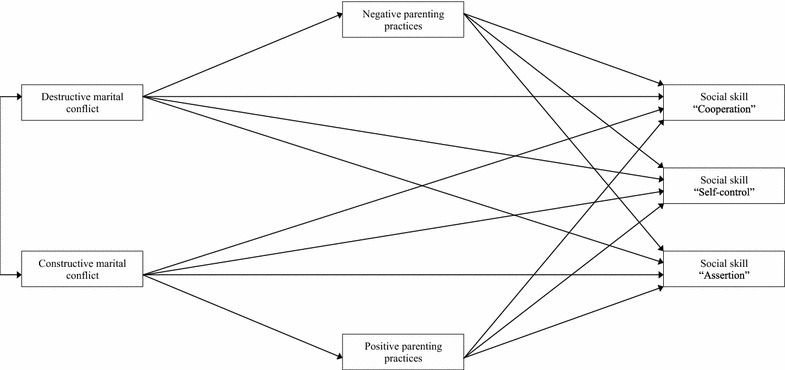
This study examined the pathways by which destructive and constructive marital conflict leading to social skills development in preschool children, are mediated through negative and positive parenting practices.
Mothers of 2931 Japanese children, aged 5-6 years, completed self-report questionnaires regarding their marital relationship (the Quality of co-parental communication scale) and parental practices (the Alabama parenting questionnaire). The children's teachers evaluated their social skills using the Social skills scale.
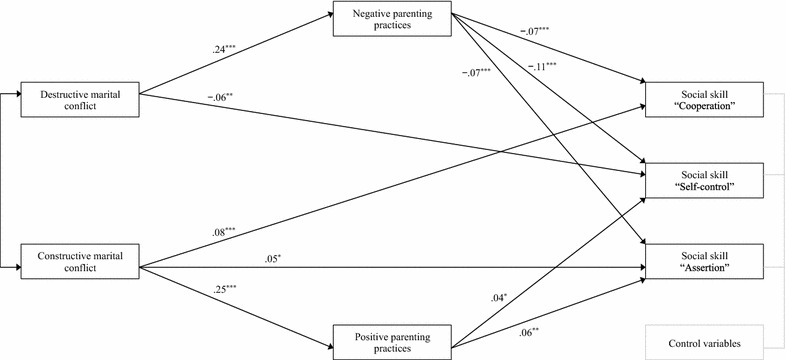
Path analyses revealed significant direct paths from destructive marital conflict to negative parenting practices and lower scores on the self-control component of social skills. In addition, negative parenting practices mediated the relationship between destructive marital conflict and lower scores on cooperation, self-control, and assertion. Our analyses also revealed significant direct paths from constructive marital conflict to positive parenting practices, and higher scores on cooperation and assertion. Positive parenting practices mediated the relationship between constructive marital conflict and higher scores on self-control and assertion.
These findings suggest that destructive and constructive marital conflict may directly and indirectly influence children's social skills development through the mediation of parenting practices.
本研究探讨了破坏性和建设性婚姻冲突通过消极和积极育儿方式的中介作用,从而影响学龄前儿童社交技能发展的途径。
2931名5至6岁日本儿童的母亲完成了关于其婚姻关系(共同养育沟通质量量表)和育儿方式(阿拉巴马育儿问卷)的自我报告问卷。儿童的教师使用社交技能量表评估他们的社交技能。
路径分析显示,从破坏性婚姻冲突到消极育儿方式以及社交技能自我控制部分得分较低存在显著的直接路径。此外,消极育儿方式在破坏性婚姻冲突与合作、自我控制和 assertiveness(此处原文有误,推测为assertion,意为坚定自信)得分较低之间起中介作用。我们的分析还显示,从建设性婚姻冲突到积极育儿方式以及合作和 assertiveness得分较高存在显著的直接路径。积极育儿方式在建设性婚姻冲突与自我控制和 assertiveness得分较高之间起中介作用。
这些发现表明,破坏性和建设性婚姻冲突可能通过育儿方式的中介作用直接和间接地影响儿童的社交技能发展。