Poudel Suresh, Giannone Richard J, Rodriguez Miguel, Raman Babu, Martin Madhavi Z, Engle Nancy L, Mielenz Jonathan R, Nookaew Intawat, Brown Steven D, Tschaplinski Timothy J, Ussery David, Hettich Robert L
Biosciences Division, Oak Ridge National Lab, Oak Ridge, TN 37831 USA.
Department of Genome Science and Technology, University of Tennessee, Knoxville, TN 37996 USA.
Biotechnol Biofuels. 2017 Jan 10;10:14. doi: 10.1186/s13068-016-0697-5. eCollection 2017.
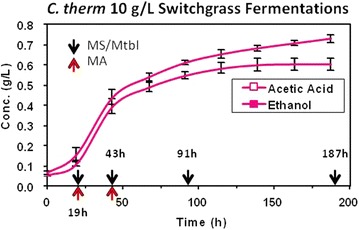
is capable of solubilizing and converting lignocellulosic biomass into ethanol. Although much of the work-to-date has centered on characterizing this microbe's growth on model cellulosic substrates, such as cellobiose, Avicel, or filter paper, it is vitally important to understand its metabolism on more complex, lignocellulosic substrates to identify relevant industrial bottlenecks that could undermine efficient biofuel production. To this end, we have examined a time course progression of grown on switchgrass to assess the metabolic and protein changes that occur during the conversion of plant biomass to ethanol.
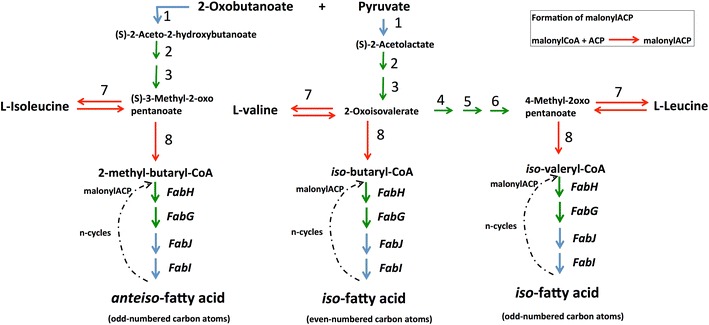
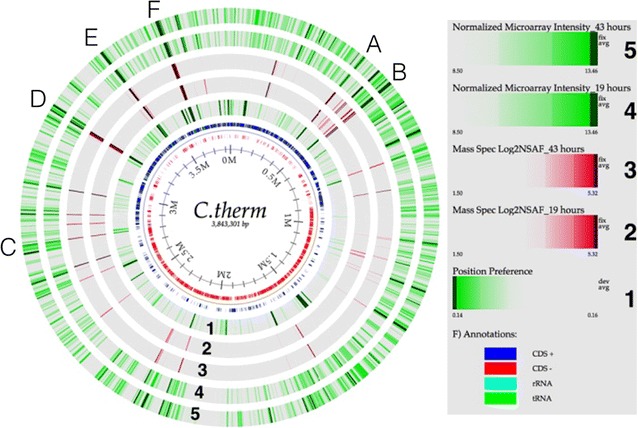
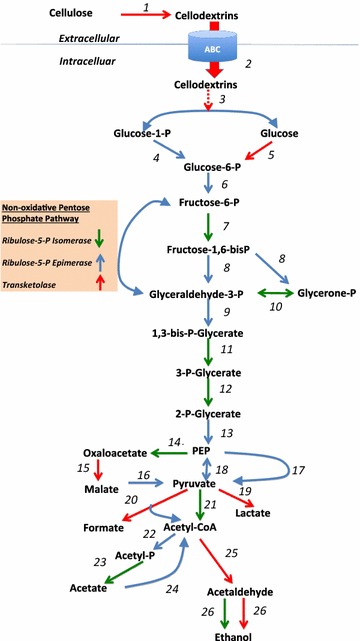
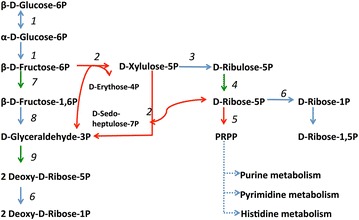
The most striking feature of the metabolome was the observed accumulation of long-chain, branched fatty acids over time, implying an adaptive restructuring of cellular membrane as the culture progresses. This is undoubtedly a response to the gradual accumulation of lignocellulose-derived inhibitory compounds as the organism deconstructs the switchgrass to access the embedded cellulose. Corroborating the metabolomics data, proteomic analysis revealed a corresponding time-dependent increase in various enzymes, including those involved in the interconversion of branched amino acids valine, leucine, and isoleucine to iso- and anteiso-fatty acid precursors. Additionally, the metabolic accumulation of hemicellulose-derived sugars and sugar alcohols concomitant with increased abundance of enzymes involved in C5 sugar metabolism/pentose phosphate pathway indicates that shifts glycolytic intermediates to alternate pathways to modulate overall carbon flux in response to C5 sugar metabolites that increase during lignocellulose deconstruction.
Integrated omic platforms provided complementary systems biological information that highlight 's specific response to cytotoxic inhibitors released during the deconstruction and utilization of switchgrass. These additional viewpoints allowed us to fully realize the level to which the organism adapts to an increasingly challenging culture environment-information that will prove critical to 's industrial efficacy.
能够溶解木质纤维素生物质并将其转化为乙醇。尽管迄今为止的许多工作都集中在表征这种微生物在模型纤维素底物(如纤维二糖、微晶纤维素或滤纸)上的生长情况,但了解其在更复杂的木质纤维素底物上的代谢情况对于识别可能破坏高效生物燃料生产的相关工业瓶颈至关重要。为此,我们研究了在柳枝稷上生长的时间进程,以评估植物生物质转化为乙醇过程中发生的代谢和蛋白质变化。
代谢组最显著的特征是观察到随着时间的推移长链支链脂肪酸的积累,这意味着随着培养的进行细胞膜发生了适应性重构。这无疑是对木质纤维素衍生的抑制性化合物逐渐积累的一种反应,因为该生物体分解柳枝稷以获取其中嵌入的纤维素。蛋白质组分析证实了代谢组学数据,显示各种酶相应地随时间增加,包括那些参与支链氨基酸缬氨酸、亮氨酸和异亮氨酸向异脂肪酸和反异脂肪酸前体相互转化的酶。此外,半纤维素衍生的糖和糖醇的代谢积累以及参与C5糖代谢/磷酸戊糖途径的酶丰度增加表明,随着木质纤维素解构过程中C5糖代谢物的增加,该微生物将糖酵解中间产物转移到替代途径以调节整体碳通量。
综合组学平台提供了互补的系统生物学信息,突出了该微生物对柳枝稷解构和利用过程中释放的细胞毒性抑制剂的特定反应。这些额外的观点使我们能够充分认识到该生物体适应日益具有挑战性的培养环境的程度——这些信息对于其工业效能至关重要。