Mehta V K, Verma R, Garg R K, Malhotra H S, Sharma P K, Jain A
Department of Neurology, King George's Medical University, Lucknow, Uttar Pradesh, India.
Department of Microbiology, King George's Medical University, Lucknow, Uttar Pradesh, India.
J Postgrad Med. 2017 Jan-Mar;63(1):11-15. doi: 10.4103/0022-3859.188545.
Pro-inflammatory markers play a key role in the pathogenesis of various Flavivirus infection.
In this study, we evaluated the role of these markers in neurological manifestations of dengue.
Consecutive dengue cases with different neurological manifestations who presented between August 2012 and July 2014 were studied in hospital-based case-control study.
Interleukin (IL-6) and IL-8 level were measured in serum and cerebrospinal fluid (CSF) of dengue cases with different neurological manifestations and also in age- and sex-matched controls. Level was analyzed with various parameters and outcomes.
Statistical analysis was done using SPSS version 16.0 by applying appropriate statistical methods. P < 0.05 considered statistically significant.
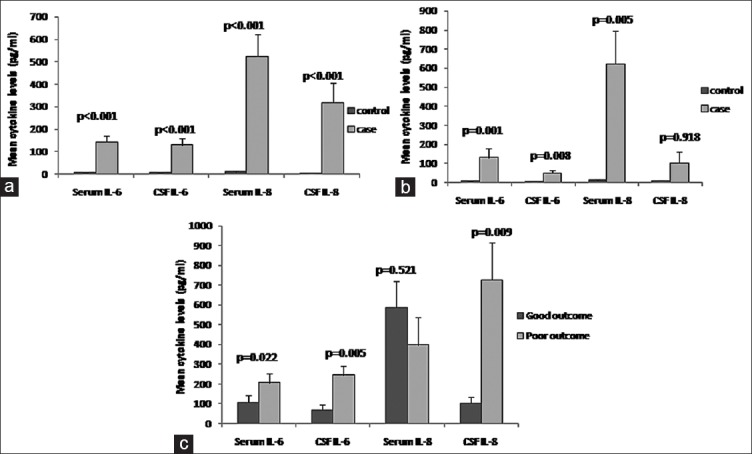
Out of the 40 enrolled cases of dengue with neurological manifestations, 29 had central nervous system and 11 had peripheral nervous system (CNS/PNS) manifestations. In CNS group, both IL-6 and IL-8 (CSF and serum) were significantly elevated (P < 0.001), whereas CSF IL-6 (P = 0.008), serum IL-6 (P = 0.001), and serum IL-8 (P = 0.005) were significantly elevated in PNS group. CSF IL-6, serum IL-6, and IL-8 were significantly elevated in poor outcome patients in CNS group (P < 0.05). CSF IL-6 and IL-8 were significantly elevated in CSF dengue positive cases as compared to CSF negative patients (P < 0.05). Cytokine level was not significantly correlated with neuroimaging abnormality in CNS group. Nine patients died and the remainder recovered.
Elevated level of IL-6 and IL-8 is associated with different neurological manifestations and poor outcome, but whether they are contributing to neuropathogenesis or simply a correlate of severe disease remains to be determined.
促炎标志物在各种黄病毒感染的发病机制中起关键作用。
在本研究中,我们评估了这些标志物在登革热神经表现中的作用。
在一项基于医院的病例对照研究中,对2012年8月至2014年7月期间出现不同神经表现的连续登革热病例进行了研究。
测量了有不同神经表现的登革热病例以及年龄和性别匹配的对照者血清和脑脊液(CSF)中的白细胞介素(IL-6)和IL-8水平。对该水平与各种参数和结果进行了分析。
使用SPSS 16.0版应用适当的统计方法进行统计分析。P<0.05被认为具有统计学意义。
在纳入的40例有神经表现的登革热病例中,29例有中枢神经系统表现,11例有外周神经系统(CNS/PNS)表现。在中枢神经系统组中,IL-6和IL-8(脑脊液和血清)均显著升高(P<0.001),而在外周神经系统组中,脑脊液IL-6(P = 0.008)、血清IL-6(P = 0.001)和血清IL-8(P = 0.005)显著升高。中枢神经系统组中预后不良的患者脑脊液IL-6、血清IL-6和IL-8显著升高(P<0.05)。与脑脊液阴性患者相比,脑脊液登革热阳性病例中的脑脊液IL-6和IL-8显著升高(P<0.05)。中枢神经系统组中细胞因子水平与神经影像学异常无显著相关性。9例患者死亡,其余患者康复。
IL-6和IL-8水平升高与不同的神经表现及不良预后相关,但它们是否促成神经发病机制或仅仅是重症疾病的一个关联因素仍有待确定。