Gliem Michael, Lee John-Ih, Barckhan Aurica, Turowski Bernd, Hartung Hans-Peter, Jander Sebastian
Department of Neurology, Heinrich-Heine-University, Medical Faculty, Düsseldorf, Germany.
Department of Diagnostic and Interventional Radiology, Heinrich-Heine-University, Medical Faculty, Düsseldorf, Germany.
PLoS One. 2017 Jan 12;12(1):e0170247. doi: 10.1371/journal.pone.0170247. eCollection 2017.
Endovascular therapy (EVT) with stent retrievers in addition to i.v. thrombolysis (IVT) has proven effective in acute stroke patients with middle cerebral artery (MCA, M1 segment) and distal internal carotid artery (ICA) occlusion. Limited data exist concerning acute cervical ICA occlusion, either alone or in combination with intracranial ICA occlusion (tandem occlusion). Therefore we analyzed outcome and treatment effects in stroke associated with cervical ICA occlusion, with specific focus on the impact of intracranial ICA or M1 patency.
Seventy-eight patients with cervical ICA occlusion from our local stroke unit registry were analyzed retrospectively. Thrombolysis in Cerebral Infarction (TICI) classification, infarct size, modified Rankin scale (mRS), symptomatic intracerebral hemorrhage (ICH), and death were assessed as outcome parameters.
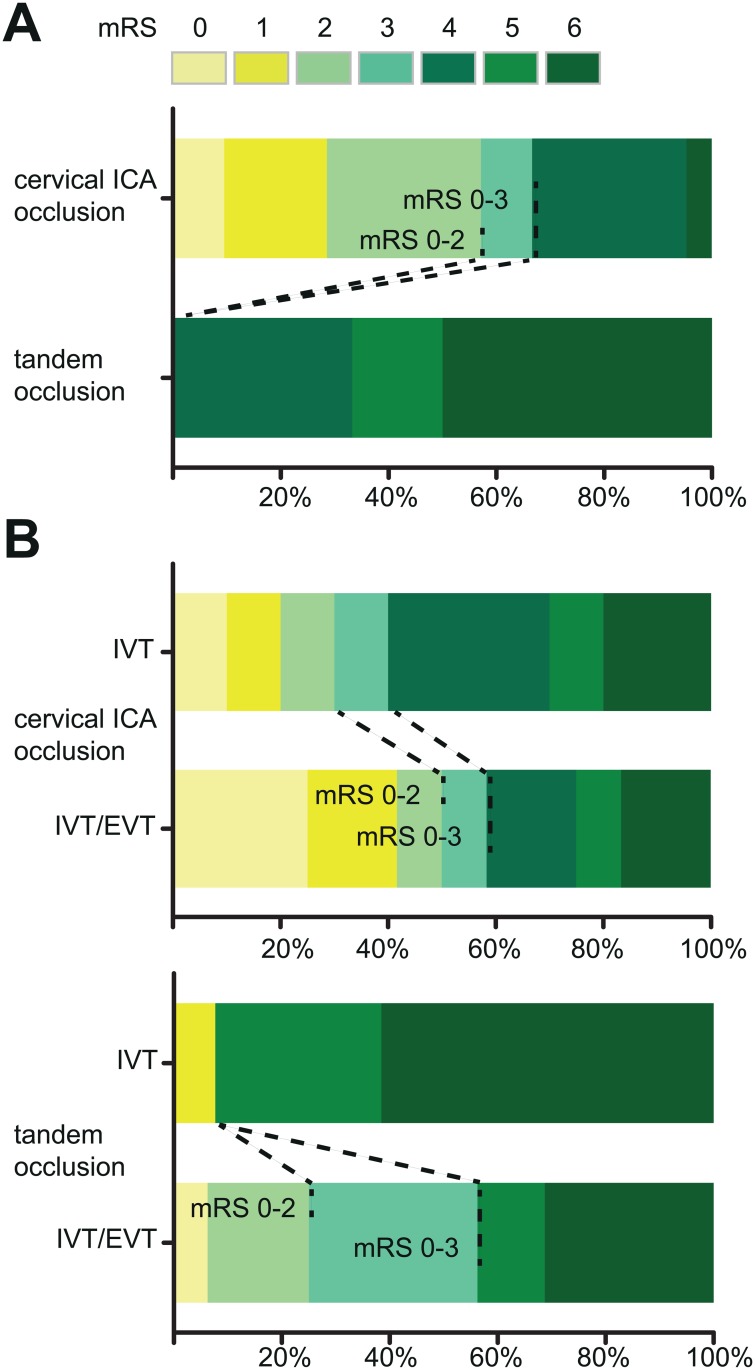
Forty-three patients had isolated cervical ICA occlusion whereas 35 patients presented with extra-/intracranial tandem occlusion. Patients underwent IVT alone (n = 23), combined IVT/EVT (n = 28) or no treatment (n = 27). Treated and untreated patients with tandem occlusion had a worse outcome after 90 days compared to isolated cervical occlusion (OR for moderate outcome 0.29, 0.27-0.88, p = 0.01). Additional EVT improved outcome in patients with tandem occlusion (OR for moderate outcome: 15.43, 1.60-148.90, p = 0.008) but not isolated cervical occlusion (OR 1.33, 0.38-11.60, NS).
In contrast to tandem occlusion, stroke outcome in patients with isolated cervical ICA occlusion was generally more benign and not improved by combined IVT/EVT compared to IVT alone. Intracranial vessel patency may be critical for treatment decision in acute cervical ICA occlusion.
除静脉溶栓(IVT)外,使用取栓支架进行血管内治疗(EVT)已被证明对大脑中动脉(MCA,M1段)和颈内动脉远端(ICA)闭塞的急性卒中患者有效。关于单纯急性颈内动脉闭塞或与颅内颈内动脉闭塞(串联闭塞)联合存在的数据有限。因此,我们分析了与颈内动脉闭塞相关的卒中的结局和治疗效果,特别关注颅内颈内动脉或M1通畅的影响。
回顾性分析了我们当地卒中单元登记处的78例颈内动脉闭塞患者。将脑梗死溶栓(TICI)分类、梗死大小、改良Rankin量表(mRS)、症状性颅内出血(ICH)和死亡作为结局参数进行评估。
43例患者为单纯颈内动脉闭塞,而35例患者为颅外/颅内串联闭塞。患者单独接受IVT(n = 23)、IVT/EVT联合治疗(n = 28)或未接受治疗(n = 27)。与单纯颈内动脉闭塞相比,串联闭塞的治疗和未治疗患者在90天后结局更差(中度结局的OR为0.29,0.27 - 0.88,p = 0.01)。额外的EVT改善了串联闭塞患者的结局(中度结局的OR:15.43,1.60 - 148.90,p = 0.008),但未改善单纯颈内动脉闭塞患者的结局(OR 1.33,0.38 - 11.60,无显著性差异)。
与串联闭塞不同,单纯颈内动脉闭塞患者的卒中结局通常更良性,与单独IVT相比,IVT/EVT联合治疗并未改善结局。颅内血管通畅可能是急性颈内动脉闭塞治疗决策的关键。