Bérard Anick, Zhao Jin-Ping, Sheehy Odile
Research Center, CHU Sainte-Justine, Montreal, Quebec, Canada.
Faculty of Pharmacy, University of Montreal, Montreal, Quebec, Canada.
BMJ Open. 2017 Jan 12;7(1):e013372. doi: 10.1136/bmjopen-2016-013372.
Antidepressant use during gestation has been associated with risk of major congenital malformations but estimates can lack statistical power or be confounded by maternal depression. We aimed to determine the association between first-trimester exposure to antidepressants and the risk of major congenital malformations in a cohort of depressed/anxious women.
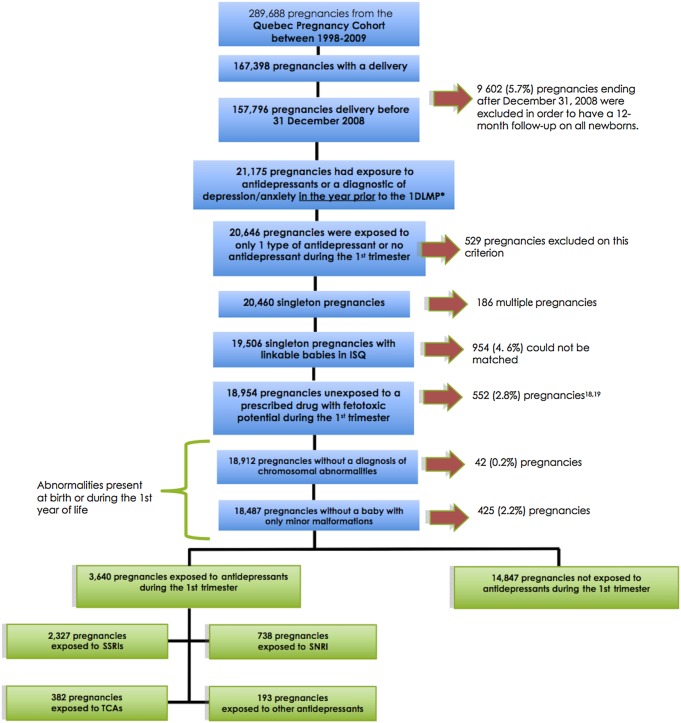
Data were obtained from the Quebec Pregnancy Cohort (QPC). All pregnancies with a diagnosis of depression or anxiety, or exposed to antidepressants in the 12 months before pregnancy, and ending with a live-born singleton were included.
Antidepressant classes (selective serotonin reuptake inhibitors (SSRI), serotonin-norepinephrine reuptake inhibitors (SNRI), tricyclic antidepressants (TCA) and other antidepressants) and types were individually compared with non-exposure during the first trimester (depressed untreated). Major congenital malformations overall and organ-specific malformations in the first year of life were identified.
18 487 pregnant women were included. When looking at the specific types of antidepressant used during the first trimester, only citalopram was increasing the risk of major congenital malformations (adjusted OR, (aOR) 1.36, 95% CI 1.08 to 1.73; 88 exposed cases), although there was a trend towards increased risk for the most frequently used antidepressants. Antidepressants with serotonin reuptake inhibition effect (SSRI, SNRI, amitriptyline (the most used TCA)) increased the risk of certain organ-specific defects: paroxetine increased the risk of cardiac defects (aOR 1.45, 95% CI 1.12 to 1.88), and ventricular/atrial septal defects (aOR 1.39, 95% CI 1.00 to 1.93); citalopram increased the risk of musculoskeletal defects (aOR 1.92, 95% CI 1.40 to 2.62), and craniosynostosis (aOR 3.95, 95% CI 2.08 to 7.52); TCA was associated with eye, ear, face and neck defects (aOR 2.45, 95% CI 1.05 to 5.72), and digestive defects (aOR 2.55, 95% CI 1.40 to 4.66); and venlafaxine was associated with respiratory defects (aOR 2.17, 95% CI 1.07 to 4.38).
Antidepressants with effects on serotonin reuptake during embryogenesis increased the risk of some organ-specific malformations in a cohort of pregnant women with depression.
孕期使用抗抑郁药与重大先天性畸形风险相关,但估计可能缺乏统计学效力或受母亲抑郁影响而产生混淆。我们旨在确定抑郁/焦虑女性队列中孕早期接触抗抑郁药与重大先天性畸形风险之间的关联。
数据来自魁北克妊娠队列(QPC)。纳入所有诊断为抑郁或焦虑、或在怀孕前12个月接触过抗抑郁药且以单胎活产结束的妊娠。
将抗抑郁药类别(选择性5-羟色胺再摄取抑制剂(SSRI)、5-羟色胺-去甲肾上腺素再摄取抑制剂(SNRI)、三环类抗抑郁药(TCA)和其他抗抑郁药)及类型分别与孕早期未接触(未治疗的抑郁患者)进行比较。确定总体重大先天性畸形及生命第一年的器官特异性畸形。
纳入18487名孕妇。在查看孕早期使用的抗抑郁药具体类型时,只有西酞普兰会增加重大先天性畸形风险(校正比值比(aOR)为1.36,95%置信区间为1.08至1.73;88例暴露病例),尽管最常用的抗抑郁药有风险增加的趋势。具有5-羟色胺再摄取抑制作用的抗抑郁药(SSRI、SNRI、阿米替林(最常用的TCA))会增加某些器官特异性缺陷的风险:帕罗西汀会增加心脏缺陷风险(aOR为1.45,95%置信区间为1.12至1.88)以及室间隔/房间隔缺损风险(aOR为1.39,95%置信区间为1.00至1.93);西酞普兰会增加肌肉骨骼缺陷风险(aOR为1.92,95%置信区间为1.40至2.62)以及颅缝早闭风险(aOR为3.95,95%置信区间为2.08至7.52);TCA与眼、耳、面和颈部缺陷相关(aOR为2.45,95%置信区间为1.05至5.72)以及消化缺陷相关(aOR为2.55,95%置信区间为1.40至4.66);文拉法辛与呼吸缺陷相关(aOR为2.17,95%置信区间为1.07至4.38)。
在患有抑郁症的孕妇队列中,胚胎发育过程中对5-羟色胺再摄取有影响的抗抑郁药会增加某些器官特异性畸形的风险。