Department of Epidemiology and Biostatistics, Texas A&M University, College Station, TX, United States of America.
School of Nursing, Texas A&M University, College Station, TX, United States of America.
PLoS One. 2023 Nov 29;18(11):e0294996. doi: 10.1371/journal.pone.0294996. eCollection 2023.
The association of maternal exposure to selective serotonin reuptake inhibitors (SSRIs) or serotonin and norepinephrine reuptake inhibitors (SNRIs) with the risk of system-specific congenital malformations in offspring remains unclear. We conducted a meta-analysis to examine this association and the risk difference between these two types of inhibitors.
A literature search was performed from January 2000 to May 2023 using PubMed and Web of Science databases. Cohort and case-control studies that assess the association of maternal exposure to SSRIs or SNRIs with the risk of congenital abnormalities were eligible for the study.
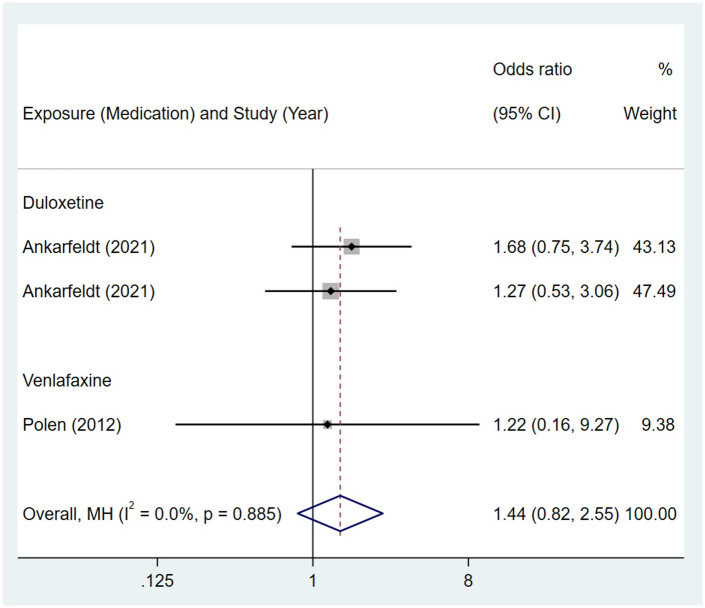
Twenty-one cohort studies and seven case-control studies were included in the meta-analysis. Compared to non-exposure, maternal exposure to SNRIs is associated with a higher risk of congenital cardiovascular abnormalities (pooled OR: 1.64 with 95% CI: 1.36, 1.97), anomalies of the kidney and urinary tract (pooled OR: 1.63 with 95% CI: 1.21, 2.20), malformations of nervous system (pooled OR: 2.28 with 95% CI: 1.50, 3.45), anomalies of digestive system (pooled OR: 2.05 with 95% CI: 1.60, 2.64) and abdominal birth defects (pooled OR: 2.91 with 95%CI: 1.98, 4.28), while maternal exposure to SSRIs is associated with a higher risk of congenital cardiovascular abnormalities (pooled OR: 1.25 with 95%CI: 1.20, 1.30), anomalies of the kidney and urinary tract (pooled OR: 1.14 with 95%CI: 1.02, 1.27), anomalies of digestive system (pooled OR: 1.11 with 95%CI: 1.01, 1.21), abdominal birth defects (pooled OR: 1.33 with 95%CI: 1.16, 1.53) and musculoskeletal malformations (pooled OR: 1.44 with 95%CI: 1.32, 1.56).
SSRIs and SNRIs have various teratogenic risks. Clinicians must consider risk-benefit ratios and patient history when prescribing medicines.
母体暴露于选择性 5-羟色胺再摄取抑制剂(SSRIs)或 5-羟色胺和去甲肾上腺素再摄取抑制剂(SNRIs)与后代特定系统先天性畸形的风险之间的关联尚不清楚。我们进行了一项荟萃分析,以检查这种关联以及这两种抑制剂之间的风险差异。
从 2000 年 1 月到 2023 年 5 月,使用 PubMed 和 Web of Science 数据库进行了文献检索。评估母体暴露于 SSRIs 或 SNRIs 与先天性异常风险之间关联的队列研究和病例对照研究符合纳入标准。
共有 21 项队列研究和 7 项病例对照研究纳入荟萃分析。与非暴露相比,母体暴露于 SNRIs 与先天性心血管异常(汇总 OR:1.64,95%CI:1.36,1.97)、肾脏和泌尿道异常(汇总 OR:1.63,95%CI:1.21,2.20)、神经系统畸形(汇总 OR:2.28,95%CI:1.50,3.45)、消化系统异常(汇总 OR:2.05,95%CI:1.60,2.64)和腹部出生缺陷(汇总 OR:2.91,95%CI:1.98,4.28)的风险增加相关,而母体暴露于 SSRIs 与先天性心血管异常(汇总 OR:1.25,95%CI:1.20,1.30)、肾脏和泌尿道异常(汇总 OR:1.14,95%CI:1.02,1.27)、消化系统异常(汇总 OR:1.11,95%CI:1.01,1.21)、腹部出生缺陷(汇总 OR:1.33,95%CI:1.16,1.53)和肌肉骨骼畸形(汇总 OR:1.44,95%CI:1.32,1.56)的风险增加相关。
SSRIs 和 SNRIs 具有不同的致畸风险。临床医生在开处方时必须考虑风险-效益比和患者病史。