Kim Sang Hyuck, Yun Jae Moon, Chang Chong Bum, Piao Heng, Yu Su Jong, Shin Dong Wook
Sang Hyuck Kim, Jae Moon Yun, Dong Wook Shin, Department of Family Medicine, Seoul National University Hospital, Seoul 03080, South Korea.
World J Gastroenterol. 2016 Dec 28;22(48):10643-10652. doi: 10.3748/wjg.v22.i48.10643.
To assess the prevalence of possible risk factors of upper gastrointestinal bleeding (UGIB) and their age-group specific trend among the general population and osteoarthritis patients.
We utilized data from the National Health Insurance Service that included claims data and results of the national health check-up program. Comorbid conditions (peptic ulcer, diabetes, liver disease, chronic renal failure, and gastroesophageal reflux disease), concomitant drugs (aspirin, clopidogrel, cilostazol, non-steroidal anti-inflammatory drugs, steroid, anticoagulants, and SSRI), personal habits (smoking, and alcohol consumption) were considered as possible UGIB risk factors. We randomly imputed the prevalence of infection in the data considering the age-specific prevalence of () infection in Korea. The prevalence of various UGIB risk factors and the age-group specific trend of the prevalence were identified. Prevalence was compared between osteoarthritis patients and others.
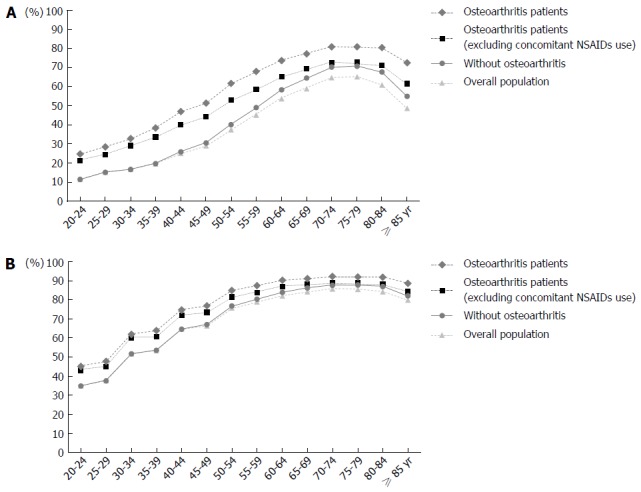
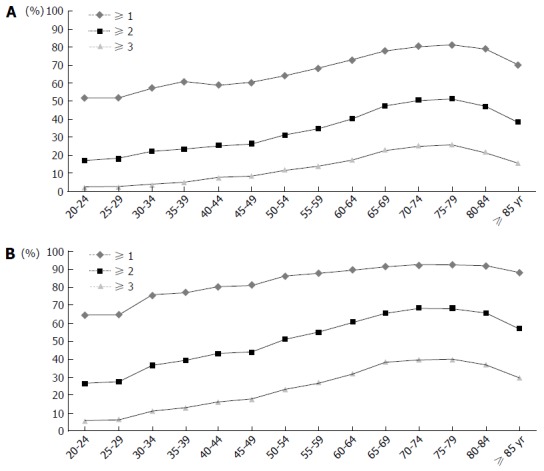
A total of 801926 subjects (93855 osteoarthritis patients) aged 20 and above were included. The prevalence of individual and concurrent multiple risk factors became higher as the age increased. The prevalence of each comorbid condition and concomitant drug were higher in osteoarthritis patients. Thirty-five point zero two percent of the overall population and 68.50% of osteoarthritis patients had at least one or more risk factors of UGIB. The prevalence of individual and concurrent multiple risk factors in younger age groups were also substantial. Furthermore, when personal habits (smoking, and alcohol consumption) and infection were included, the prevalence of concurrent multiple risk factors increased greatly even in younger age groups.
Prevalence of UGIB risk factors was high in elderly population, but was also considerable in younger population. Patient with osteoarthritis was at higher UGIB risk than those without osteoarthritis. Physicians should consider individualized risk assessment regardless of age when prescribing drugs or performing procedures that may increase the risk of UGIB, and take necessary measures to reduce modifiable risk factors such as eradication or lifestyle counseling.
评估上消化道出血(UGIB)可能的危险因素在普通人群和骨关节炎患者中的患病率及其年龄组特异性趋势。
我们利用了来自国民健康保险服务的数据,其中包括理赔数据和全国健康检查计划的结果。合并症(消化性溃疡、糖尿病、肝病、慢性肾衰竭和胃食管反流病)、伴随用药(阿司匹林、氯吡格雷、西洛他唑、非甾体抗炎药、类固醇、抗凝剂和选择性5-羟色胺再摄取抑制剂)、个人习惯(吸烟和饮酒)被视为可能的UGIB危险因素。我们根据韩国()感染的年龄特异性患病率,对数据中的感染患病率进行随机推算。确定了各种UGIB危险因素的患病率及其年龄组特异性趋势。比较了骨关节炎患者与其他患者的患病率。
共纳入801926名20岁及以上的受试者(93855名骨关节炎患者)。个体和并发多种危险因素的患病率随年龄增长而升高。骨关节炎患者中每种合并症和伴随用药的患病率更高。总体人群的35.02%和骨关节炎患者的68.50%至少有一个或多个UGIB危险因素。年轻年龄组中个体和并发多种危险因素的患病率也相当高。此外,当纳入个人习惯(吸烟和饮酒)和()感染时,即使在年轻年龄组中,并发多种危险因素的患病率也大幅增加。
UGIB危险因素在老年人群中的患病率较高,但在年轻人群中也相当可观。骨关节炎患者发生UGIB的风险高于无骨关节炎的患者。医生在开具可能增加UGIB风险的药物或进行相关操作时,应不分年龄考虑个体化风险评估,并采取必要措施降低可改变的危险因素,如()根除或生活方式咨询。