van Schaarenburg Rosanne A, Magro-Checa César, Bakker Jaap A, Teng Y K Onno, Bajema Ingeborg M, Huizinga Tom W, Steup-Beekman Gerda M, Trouw Leendert A
Department of Rheumatology, Leiden University Medical Center , Leiden , Netherlands.
Department of Clinical Chemistry and Laboratory Medicine, Leiden University Medical Center , Leiden , Netherlands.
Front Immunol. 2016 Dec 27;7:647. doi: 10.3389/fimmu.2016.00647. eCollection 2016.
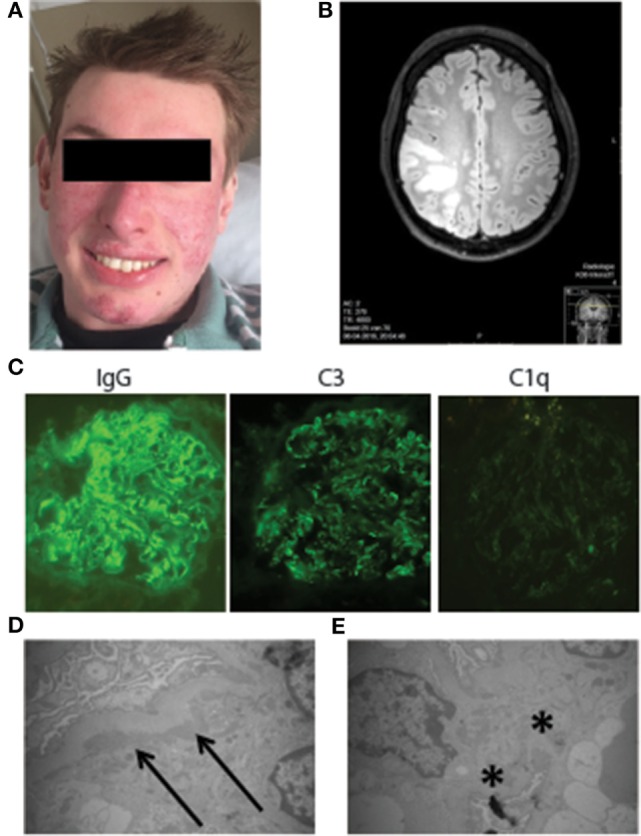
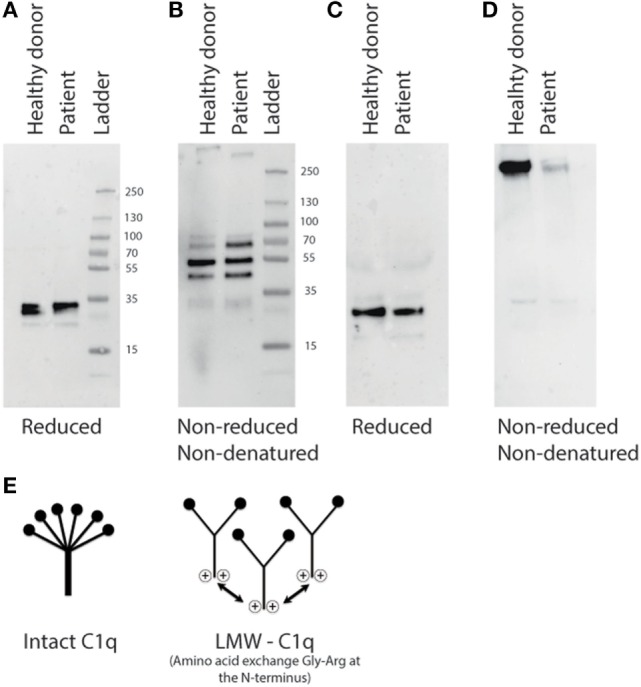
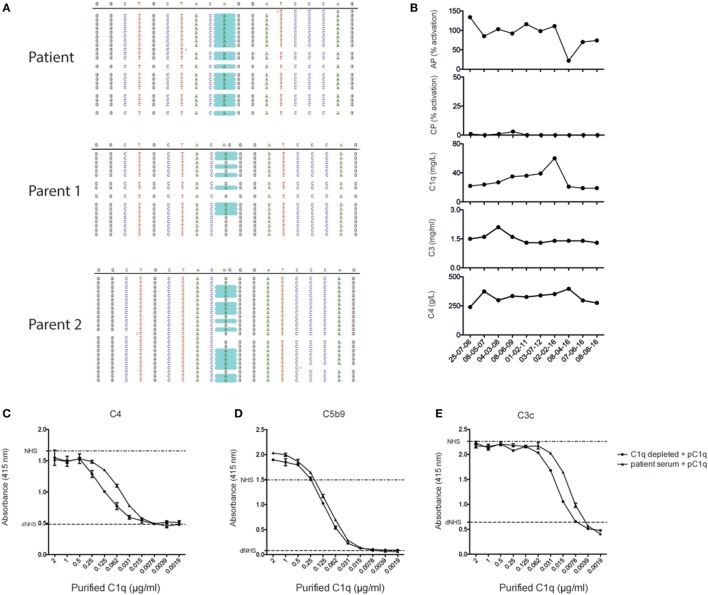
C1q deficiency is a rare immunodeficiency, which is strongly associated with the development of systemic lupus erythematosus (SLE). A mutation in one of the C1q genes can either lead to complete deficiency or to low C1q levels with C1q polypeptide in the form of low-molecular weight (LMW) C1q. Patients with C1q deficiency mainly present with cutaneous and renal involvement. Although less frequent, neuropsychiatric (NP) involvement has also been reported in 20% of the C1q-deficient patients. This involvement appears to be absent in other deficiencies of early components of the complement classical pathway (CP) (C1r/C1s, C2, or C4 deficiencies). We describe a new case with C1q deficiency with a homozygous G34R mutation in C1qC-producing LMW-C1q presenting with a severe SLE flare with NP involvement. The serum of this patient contained very low levels of a LMW variant of C1q polypeptides. Cell lysates contained the three chains of C1q, but no intact C1q was detected, consistent with the hypothesis of the existence of a LMW-C1q. Furthermore, we provide a literature overview of NP-SLE in C1q deficiency and hypothesize about the potential role of C1q in the pathogenesis of NP involvement in these patients. The onset of NP-SLE in C1q-deficient individuals is more severe when compared with complement competent NP-SLE patients. An important number of cases present with seizures and the most frequent findings in neuroimaging are changes in basal ganglia and cerebral vasculitis. A defective CP, because of non-functional C1q, does not protect against NP involvement in SLE. The absence of C1q and, subsequently, some of its biological functions may be associated with more severe NP-SLE.
C1q缺陷是一种罕见的免疫缺陷病,与系统性红斑狼疮(SLE)的发生密切相关。C1q基因之一的突变可导致完全缺陷或C1q水平降低,且以低分子量(LMW)C1q形式存在C1q多肽。C1q缺陷患者主要表现为皮肤和肾脏受累。虽然神经精神(NP)受累较少见,但在20%的C1q缺陷患者中也有报道。在补体经典途径(CP)早期成分的其他缺陷(C1r/C1s、C2或C4缺陷)中似乎不存在这种受累情况。我们描述了一例新的C1q缺陷病例,该病例在产生LMW-C1q的C1qC中存在纯合G34R突变,表现为伴有NP受累的严重SLE发作。该患者血清中C1q多肽的LMW变体水平极低。细胞裂解物中含有C1q的三条链,但未检测到完整的C1q,这与LMW-C1q存在的假设一致。此外,我们提供了C1q缺陷中NP-SLE的文献综述,并推测了C1q在这些患者NP受累发病机制中的潜在作用。与补体功能正常的NP-SLE患者相比,C1q缺陷个体中NP-SLE的发病更为严重。大量病例表现为癫痫发作,神经影像学最常见的表现是基底节改变和脑血管炎。由于C1q无功能导致的CP缺陷并不能预防SLE中的NP受累。C1q的缺失及其随后的一些生物学功能可能与更严重的NP-SLE有关。