Burke Sean V, Lin Choun-Sea, Wysocki William P, Clark Lynn G, Duvall Melvin R
Department of Biological Sciences, Northern Illinois University, DeKalb IL, USA.
Plant Tech Core Unit, Agricultural Biotechnology Research Center, Academia Sinica Taipei, Taiwan.
Front Plant Sci. 2016 Dec 27;7:1993. doi: 10.3389/fpls.2016.01993. eCollection 2016.
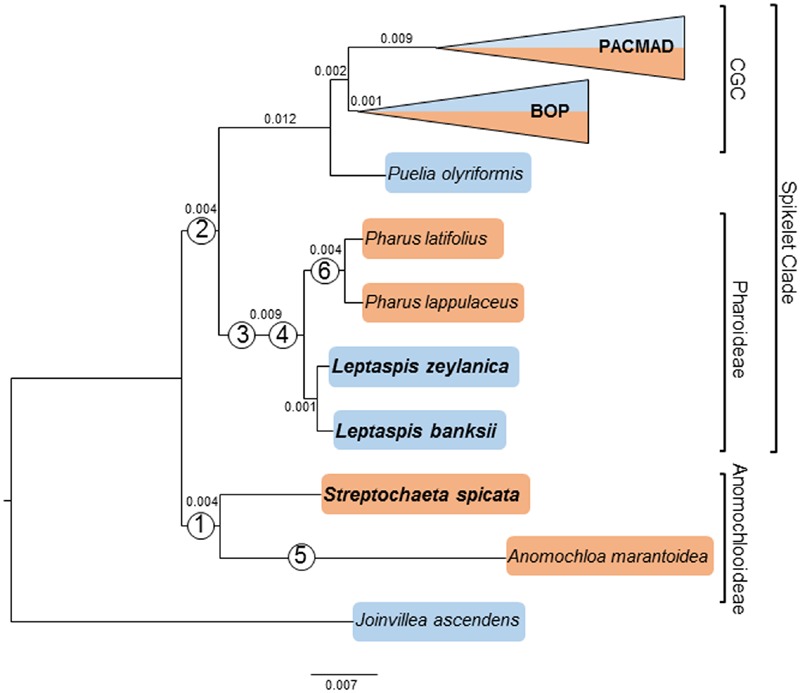
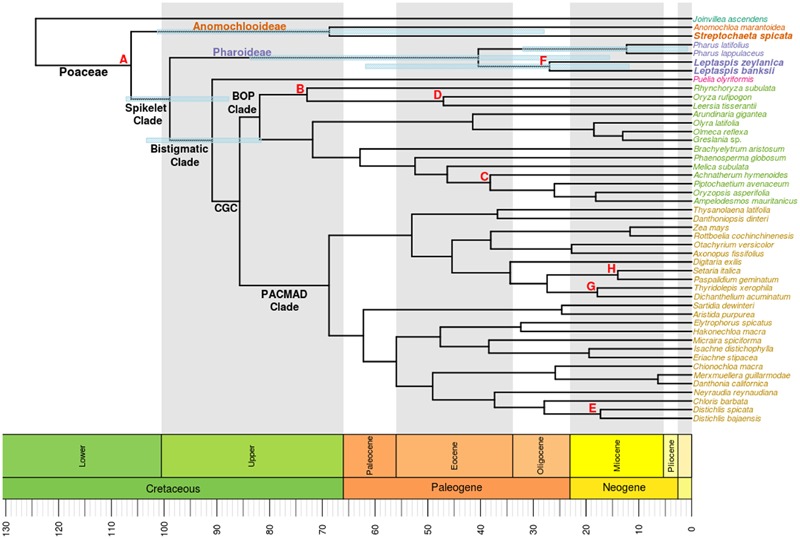
Studies of complete plastomes have proven informative for our understanding of the molecular evolution and phylogenomics of grasses. In this study, a plastome phylogenomic analysis sampled species from lineages of deeply diverging grasses including (Anomochlooideae), , and . (both Pharoideae). Plastomes from next generation sequences for three species were assembled by methods. The unambiguously aligned coding and non-coding sequences of the entire plastomes were aligned with those from 43 other grasses and the outgroup . Outgroup sampling of grasses has previously posed a challenge for plastome phylogenomic studies because of major rearrangements of the plastome. Here, over 81,000 bases of homologous sequence were aligned for phylogenomic and divergence estimation analyses. Rare genomic changes, including persistently long ψ and ψ loci, the loss of the intron, and a 21 base tandem repeat insert in the coding sequence for defined branch points in the grass phylogeny. Marked differences were seen in the topologies inferred from the complete plastome and two gene matrices, and mean maximum likelihood support values for the former were 10% higher. In the full plastome phylogenomic analyses, the two species of Anomochlooideae were monophyletic. and were found to be reciprocally monophyletic, with the estimated divergence of two species preceding those of by over 14 Ma, consistent with historical biogeography. Our estimates for deep divergences among grasses were older than previous such estimates, likely influenced by more complete taxonomic and molecular sampling and the use of recently available or previously unused fossil calibration points.
对完整质体基因组的研究已证明有助于我们理解禾本科植物的分子进化和系统发育基因组学。在本研究中,一项质体基因组系统发育分析对来自深度分化的禾本科植物谱系的物种进行了采样,包括无叶莲亚科(Anomochlooideae)、稻亚科(Oryzoideae)和早熟禾亚科(Pooideae)(二者均为稻亚科)。通过GetOrganelle方法组装了三个物种的下一代测序质体基因组。将整个质体基因组明确比对的编码和非编码序列与其他43种禾本科植物及外类群的序列进行比对。由于质体基因组的重大重排,禾本科植物外类群的采样此前一直是质体基因组系统发育研究的一个挑战。在此,对超过81,000个碱基的同源序列进行了比对,用于系统发育和分歧估计分析。罕见的基因组变化,包括持续较长的ψ和ψ位点、内含子的缺失以及在特定的编码序列中插入21个碱基的串联重复,定义了禾本科植物系统发育中的分支点。从完整质体基因组和两个基因矩阵推断的拓扑结构存在明显差异,前者的平均最大似然支持值高10%。在全质体基因组系统发育分析中,无叶莲亚科的两个物种是单系的。稻亚科和早熟禾亚科被发现是相互单系的,估计两个稻亚科物种的分歧比早熟禾亚科物种早超过1400万年,这与历史生物地理学一致。我们对禾本科植物深度分歧的估计比以前的此类估计更古老,可能受到更完整的分类学和分子采样以及使用最近可用或以前未使用的化石校准点的影响。