Rybka Justyna, Butrym Aleksandra, Wróbel Tomasz, Jaźwiec Bożena, Bogucka-Fedorczuk Aleksandra, Poręba Rafał, Kuliczkowski Kazimierz
Department of Hematology, Blood Neoplasms and Bone Marrow Transplantation, Wroclaw Medical University, Pasteura 4, 50-367, Wroclaw, Poland.
Department of Physiology, Wroclaw Medical University, Wroclaw, Poland.
Arch Immunol Ther Exp (Warsz). 2016 Dec;64(Suppl 1):147-150. doi: 10.1007/s00005-016-0433-7. Epub 2017 Jan 12.
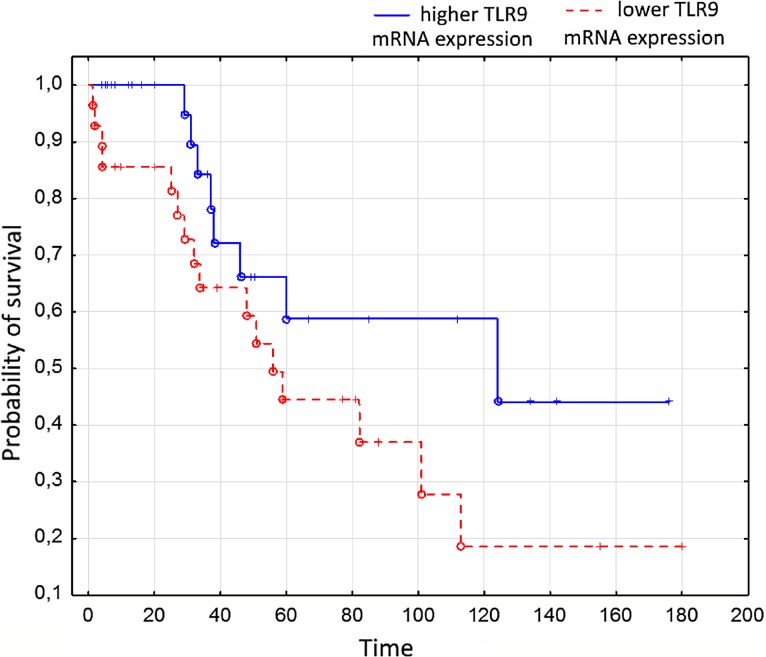
B-cell chronic lymphocytic leukemia (B-CLL) presents with progressive accumulation of monoclonal B cells in the peripheral blood, bone marrow and lymphoid organs. B-CLL is characterized by heterogeneous clinical outcome. The expression of Toll-like receptors (TLRs) and their association with other prognostic factors in B-CLL patients remain unclear. The aim of our study was to evaluate the expression of TLR2, TLR4 and TLR9 genes and their significance as biological markers in patients with B-CLL. Sixty patients with newly diagnosed B-CLL were evaluated. The healthy control group included 20 age-matched individuals. Using quantitative reverse transcriptase PCR, the mRNA expression of genes TLR2, TLR4 and TLR9 was measured. TLR4 gene expression was lower in B-CLL patients as compared to the control group and TLR2 gene expression was higher in B-CLL patients than in healthy individuals. TLR9 gene expression was higher in the control group than in patients with B-CLL. TLR4 mRNA expression was lower in patients with advanced-stage CLL (Rai stages III and IV) than in patients with early stage disease (Rai stages 0-II). TLR2 gene expression was higher in patients with advanced-stage CLL (Rai stages III and IV) than in patients with early stage disease (Rai stages 0-II; p < 0.05). Our results suggest that TLRs could become potential biological markers for the clinical outcome in patients with B-CLL.
B 细胞慢性淋巴细胞白血病(B-CLL)表现为外周血、骨髓和淋巴器官中克隆性 B 细胞的进行性积聚。B-CLL 的临床结局具有异质性。Toll 样受体(TLRs)在 B-CLL 患者中的表达及其与其他预后因素的关联仍不清楚。我们研究的目的是评估 TLR2、TLR4 和 TLR9 基因的表达及其作为 B-CLL 患者生物学标志物的意义。对 60 例新诊断的 B-CLL 患者进行了评估。健康对照组包括 20 名年龄匹配的个体。使用定量逆转录聚合酶链反应测量 TLR2、TLR4 和 TLR9 基因的 mRNA 表达。与对照组相比,B-CLL 患者的 TLR4 基因表达较低,而 B-CLL 患者的 TLR2 基因表达高于健康个体。对照组的 TLR9 基因表达高于 B-CLL 患者。晚期 CLL(Rai 分期 III 和 IV)患者的 TLR4 mRNA 表达低于早期疾病(Rai 分期 0-II)患者。晚期 CLL(Rai 分期 III 和 IV)患者的 TLR2 基因表达高于早期疾病(Rai 分期 0-II;p < 0.05)患者。我们的结果表明,TLRs 可能成为 B-CLL 患者临床结局的潜在生物学标志物。