Cao Jin, Wang Chunxia, Zhang Guang, Ji Xiang, Liu Yanxun, Sun Xiubin, Yuan Zhongshang, Jiang Zheng, Xue Fuzhong
Department of Biostatistics, School of Public Health, Shandong University, Jinan 250012, Shandong, China.
Health Management Center, Affiliated Hospital of Jining Medical University, Jining 272000, Shandong, China.
Int J Environ Res Public Health. 2017 Jan 11;14(1):67. doi: 10.3390/ijerph14010067.
Hyperuricemia (HUA) contributes to gout and many other diseases. Many hyperuricemia-related risk factors have been discovered, which provided the possibility for building the hyperuricemia prediction model. In this study we aimed to explore the incidence of hyperuricemia and develop hyperuricemia prediction models based on the routine biomarkers for both males and females in urban Han Chinese adults.
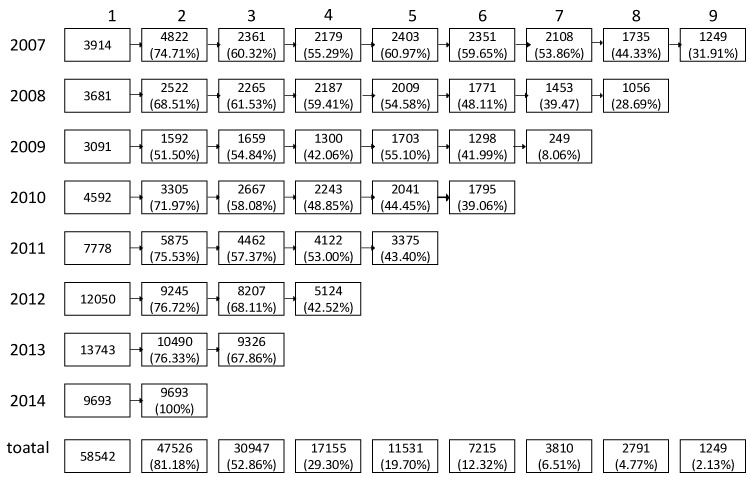
A cohort of 58,542 members of the urban population (34,980 males and 23,562 females) aged 20-80 years old, free of hyperuricemia at baseline examination, was followed up for a median 2.5 years. The Cox proportional hazards regression model was used to develop gender-specific prediction models. Harrell's C-statistics was used to evaluate the discrimination ability of the models, and the 10-fold cross-validation was used to validate the models.
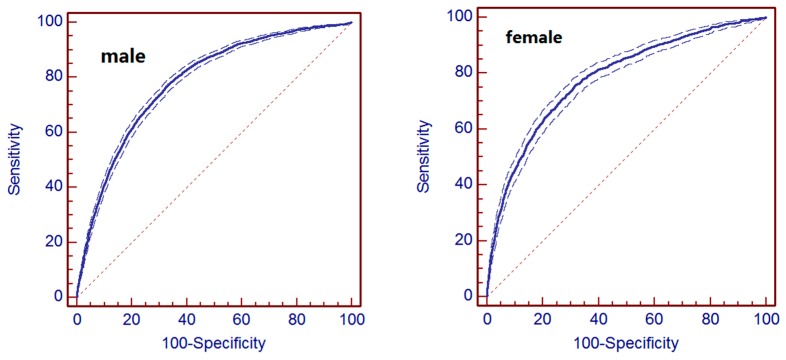
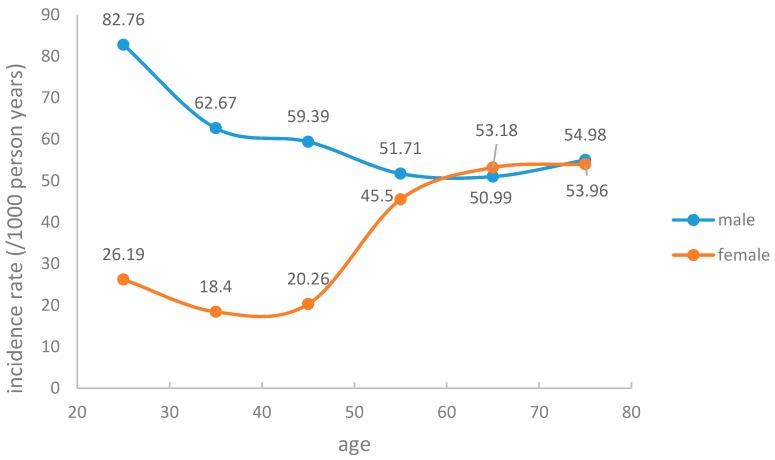
In 7139 subjects (5585 males and 1554 females), hyperuricemia occurred during a median of 2.5 years of follow-up, leading to a total incidence density of 49.63/1000 person years (64.62/1000 person years for males and 27.12/1000 person years for females). The predictors of hyperuricemia were age, body mass index (BMI) systolic blood pressure, serum uric acid for males, and BMI, systolic blood pressure, serum uric acid, triglycerides for females. The models' C statistics were 0.783 (95% confidence interval (CI), 0.779-0.786) for males and 0.784 (95% CI, 0.778-0.789) for females. After 10-fold cross-validation, the C statistics were still steady, with 0.782 for males and 0.783 for females.
In this study, gender-specific prediction models for hyperuricemia for urban Han Chinese adults were developed and performed well.
高尿酸血症(HUA)会引发痛风及许多其他疾病。许多与高尿酸血症相关的危险因素已被发现,这为构建高尿酸血症预测模型提供了可能。在本研究中,我们旨在探讨高尿酸血症的发病率,并基于常规生物标志物为城市汉族成年男性和女性建立高尿酸血症预测模型。
对58542名年龄在20至80岁之间、基线检查时无高尿酸血症的城市居民(34980名男性和23562名女性)进行队列研究,随访时间中位数为2.5年。采用Cox比例风险回归模型建立性别特异性预测模型。使用Harrell's C统计量评估模型的区分能力,并采用10折交叉验证对模型进行验证。
在7139名受试者(5585名男性和1554名女性)中,随访中位数2.5年期间发生了高尿酸血症,总发病密度为49.63/1000人年(男性为64.62/1000人年,女性为27.12/1000人年)。高尿酸血症的预测因素在男性中为年龄、体重指数(BMI)、收缩压、血清尿酸,在女性中为BMI、收缩压、血清尿酸、甘油三酯。模型的C统计量男性为0.783(95%置信区间(CI),0.779 - 0.786),女性为0.784(95%CI,0.778 - 0.789)。经过10折交叉验证后,C统计量仍然稳定,男性为0.782,女性为0.783。
在本研究中,为城市汉族成年男性和女性建立了性别特异性高尿酸血症预测模型,且模型表现良好。