Trezza Christine, Ford Susan L, Gould Elizabeth, Lou Yu, Huang Chuyun, Ritter James M, Buchanan Ann M, Spreen William, Patel Parul
ViiV Healthcare, Research Triangle Park, North Carolina, USA.
PAREXEL International, Research Triangle Park, North Carolina, USA.
Br J Clin Pharmacol. 2017 Jul;83(7):1499-1505. doi: 10.1111/bcp.13236. Epub 2017 Feb 14.
This study aimed to investigate whether cabotegravir (CAB), an integrase inhibitor in development for treatment and prevention of human immunodeficiency virus-1, influences the pharmacokinetics (PK) of a levonorgestrel (LNG) and ethinyl oestradiol (EO)-containing oral contraceptive (OC) in healthy women.
In this open-label, fixed-sequence crossover study, healthy female subjects received LNG 0.15 mg/EO 0.03 mg tablet once daily Days 1-10 alone and with oral CAB 30 mg once daily Days 11-21. At the end of each treatment period, subjects underwent predose sampling for concentrations of follicle-stimulating hormone, luteinizing hormone, and progesterone and serial PK sampling for plasma LNG, EO, and CAB concentrations.
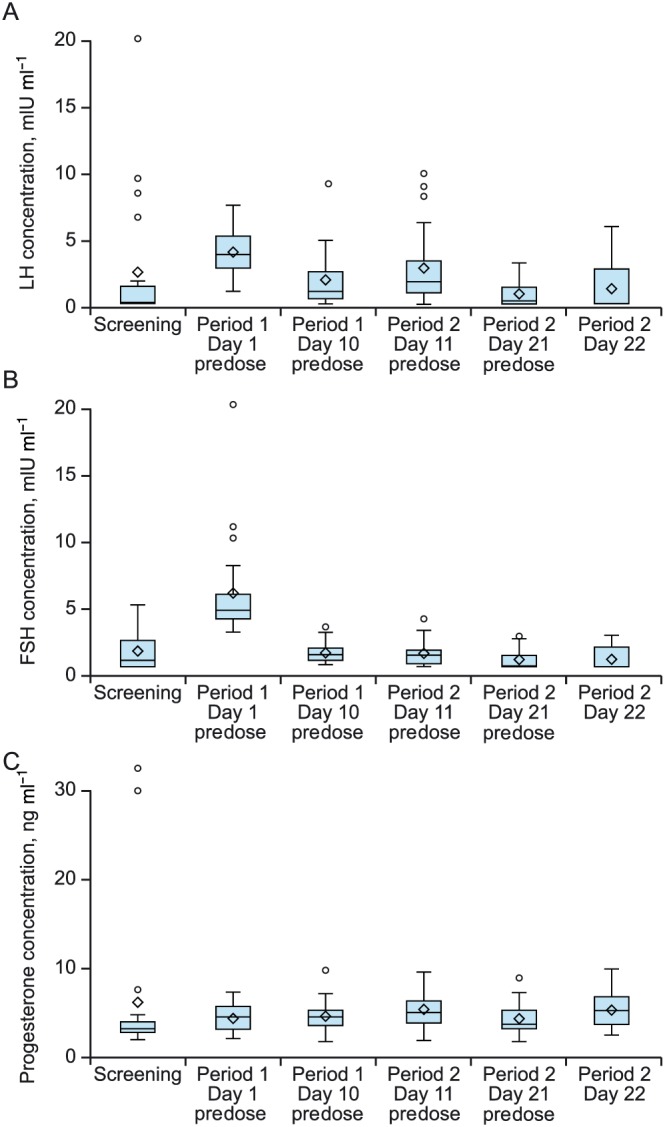
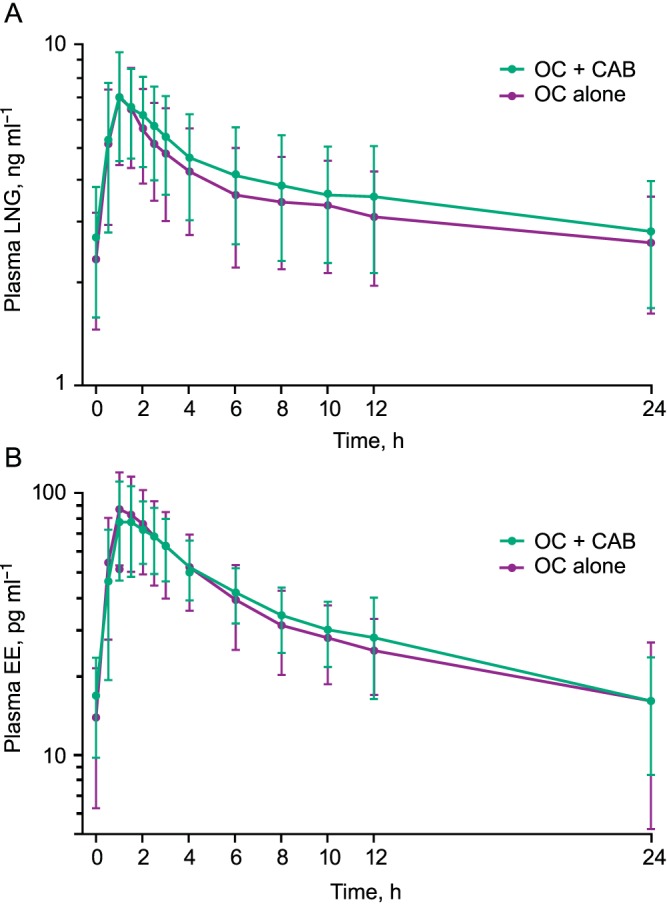
Twenty women were enrolled, and 19 completed the study. One subject was withdrawn due to an adverse event unrelated to study medications. Geometric least squares mean ratios (90% confidence interval) of LNG + CAB vs. LNG alone for LNG area under the plasma concentration-time curve over the dosing interval of duration τ and maximum observed plasma concentration were 1.12 (1.07-1.18) and 1.05 (0.96-1.15), respectively. Geometric least squares mean ratio (90% confidence interval) of EO + CAB vs. EO alone for EO area under the plasma concentration-time curve over the dosing interval of duration τ and maximum observed plasma concentration were 1.02 (0.97-1.08) and 0.92 (0.83-1.03), respectively. Steady-state CAB PK parameters were comparable to historical values. There was no apparent difference in mean luteinizing hormone, follicle-stimulating hormone, and progesterone concentrations between periods. No clinically significant trends in laboratory values, vital signs, or electrocardiography values were observed.
Repeat doses of oral CAB had no significant effect on LNG/EO PK or pharmacodynamics, which supports CAB coadministration with LNG/EO OCs in clinical practice.
本研究旨在调查卡博特韦(CAB),一种正在研发用于治疗和预防人类免疫缺陷病毒1型的整合酶抑制剂,是否会影响健康女性体内含左炔诺孕酮(LNG)和炔雌醇(EO)的口服避孕药(OC)的药代动力学(PK)。
在这项开放标签、固定顺序交叉研究中,健康女性受试者在第1 - 10天单独每日服用一次LNG 0.15 mg/EO 0.03 mg片剂,并在第11 - 21天每日一次口服CAB 30 mg。在每个治疗期结束时,受试者进行给药前采样以检测促卵泡激素、促黄体生成素和孕酮的浓度,并进行系列PK采样以检测血浆LNG、EO和CAB的浓度。
招募了20名女性,19名完成了研究。一名受试者因与研究药物无关的不良事件退出。在持续时间为τ的给药间隔内,LNG + CAB与单独使用LNG相比,LNG血浆浓度 - 时间曲线下面积的几何最小二乘均值比(90%置信区间)和最大观察血浆浓度分别为1.12(1.07 - 1.18)和1.05(0.96 - 1.15)。在持续时间为τ的给药间隔内,EO + CAB与单独使用EO相比,EO血浆浓度 - 时间曲线下面积的几何最小二乘均值比(90%置信区间)和最大观察血浆浓度分别为1.02(0.97 - 1.08)和0.92(0.83 - 1.03)。稳态CAB的PK参数与历史值相当。各时期促黄体生成素、促卵泡激素和孕酮的平均浓度无明显差异。未观察到实验室值、生命体征或心电图值有临床显著趋势。
重复口服CAB对LNG/EO的PK或药效学无显著影响,这支持在临床实践中将CAB与LNG/EO口服避孕药联合使用。