Kanady Jennifer C, Soehner Adriane M, Klein Alexandra B, Harvey Allison G
Department of Psychology, University of California, Berkeley, 3321 Tolman Hall, 94720 Berkeley, CA, USA.
Department of Psychiatry, University of Pittsburgh School of Medicine, 3811 Ohara St, 15213 Pittsburgh, PA, USA.
J Psychiatr Res. 2017 May;88:80-88. doi: 10.1016/j.jpsychires.2017.01.001. Epub 2017 Jan 5.
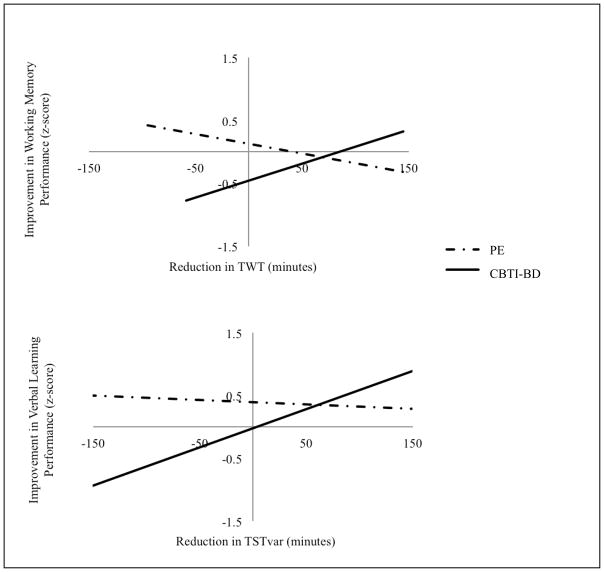
Sleep disturbance and cognitive dysfunction are two domains of impairment during inter-episode bipolar disorder. Despite evidence demonstrating the importance of sleep for cognition in healthy and sleep-disordered samples, this link has been minimally examined in bipolar disorder. The present study tested the association between insomnia-related sleep disruptions and cognitive dysfunction during inter-episode bipolar disorder. Forty-seven participants with bipolar disorder and a comorbid insomnia diagnosis (BD-Insomnia) and 19 participants with bipolar disorder without sleep disturbance in the last six months (BD-Control) participated in the study. Two domains of cognition were assessed: working memory and verbal learning. Insomnia-related sleep disruptions were assessed both categorically (i.e., insomnia diagnosis) and dimensionally (i.e., total wake time, total sleep time, total wake time variability, and total sleep time variability). Hierarchical linear regressions, adjusting for participant age, demonstrated that insomnia diagnosis did not have an independent or interactive effect on cognition. However, regardless of insomnia diagnosis, greater total sleep time variability predicted poorer working memory and verbal learning performance. Further, following sleep treatment, a reduction in total wake time predicted improved working memory performance and a reduction in total sleep time variability predicted improved verbal learning performance. These findings raise the possibility that sleep disturbance may contribute to cognitive dysfunction in bipolar disorder and highlight the importance of treating sleep disturbance in bipolar disorder.
睡眠障碍和认知功能障碍是双相情感障碍发作间期功能损害的两个方面。尽管有证据表明,在健康人群和睡眠障碍人群中,睡眠对认知功能很重要,但在双相情感障碍中,这种联系很少被研究。本研究测试了双相情感障碍发作间期与失眠相关的睡眠中断和认知功能障碍之间的关联。47名患有双相情感障碍且合并失眠诊断的参与者(双相情感障碍-失眠组)和19名在过去六个月内无睡眠障碍的双相情感障碍参与者(双相情感障碍-对照组)参与了该研究。评估了两个认知领域:工作记忆和言语学习。从分类(即失眠诊断)和维度(即总觉醒时间、总睡眠时间、总觉醒时间变异性和总睡眠时间变异性)两方面评估了与失眠相关的睡眠中断情况。在对参与者年龄进行校正的分层线性回归分析中,结果显示失眠诊断对认知功能没有独立或交互作用。然而,无论是否有失眠诊断,总睡眠时间变异性越大,预示着工作记忆和言语学习表现越差。此外,在睡眠治疗后,总觉醒时间的减少预示着工作记忆表现的改善,总睡眠时间变异性的减少预示着言语学习表现的改善。这些发现增加了睡眠障碍可能导致双相情感障碍认知功能障碍的可能性,并突出了治疗双相情感障碍睡眠障碍的重要性。