Cherif M, Chtourou H, Souissi N, Aouidet A, Chamari K
Higher Institute of Sport and Physical Education of Ksar Said, University of Manouba, Tunis, Tunisia; Research Laboratory ''Sport Performance Optimization'' National Center of Medicine and Science in Sport, Tunis, Tunisia.
Research Laboratory ''Sport Performance Optimization'' National Center of Medicine and Science in Sport, Tunis, Tunisia.
Biol Sport. 2016 Dec;33(4):393-398. doi: 10.5604/20831862.1224096. Epub 2016 Nov 10.
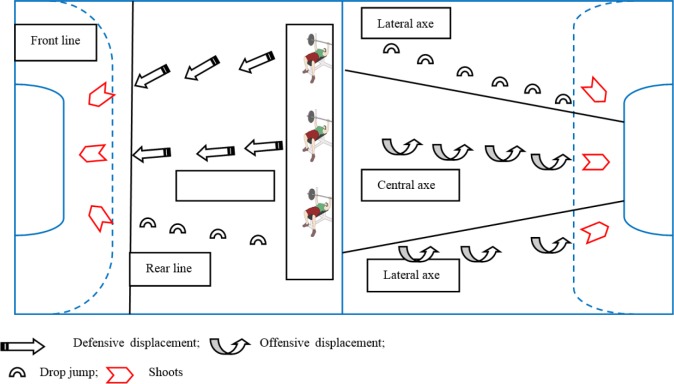
This study was designed to assess the effect of strength and power training on throwing velocity and muscle strength in handball players according to their playing positions. Twenty-two male handball players were assigned to either an experimental group (n=11) or a control group (n=11) (age: 22.1 ± 3.0 years). They were asked to complete (i) the ball throwing velocity test and (ii) the one-repetition maximum (1-RM) tests for the half-back squat, the pull-over, the bench press, the developed neck, and the print exercises before and after 12 weeks of maximal power training. The training was designed to improve strength and power with an intensity of 85-95% of the 1RM. In addition to their usual routine handball training sessions, participants performed two sessions per week. During each session, they performed 3-5 sets of 3-8 repetitions with 3 min of rest in between. Then, they performed specific shots (i.e., 12 to 40). Ball-throwing velocity (p<0.001) was higher after the training period in rear line players (RL). The training programme resulted in an improvement of 1RM bench press (p<0.001), 1RM developed neck (p<0.001) and 1RM print (p<0.001) in both front line (FL) and RL. The control group showed a significant improvement only in ball-throwing velocity (p<0.01) and 1RM bench press (p<0.01) in RL. A significantly greater improvement was found in ball-throwing velocity (p<0.001), 1RM bench press (p<0.001), and 1RM half-back squat exercises in players of the central axis (CA) compared to the lateral axis (LA) (p<0.01). The power training programme induced significantly greater increases in ball-throwing velocity and muscle strength in FL than RL and in CA than LA axis players.
本研究旨在根据手球运动员的比赛位置,评估力量和功率训练对其投掷速度和肌肉力量的影响。22名男性手球运动员被分为实验组(n = 11)和对照组(n = 11)(年龄:22.1±3.0岁)。要求他们在进行12周的最大功率训练前后,完成(i)投球速度测试和(ii)对半蹲、仰卧上拉、卧推、发达颈肌和引体向上练习的一次重复最大值(1-RM)测试。该训练旨在以1RM的85-95%的强度提高力量和功率。除了常规的手球训练课程外,参与者每周进行两次训练。在每次训练中,他们进行3-5组,每组3-8次重复,组间休息3分钟。然后,他们进行特定的投篮(即12至40次)。训练期后,后防线球员(RL)的投球速度更高(p<0.001)。训练计划使前线(FL)和RL的1RM卧推(p<0.001)、1RM发达颈肌(p<0.001)和1RM引体向上(p<0.001)均有所提高。对照组仅在RL的投球速度(p<0.01)和1RM卧推(p<0.01)方面有显著提高。与侧轴(LA)球员相比,中轴线(CA)球员的投球速度(p<0.001)、1RM卧推(p<0.001)和1RM半蹲练习有显著更大的提高(p<0.01)。功率训练计划使FL球员的投球速度和肌肉力量的增加显著大于RL球员,CA轴球员大于LA轴球员。