Kim Hyunyun, Kim Sujin, Baek Sang Hong, Kwon Sang-Mo
Laboratory for Vascular Medicine and Stem Cell Biology, Convergence Stem Cell Research Center, Medical Research Institute, Pusan National University School of Medicine, Yangsan, Republic of Korea.
Laboratory of Cardiovascular Regeneration, Division of Cardiovascular Medicine, Seoul St. Mary's Hospital, The Catholic University of Korea School of Medicine, Seoul, Republic of Korea.
Stem Cells Int. 2016;2016:8340257. doi: 10.1155/2016/8340257. Epub 2016 Dec 20.
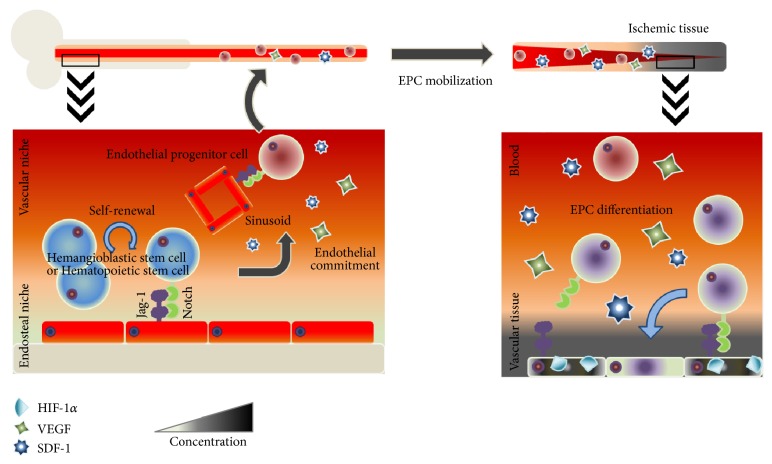
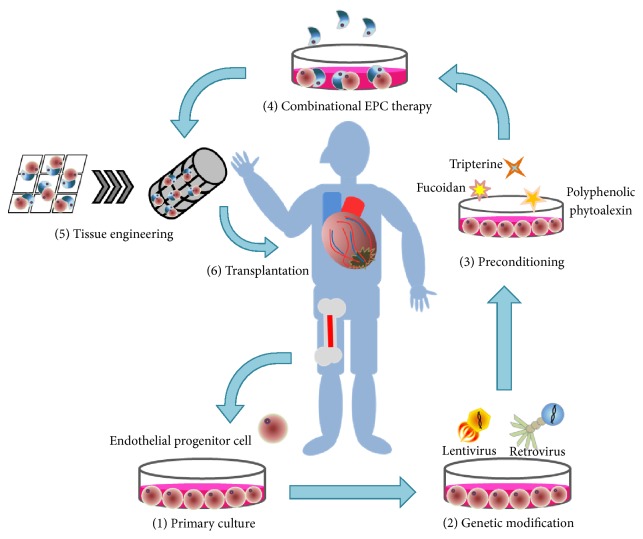
Cardiovascular diseases (CVDs), including atherosclerosis, stroke, and myocardial infarction, is a major cause of death worldwide. In aspects of cell therapy against CVD, it is generally accepted that endothelial progenitor cells (EPCs) are potent neovascular modulators in ischemic tissues. In response to ischemic injury signals, EPCs located in a bone marrow niche migrate to injury sites and form new vessels by secreting various vasculogenic factors including VEGF, SDF-1, and FGF, as well as by directly differentiating into endothelial cells. Nonetheless, in ischemic tissues, most of engrafted EPCs do not survive under harsh ischemic conditions and nutrient depletion. Therefore, an understanding of diverse EPC-related cytoprotective mediators underlying EPC homeostasis in ischemic tissues may help to overcome current obstacles for EPC-mediated cell therapy for CVDs. Additionally, to enhance EPC's functional capacity at ischemic sites, multiple strategies for cell survival should be considered, that is, preconditioning of EPCs with function-targeting drugs including natural compounds and hormones, virus mediated genetic modification, combined therapy with other stem/progenitor cells, and conglomeration with biomaterials. In this review, we discuss multiple cytoprotective mediators of EPC-based cardiovascular repair and propose promising therapeutic strategies for the treatment of CVDs.
心血管疾病(CVDs),包括动脉粥样硬化、中风和心肌梗死,是全球主要的死亡原因。在针对心血管疾病的细胞治疗方面,人们普遍认为内皮祖细胞(EPCs)是缺血组织中强大的新血管调节因子。响应缺血损伤信号,位于骨髓微环境中的EPCs迁移至损伤部位,并通过分泌包括血管内皮生长因子(VEGF)、基质细胞衍生因子-1(SDF-1)和碱性成纤维细胞生长因子(FGF)等多种血管生成因子,以及直接分化为内皮细胞来形成新血管。然而,在缺血组织中,大多数植入的EPCs在恶劣的缺血条件和营养耗竭下无法存活。因此,了解缺血组织中EPCs稳态下各种与EPC相关的细胞保护介质,可能有助于克服当前EPC介导的心血管疾病细胞治疗的障碍。此外,为了增强EPCs在缺血部位的功能能力,应考虑多种细胞存活策略,即使用包括天然化合物和激素在内的功能靶向药物对EPCs进行预处理、病毒介导的基因修饰、与其他干细胞/祖细胞联合治疗以及与生物材料聚集。在这篇综述中,我们讨论了基于EPCs的心血管修复的多种细胞保护介质,并提出了治疗心血管疾病的有前景的治疗策略。