Rhee Connie M, Ghahremani-Ghajar Mehrdad, Obi Yoshitsugu, Kalantar-Zadeh Kamyar
Division of Nephrology and Hypertension, University of California Irvine School of Medicine, Orange, CA, USA -
Division of Nephrology and Hypertension, University of California Irvine School of Medicine, Orange, CA, USA.
Panminerva Med. 2017 Jun;59(2):188-196. doi: 10.23736/S0031-0808.17.03299-2. Epub 2017 Jan 13.
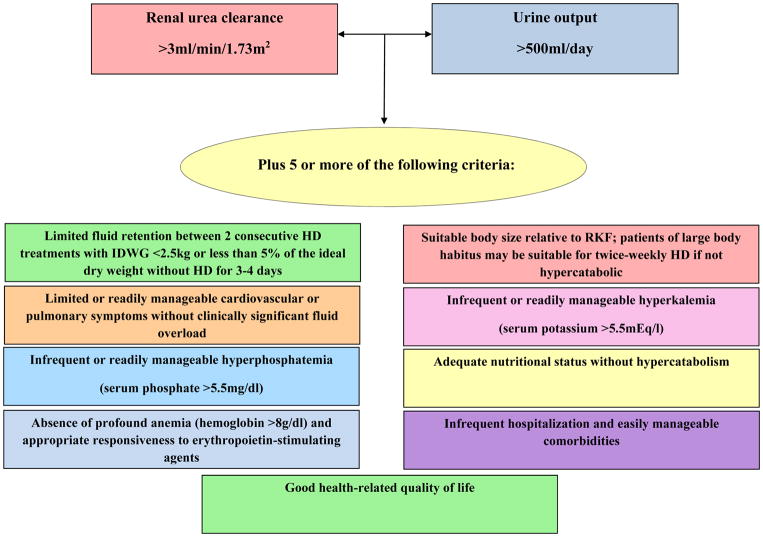
Registry or national dialysis data show that a sizeable proportion of contemporary dialysis patients have substantial levels of residual kidney function especially upon transitioning to dialysis therapy. However, among incident hemodialysis patients, the prevailing paradigm has been to initiate "full-dose" triweekly treatment schedules irrespective of native kidney function in most developed countries. Recognizing the benefits of residual kidney function upon the health and survival of dialysis patients, there has been growing interest in incremental hemodialysis, in which dialysis frequency and dose are tailored according to the degree of patients' residual kidney function. Infrequent hemodialysis can also be used for those who prefer a more conservative approach in managing uremia. Clinical practice guidelines support the use of twice-weekly hemodialysis among patients with adequate residual kidney function (renal urea clearance >3 mL/min/1.73 m2), and a growing body of evidence indicates that incremental hemodialysis is associated with better preservation of residual kidney function without adversely impacting survival. Nonetheless, incremental hemodialysis remains an underutilized approach in this population. In this review, we will discuss the history of the twice- versus triweekly hemodialysis schedules; current clinical practice guidelines regarding infrequent hemodialysis; emerging data on incremental treatment regimens and outcomes; and guidelines for the practical implementation of incremental and infrequent hemodialysis in the clinical setting.
登记处或国家透析数据显示,相当一部分当代透析患者具有相当程度的残余肾功能,尤其是在开始透析治疗时。然而,在大多数发达国家,对于新接受血液透析的患者,普遍的模式是不管其自身肾功能如何,都开始采用每周三次的“全剂量”治疗方案。认识到残余肾功能对透析患者健康和生存的益处,人们对递增式血液透析的兴趣日益浓厚,即在递增式血液透析中,透析频率和剂量根据患者残余肾功能的程度进行调整。对于那些在管理尿毒症方面倾向于采用更保守方法的患者,也可采用不频繁的血液透析。临床实践指南支持在残余肾功能充足(肾尿素清除率>3 mL/min/1.73 m²)的患者中使用每周两次的血液透析,越来越多的证据表明,递增式血液透析与更好地保留残余肾功能相关,且不会对生存产生不利影响。尽管如此,递增式血液透析在这一人群中仍然是一种未得到充分利用的方法。在本综述中,我们将讨论每周两次与每周三次血液透析方案的历史;当前关于不频繁血液透析的临床实践指南;递增式治疗方案和结果的新数据;以及在临床环境中实际实施递增式和不频繁血液透析的指南。