Hall P S, Lord S R, Collinson M, Marshall H, Jones M, Lowe C, Howard H, Swinson D, Velikova G, Anthoney A, Roy R, Dent J, Cheeseman S, Last K, Seymour M T
Edinburgh Cancer Research Centre, University of Edinburgh, Edinburgh EH4 2XR, UK.
Department of Oncology, University of Oxford, Oxford, UK.
Br J Cancer. 2017 Feb 14;116(4):472-478. doi: 10.1038/bjc.2016.442. Epub 2017 Jan 17.
Elderly patients are commonly under-represented in cancer clinical trials. The 321GO was undertaken in preparation for a definitive phase three trial assessing different chemotherapy regimens in a frail and/or elderly population with advanced gastroesophageal (GO) cancer.
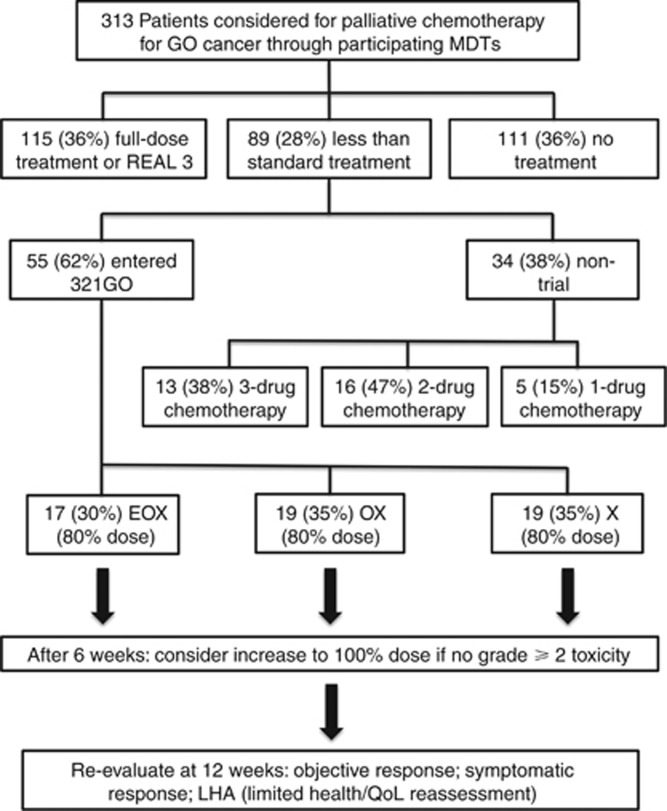
Patients with advanced GO cancer considered unfit for conventional dose chemotherapy were randomly assigned in a 1 : 1 : 1 ratio to: epirubicin, oxaliplatin and capecitabine (EOX); oxaliplatin and capecitabine (OX); and capecitabine alone (X) (all 80% of full dose and unblinded). The primary end point was patient recruitment over an 18-month period. A registration study recorded treatment choice for all patients with advanced GO cancer at trial centres.
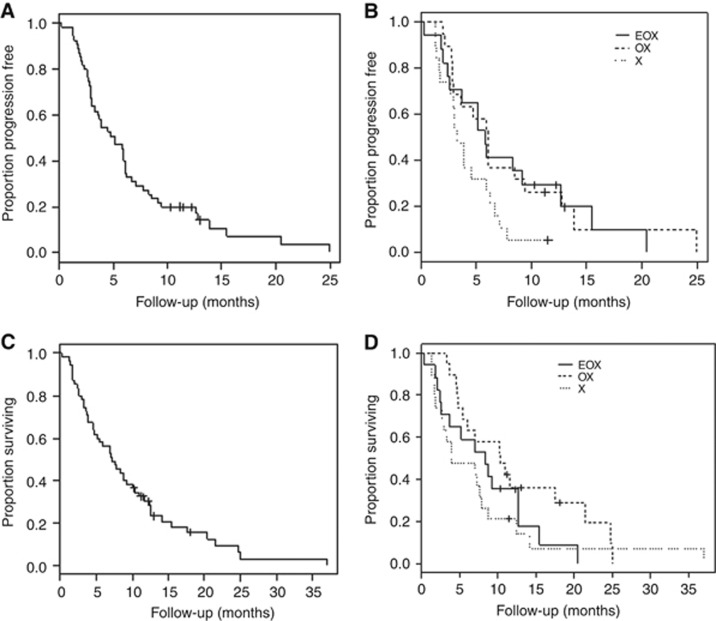
A total of 313 patients were considered for palliative chemotherapy for GO cancer over the 18-month period: 115 received full dose treatment, 89 less than standard treatment or entered 321GO and 111 no treatment. Within 321GO, 55 patients were randomly assigned (19 to OX and X; 17 to EOX). Progression-free survival (PFS) for all patients was 4.4 months and by arm 5.4, 5.6 and 3.0 months for EOX, OX and X, respectively. The number of patients with a good overall treatment utility (OTU), a novel patient-centred endpoint, at 12 weeks was 3 (18%), 6 (32%) and 1 (6%) for EOX, OX and X, respectively. At 6 weeks, 22 patients (41%) had experienced a non-haematologic toxicity ⩾grade 3, most commonly lethargy or diarrhoea. The OTU was prognostic for overall survival in patients alive at week 12 (logrank test P=0.0001).
It is feasible to recruit elderly and/or frail patients with advanced GO cancer to a randomised clinical trial. The OX is the preferred regimen for further study. Overall treatment utility shows promise as a comparator between treatment regimens for feasibility and randomised trials in the elderly and/or frail GO cancer population.
老年患者在癌症临床试验中的代表性通常不足。开展321GO研究是为一项确定性三期试验做准备,该试验旨在评估针对体弱和/或老年晚期胃食管癌(GO)患者的不同化疗方案。
被认为不适合常规剂量化疗的晚期GO癌症患者按1∶1∶1的比例随机分配至以下三组:表柔比星、奥沙利铂和卡培他滨(EOX)组;奥沙利铂和卡培他滨(OX)组;以及单独使用卡培他滨(X)组(均为全剂量的80%且不设盲)。主要终点是18个月内的患者招募情况。一项登记研究记录了试验中心所有晚期GO癌症患者的治疗选择。
在18个月期间,共有313例晚期GO癌症患者被考虑进行姑息化疗:115例接受全剂量治疗,89例接受低于标准的治疗或进入321GO研究,111例未接受治疗。在321GO研究中,55例患者被随机分组(19例分到OX组和X组;17例分到EOX组)。所有患者的无进展生存期(PFS)为4.4个月,按治疗组分别为:EOX组5.4个月、OX组5.6个月、X组3.0个月。以一种新的以患者为中心的终点——良好总体治疗效用(OTU)来衡量,在12周时,EOX组、OX组和X组的患者人数分别为3例(18%)、6例(32%)和1例(6%)。在6周时,22例患者(41%)出现了≥3级的非血液学毒性,最常见的是乏力或腹泻。OTU对12周时存活患者的总生存期具有预后价值(对数秩检验P=0.0001)。
招募老年和/或体弱的晚期GO癌症患者参加随机临床试验是可行的。OX方案是进一步研究的首选方案。总体治疗效用有望作为老年和/或体弱GO癌症患者治疗方案在可行性和随机试验方面的比较指标。