Deb Alok K, Dutta Shanta, Hnichho Chhaihlo, Vanlalpeki Mary, Phosa Hli Thapi, Rakhu Khaila, Fanai Samuel Lalfakawma, Chakrabarti Manoj, Panda Samiran
National Institute of Cholera & Enteric Diseases / Indian Council of Medical Research (NICED/ICMR), P-33 CIT Road, Scheme-XM, Beliaghata, Kolkata, 700010, India.
District Health Program Administration, Saiha, Mizoram, India.
BMC Pediatr. 2017 Jan 17;17(1):23. doi: 10.1186/s12887-017-0778-z.
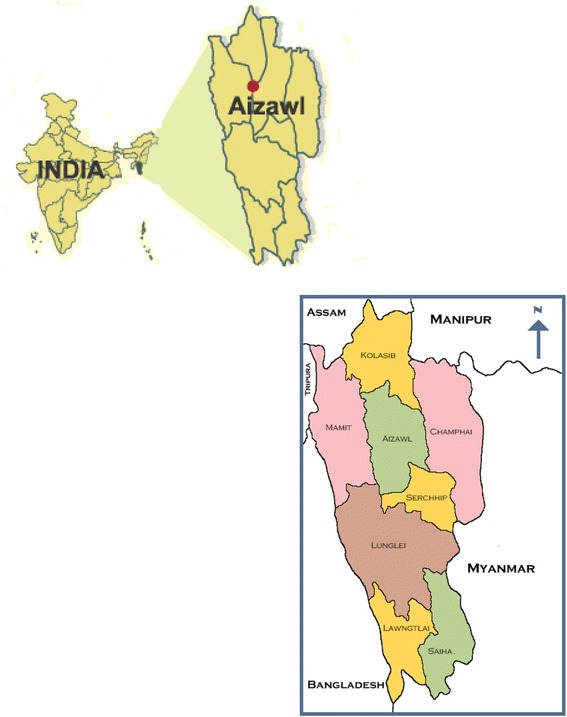
Infant mortality has dropped considerably in India over the last 5 years. A sharp contrast to this decline in national average of infant mortality is the rate recorded during 2014-2015 from the southernmost district of Saiha, Mizoram having a common international border with Myanmar. As this district specific rate (113 per 1000 live births) is 3 times higher compared to the national and state average, the present investigation was carried out to identify associated factors.
We examined secondary data made available by the national health mission, consulted with local community members and generated primary data through interviews. A case-control study design was followed. Mothers, who delivered a child during 2013-2015 and subsequently lost them due to infant death, formed the case group and controls were selected from same neighborhood as with case-mothers. The mother and child tracking system maintained by the district specific national health mission office was used for recruiting cases and controls. A total of 195 mothers were interviewed; 66 of them belonged to 'cases' and 129 were 'controls'.
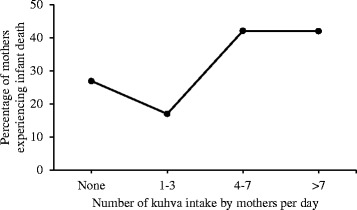
The mean age of the respondents was 27 years (median 27; SD ± 5; minimum 17 & maximum 44). In uni-variate analyses 'child delivery at home', 'low birth weight', 'non-attendance of school by mothers', 'completed standard of school education by mothers', 'both parents working', 'mothers receiving blood transfusion during last pregnancy', and 'fourth or more birth order during last pregnancy' were associated with infant deaths. Intriguingly, the number of daily kuhva (raw areca nut) intake during last pregnancy was significantly higher among case-mothers compared to controls. In conditional logistic regression, 'low birth weight' (adjusted OR (AOR) 14.7; 95% CI 2.1-101.8; p = 0.006), and 'consumption of 4 or more kuhva per day' (AOR 8; 95% CI 1.9-34.3; p = 0.005) were independently associated with infant-death-experiences.
The present investigation merits due attention from policy makers and health planners for immediate improvement in peri-natal and neonatal care services in the remote district of Saiha. Need for further research exploring socio-behavioural issues around areca nut consumption and effects of interventions to reduce areca nut intake on maternal and children health are underscored.
在过去5年里,印度的婴儿死亡率大幅下降。与全国婴儿死亡率下降形成鲜明对比的是,2014 - 2015年期间,与缅甸有共同国际边界的米佐拉姆邦最南端的赛哈区记录的死亡率。由于该地区特定的死亡率(每1000例活产中有113例)比全国和邦平均水平高出3倍,因此开展了本次调查以确定相关因素。
我们审查了国家卫生使命提供的二手数据,咨询了当地社区成员,并通过访谈收集了原始数据。采用病例对照研究设计。在2013 - 2015年期间分娩且随后因婴儿死亡而失去孩子的母亲组成病例组,对照组从与病例母亲同一社区中选取。由地区特定的国家卫生使命办公室维护的母婴追踪系统用于招募病例和对照。总共采访了195名母亲;其中66名属于“病例”组,129名是“对照”组。
受访者的平均年龄为27岁(中位数27;标准差±5;最小17岁,最大44岁)。在单变量分析中,“在家分娩”、“低出生体重”、“母亲未上学”、“母亲完成的学校教育水平”、“父母双方都工作”、“母亲在上次怀孕期间接受输血”以及“上次怀孕时的第四胎或更高胎次”与婴儿死亡有关。有趣的是,与对照组相比,病例组母亲在上次怀孕期间每天食用库瓦(生槟榔)的数量明显更高。在条件逻辑回归中,“低出生体重”(调整后的比值比(AOR)14.7;95%置信区间2.1 - 101.8;p = 0.006)和“每天食用4个或更多库瓦”(AOR 8;95%置信区间1.9 - 34.3;p = 0.005)与婴儿死亡经历独立相关。
本次调查值得政策制定者和卫生规划者给予应有的关注,以便立即改善赛哈偏远地区的围产期和新生儿护理服务。强调需要进一步研究探索围绕槟榔消费的社会行为问题以及减少槟榔摄入量的干预措施对母婴健康的影响。