Ma Wen-Zhi, Zheng Xiao-Min, Hei Chang-Chun, Zhao Cheng-Jun, Xie Sha-Sha, Chang Qing, Cai Yu-Fang, Jia Hua, Pei Xiu-Ying, Wang Yan-Rong
Key Laboratory of Fertility Preservation and Maintenance of Ministry of Education, Key Laboratory of Reproduction and Genetic of Ningxia Hui Autonomous Region, and Department of Anatomy, Histology and Embryology, Ningxia Medical University, Shengli street No.1160, Yinchuan, 750004, China.
The No, 1 People's Hospital of xingtai, Hongxing street No.16, No, Xingtai, 054000, China.
J Ovarian Res. 2017 Jan 17;10(1):5. doi: 10.1186/s13048-016-0299-7.
Ovarian transplantation is a useful method for preserving the fertility of young women with cancer who undergo radiotherapy and chemotherapy. Follicle-stimulating hormone (FSH) is use to protect transplanted ovarian tissues from ischemia injury through promoting revascularization after transplantation, but the side effect of high level FSH is ovarian overstimulation leading to substantial follicular loss. In this study, we investigated the optimal usage of FSH on revascularization in the in vitro cultured ovarian tissues before and after transplantation.
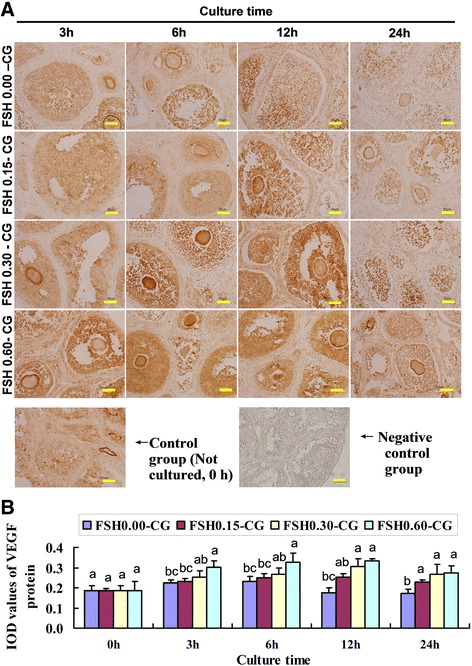
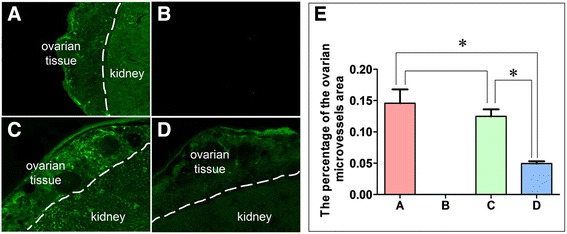
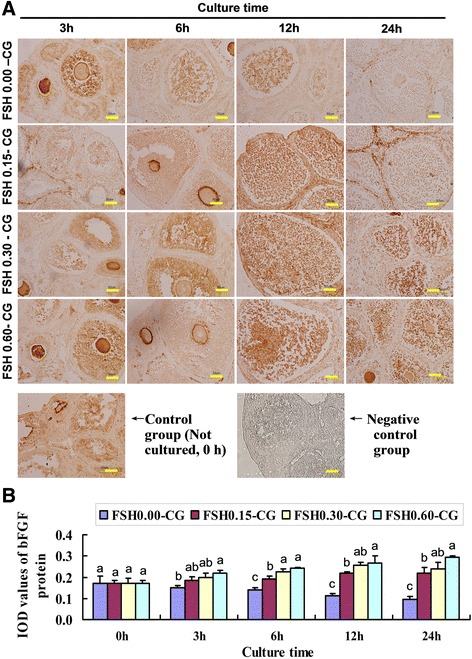
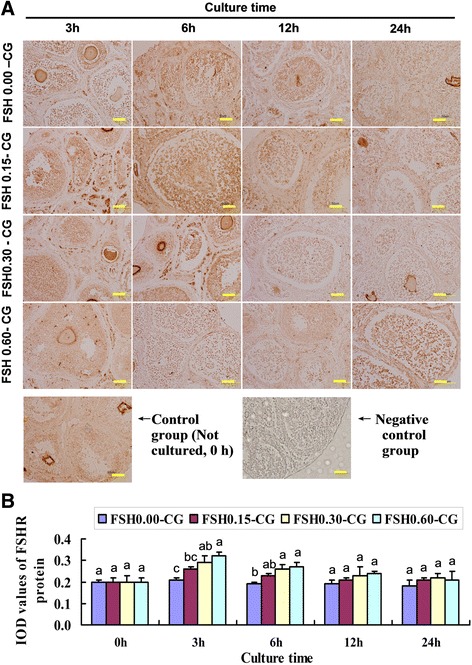
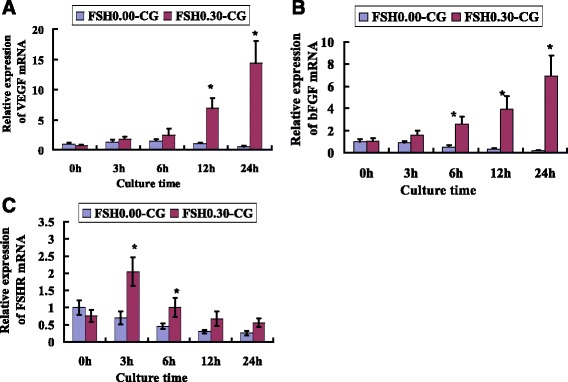
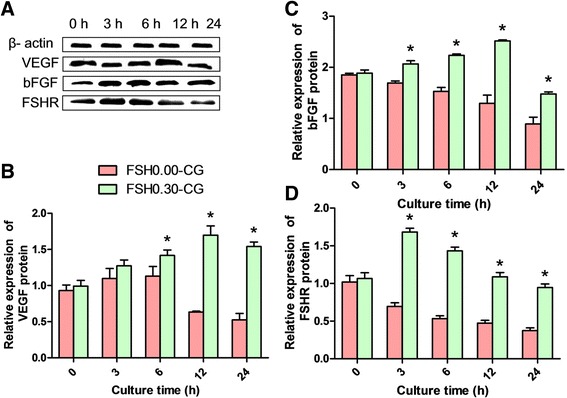
FSH mainly exhibited an additive response in the gene and protein expression of vascular endothelial growth factor (VEGF), basic fibroblast growth factor (bFGF) and follicle stimulating hormone receptor (FSHR) with its raised concentrations (0.15 IU/ml, 0.30 IU/ml and 0.60 IU/ml) and prolonged treatment (3 h, 6 h, 12 h, 24 h). The concentrations with 0.60 IU/ml FSH could obviously promoted the expression of VEGF, bFGF and FSHR, but under this concentration FSH could also overstimulated the ovarian tissue leading to follicular loss. With the increase of culture time, the gene and protein expression of VEGF and bFGF both were up-regulated in all of the FSH added groups, but FSHR expression decreased when culture time exceeded 12 h. So we chose 0.30 IU/ml FSH added concentration and 6 h culture time as the FSH usage condition in functional revascularization verification experiment, and found that under this condition FSH promoted 2.5 times increase of vascular density in treated group than in control group after ovarian tissues transplantation.
Ovarian intervention with 0.30 IU/ml FSH for 6 h is an optimal FSH usage condition which could accelerate the revascularization in the allotransplanted ovarian tissue and can not produce ovarian overstimulation.
卵巢移植是一种用于保护接受放疗和化疗的年轻癌症女性生育能力的有效方法。促卵泡激素(FSH)用于通过促进移植后血管再生来保护移植的卵巢组织免受缺血损伤,但高水平FSH的副作用是卵巢过度刺激导致大量卵泡丢失。在本研究中,我们调查了FSH在移植前后体外培养的卵巢组织血管再生中的最佳使用方法。
随着FSH浓度升高(0.15 IU/ml、0.30 IU/ml和0.60 IU/ml)及处理时间延长(3小时、6小时、12小时、24小时),FSH在血管内皮生长因子(VEGF)、碱性成纤维细胞生长因子(bFGF)和促卵泡激素受体(FSHR)的基因和蛋白表达上主要表现为累加反应。0.60 IU/ml FSH浓度可明显促进VEGF、bFGF和FSHR的表达,但在此浓度下FSH也会过度刺激卵巢组织导致卵泡丢失。随着培养时间增加,所有添加FSH组中VEGF和bFGF的基因和蛋白表达均上调,但培养时间超过12小时后FSHR表达下降。因此,我们选择0.30 IU/ml FSH添加浓度和6小时培养时间作为功能血管再生验证实验中的FSH使用条件,发现在此条件下卵巢组织移植后,处理组的血管密度比对照组增加了2.5倍。
用0.30 IU/ml FSH干预卵巢6小时是最佳的FSH使用条件,可加速同种异体移植卵巢组织的血管再生且不会产生卵巢过度刺激。