Brooks Jonathan C W, Davies Wendy-Elizabeth, Pickering Anthony E
Clinical Research Imaging Centre and.
School of Physiology, Pharmacology and Neuroscience, University of Bristol, Bristol, BS8 1TD, United Kingdom, and.
J Neurosci. 2017 Mar 1;37(9):2279-2291. doi: 10.1523/JNEUROSCI.2193-16.2016. Epub 2017 Jan 17.
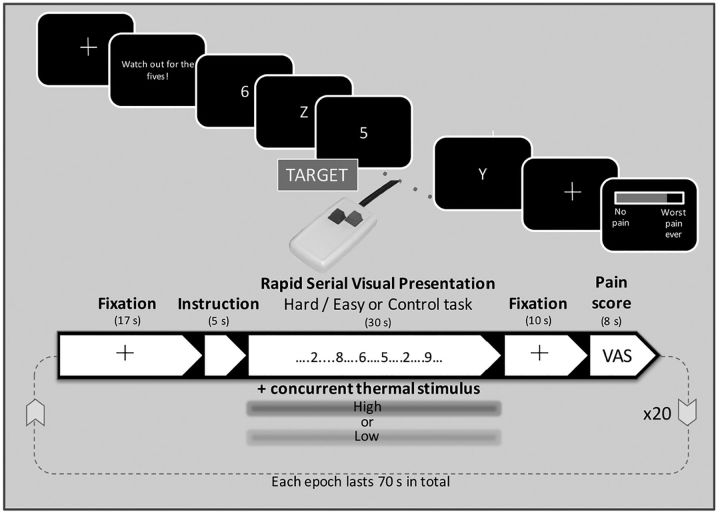
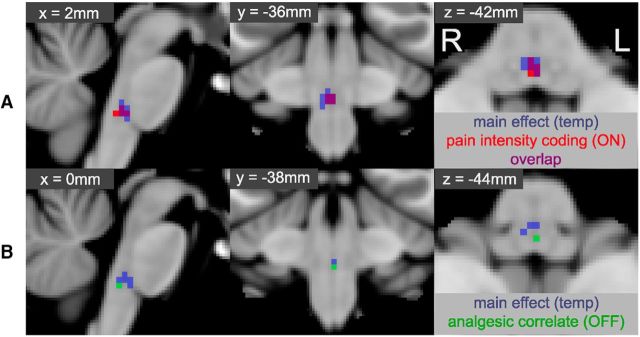
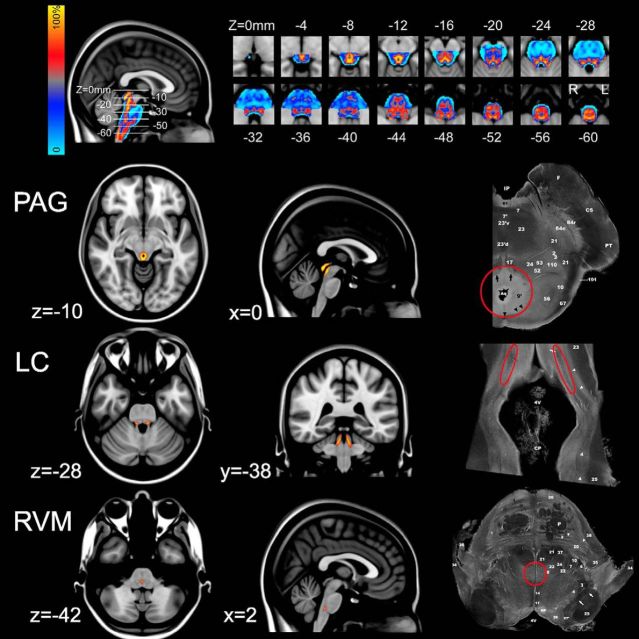
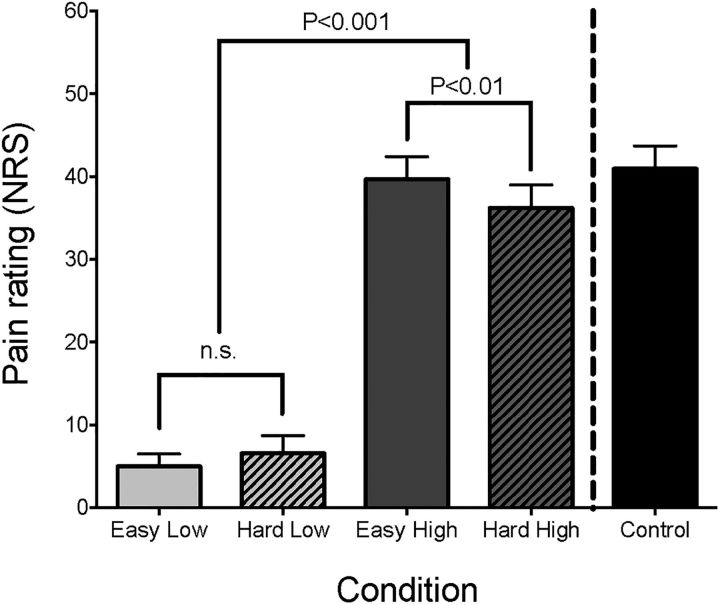
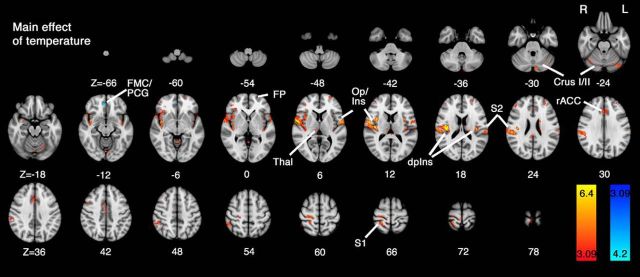
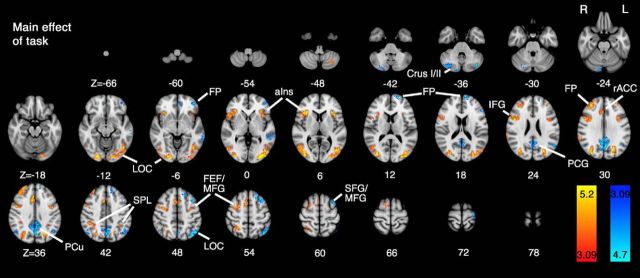
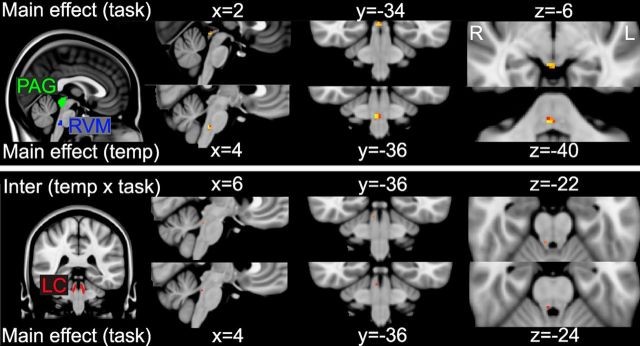
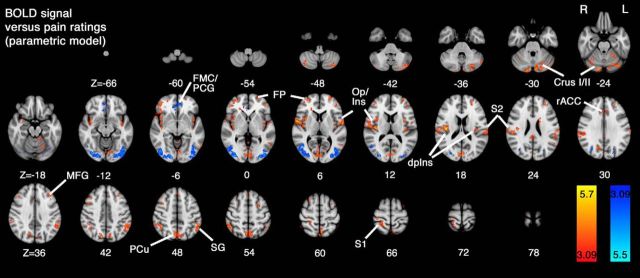
Previous human imaging studies manipulating attention or expectancy have identified the periaqueductal gray (PAG) as a key brainstem structure implicated in endogenous analgesia. However, animal studies indicate that PAG analgesia is mediated largely via caudal brainstem structures, such as the rostral ventromedial medulla (RVM) and locus coeruleus (LC). To identify their involvement in endogenous analgesia, we used brainstem optimized, whole-brain imaging to record responses to concurrent thermal stimulation (left forearm) and visual attention tasks of titrated difficulty in 20 healthy subjects. The PAG, LC, and RVM were anatomically discriminated using a probabilistic atlas. Pain ratings disclosed the anticipated analgesic interaction between task difficulty and pain intensity ( < 0.001). Main effects of noxious thermal stimulation were observed across several brain regions, including operculoinsular, primary somatosensory, and cingulate cortices, whereas hard task difficulty was represented in anterior insular, parietal, and prefrontal cortices. Permutation testing within the brainstem nuclei revealed the following: main effects of task in dorsal PAG and right LC; and main effect of temperature in RVM and a task × temperature interaction in right LC. Intrasubject regression revealed a distributed network of supratentorial brain regions and the RVM whose activity was linearly related to pain intensity. Intersubject analgesia scores correlated to activity within a distinct region of the RVM alone. These results identify distinct roles for a brainstem triumvirate in attentional analgesia: with the PAG activated by attentional load; specific RVM regions showing pronociceptive and antinociceptive processes (in line with previous animal studies); and the LC showing lateralized activity during conflicting attentional demands. Attention modulates pain intensity, and human studies have identified roles for a network of forebrain structures plus the periaqueductal gray (PAG). Animal data indicate that the PAG acts via caudal brainstem structures to control nociception. We investigated this issue within an attentional analgesia paradigm with brainstem-optimized fMRI and analysis using a probabilistic brainstem atlas. We find pain intensity encoding in several forebrain structures, including the insula and attentional activation of the PAG. Discrete regions of the rostral ventromedial medulla bidirectionally influence pain perception, and locus coeruleus activity mirrors the interaction between attention and nociception. This approach has enabled the resolution of contributions from a hub of key brainstem structures to endogenous analgesia.
以往通过操纵注意力或预期进行的人体成像研究已确定中脑导水管周围灰质(PAG)是内源性镇痛中涉及的关键脑干结构。然而,动物研究表明,PAG镇痛主要通过脑干尾端结构介导,如延髓头端腹内侧区(RVM)和蓝斑(LC)。为了确定它们在内源性镇痛中的作用,我们对20名健康受试者进行了脑干优化的全脑成像,以记录对同时进行的热刺激(左前臂)和难度递增的视觉注意力任务的反应。使用概率图谱在解剖学上区分PAG、LC和RVM。疼痛评分揭示了任务难度与疼痛强度之间预期的镇痛相互作用(<0.001)。在包括岛盖部、初级体感皮层和扣带回皮层在内的多个脑区观察到了有害热刺激的主要效应,而在岛叶前部、顶叶和前额叶皮层则表现出高难度任务的效应。在脑干核团内进行的置换检验显示:背侧PAG和右侧LC中任务的主要效应;RVM中温度的主要效应以及右侧LC中任务×温度的相互作用。受试者内回归揭示了幕上脑区和RVM的分布式网络,其活动与疼痛强度呈线性相关。受试者间的镇痛评分仅与RVM一个独特区域内的活动相关。这些结果确定了脑干三联体在注意力镇痛中的不同作用:PAG被注意力负荷激活;特定的RVM区域表现出促痛和抗痛过程(与先前的动物研究一致);LC在注意力需求冲突期间表现出偏侧化活动。注意力调节疼痛强度,人体研究已确定前脑结构网络以及中脑导水管周围灰质(PAG)的作用。动物数据表明,PAG通过脑干尾端结构控制伤害感受。我们在注意力镇痛范式中使用脑干优化的功能磁共振成像并使用概率脑干图谱进行分析,对这一问题进行了研究。我们发现包括岛叶在内的几个前脑结构中存在疼痛强度编码,以及PAG的注意力激活。延髓头端腹内侧区的离散区域双向影响疼痛感知,蓝斑活动反映了注意力与伤害感受之间的相互作用。这种方法能够解析关键脑干结构中心对内源性镇痛的贡献。