Xiao Ning, Wu Yunyu, Pan Cunhong, Yu Ling, Chen Yu, Liu Guangqing, Li Yuhong, Zhang Xiaoxiang, Wang Zhiping, Dai Zhengyuan, Liang Chengzhi, Li Aihong
Lixiahe Agricultural Research Institute of Jiangsu Province, Yangzhou - Jiangsu Collaborative Innovation Center for Modern Crop Production, Nanjing - Institute of Jiangsu Province National Rice Industry Technology System of Yangzhou Comprehensive Experimental Station Yangzhou, China.
Institute of Genetics and Developmental Biology, Chinese Academy of Sciences Beijing, China.
Front Plant Sci. 2017 Jan 3;7:1918. doi: 10.3389/fpls.2016.01918. eCollection 2016.
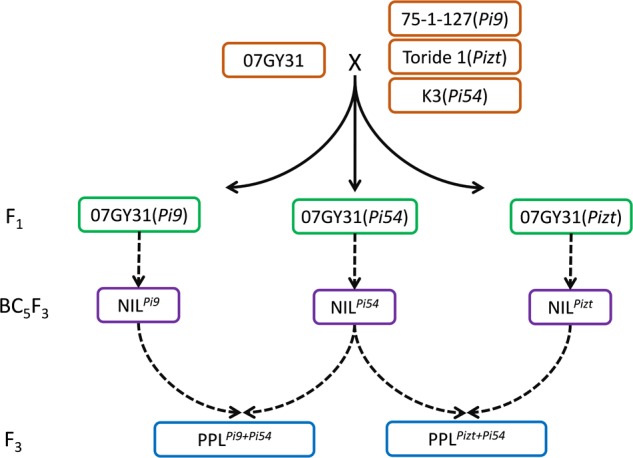
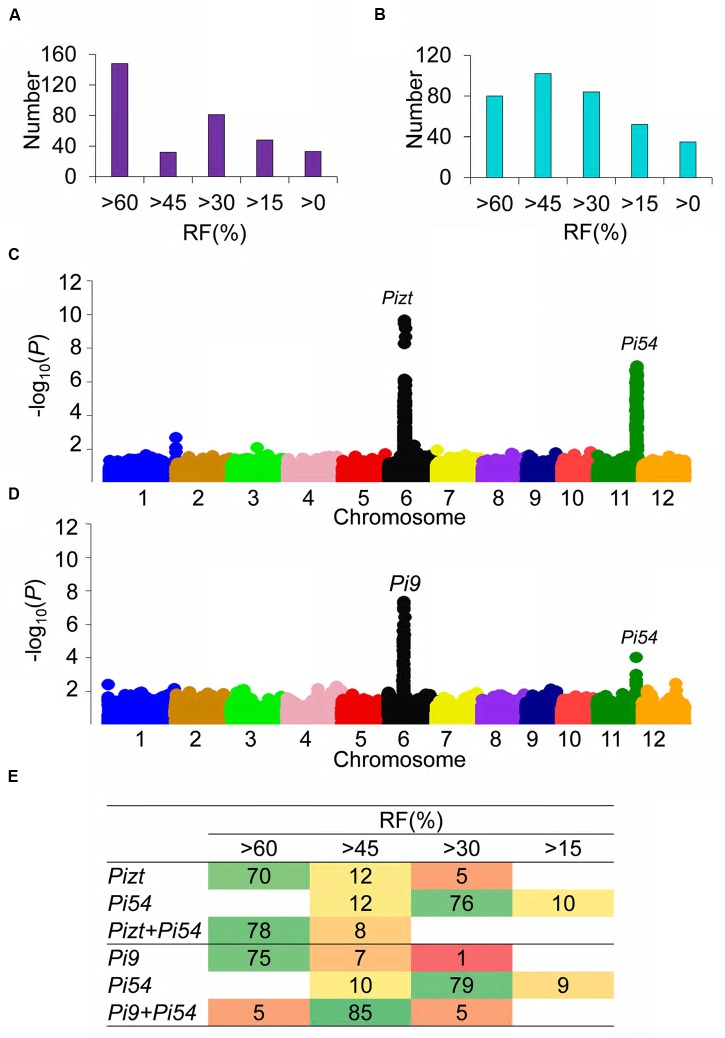
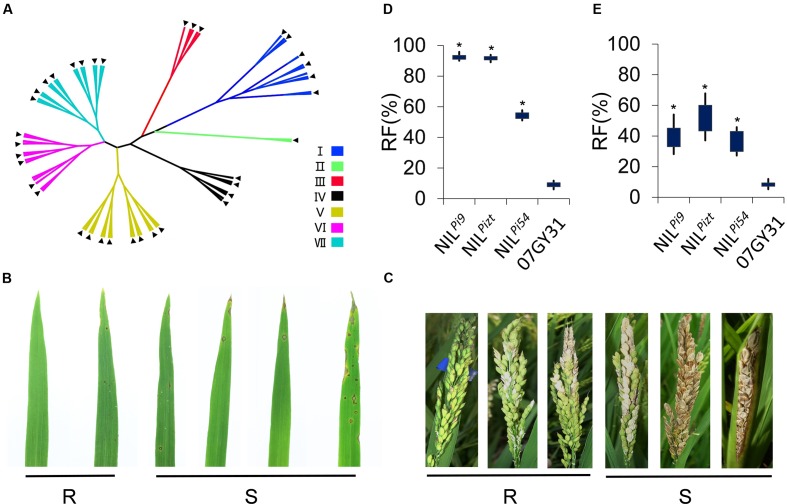
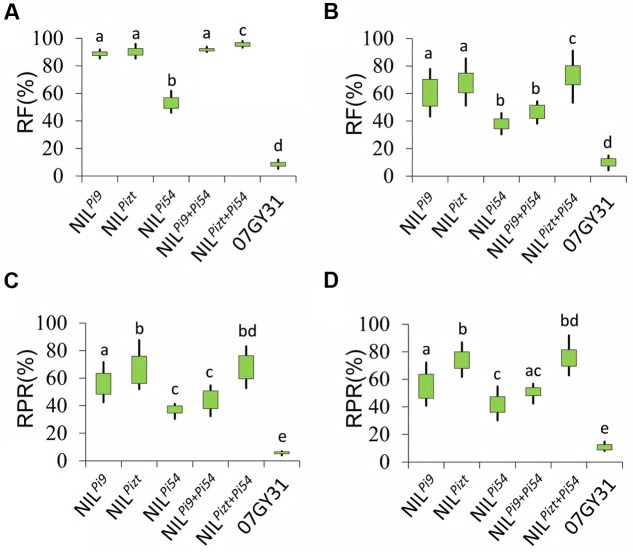
Rice blast, caused by the fungal pathogen , is a major constraint to rice production worldwide. In this study, we developed monogenic near-isogenic lines (NILs) NIL , NIL , and NIL carrying genes , , and , respectively, by marker assisted backcross breeding using 07GY31 as the genetic background with good agronomic traits. Polygene pyramid lines (PPLs) PPL combining with , and PPL combining with were then developed using corresponding NILs with genetic background recovery rates of more than 97%. Compared to 07GY31, the above NILs and PPLs exhibited significantly enhanced resistance frequencies (RFs) for both leaf and panicle blasts. RFs of both PPLs for leaf blast were somewhat higher than those of their own parental NILs, respectively, and PPL exhibited higher RF for panicle blast than NIL and NIL ( < 0.001), hinting an additive effect on the resistance. However, PPL exhibited lower RF for panicle blast than NIL ( < 0.001), failing to realize an additive effect. PPL showed higher resistant level for panicle blast and better additive effects on the resistance than PPL . It was suggested that major R genes interacted with each other in a way more complex than additive effect in determining panicle blast resistance levels. Genotyping by sequencing analysis and extreme-phenotype genome-wide association study further confirmed the above results. Moreover, data showed that pyramiding multiple resistance genes did not affect the performance of basic agronomic traits. So the way to enhance levels of leaf and panicle blast resistances for rice breeding in this study is effective and may serve as a reference for breeders. Resistant levels of rice blast is resulted from different combinations of major R genes, PPL showed higher resistant level and better additive effects on the panicle blast resistance than PPL .
由真菌病原体引起的稻瘟病是全球水稻生产的主要限制因素。在本研究中,我们以农艺性状优良的07GY31为遗传背景,通过标记辅助回交育种,分别培育出携带基因、和的单基因近等基因系(NILs)NIL、NIL和NIL。然后,利用相应的NILs培育出基因聚合系(PPLs)PPL(将与聚合)和PPL(将与聚合),其遗传背景恢复率超过97%。与07GY31相比,上述NILs和PPLs对叶瘟和穗瘟的抗性频率(RFs)均显著提高。两个PPLs的叶瘟RFs分别略高于其亲本NILs,且PPL的穗瘟RF高于NIL和NIL(<0.001),表明存在抗性加性效应。然而,PPL的穗瘟RF低于NIL(<0.001),未实现加性效应。PPL对穗瘟的抗性水平高于PPL,且在抗性上具有更好的加性效应。这表明在决定穗瘟抗性水平时,主要抗性基因之间的相互作用方式比加性效应更为复杂。测序分析基因分型和极端表型全基因组关联研究进一步证实了上述结果。此外,数据表明聚合多个抗性基因不会影响基本农艺性状的表现。因此,本研究中提高水稻叶瘟和穗瘟抗性水平的方法是有效的,可为育种者提供参考。稻瘟病的抗性水平源于主要抗性基因的不同组合,PPL对穗瘟的抗性水平高于PPL,且在穗瘟抗性上具有更好的加性效应。