Wu Yunyu, Xiao Ning, Chen Yu, Yu Ling, Pan Cunhong, Li Yuhong, Zhang Xiaoxiang, Huang Niansheng, Ji Hongjuan, Dai Zhengyuan, Chen Xijun, Li Aihong
Lixiahe Agricultural Research Institute of Jiangsu Province, Yangzhou, 225009, China.
Jiangsu Key Laboratory of Crop Genomics and Molecular Breeding, Yangzhou University, Yangzhou, 225009, China.
Rice (N Y). 2019 Mar 1;12(1):11. doi: 10.1186/s12284-019-0264-3.
Broad-spectrum resistance gene pyramiding helps the development of varieties with broad-spectrum and durable resistance to M. oryzae. However, detailed information about how these different sources of broad-spectrum resistance genes act together or what are the best combinations to achieve broad-spectrum and durable resistance is limited.
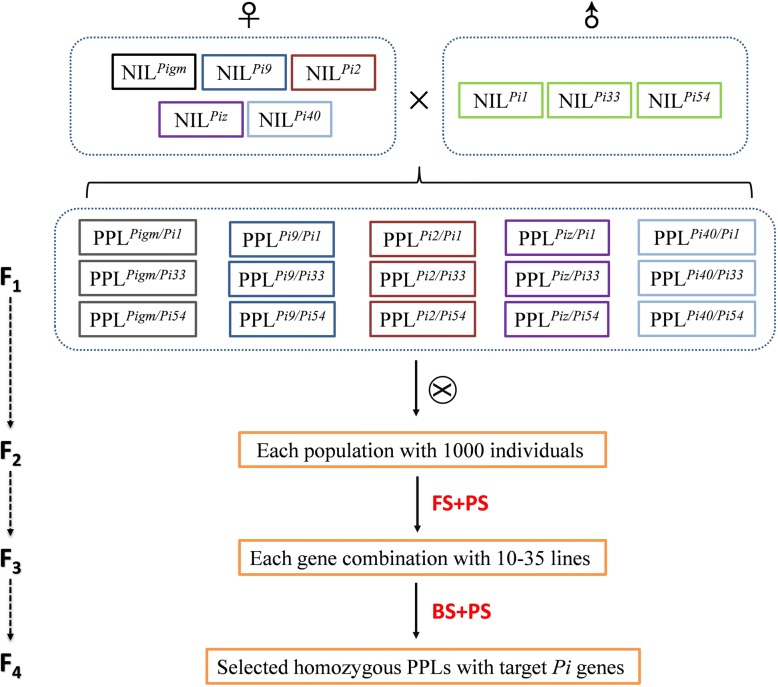
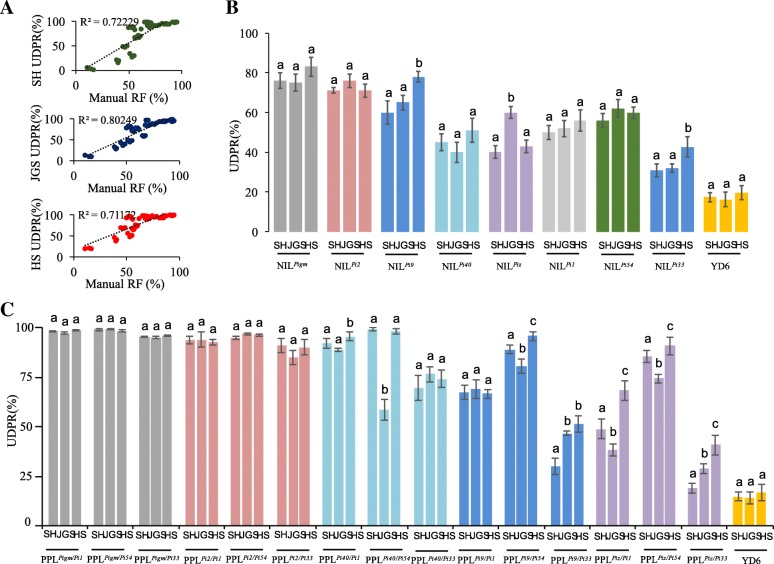
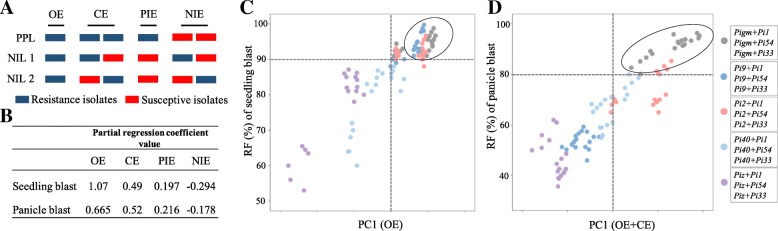
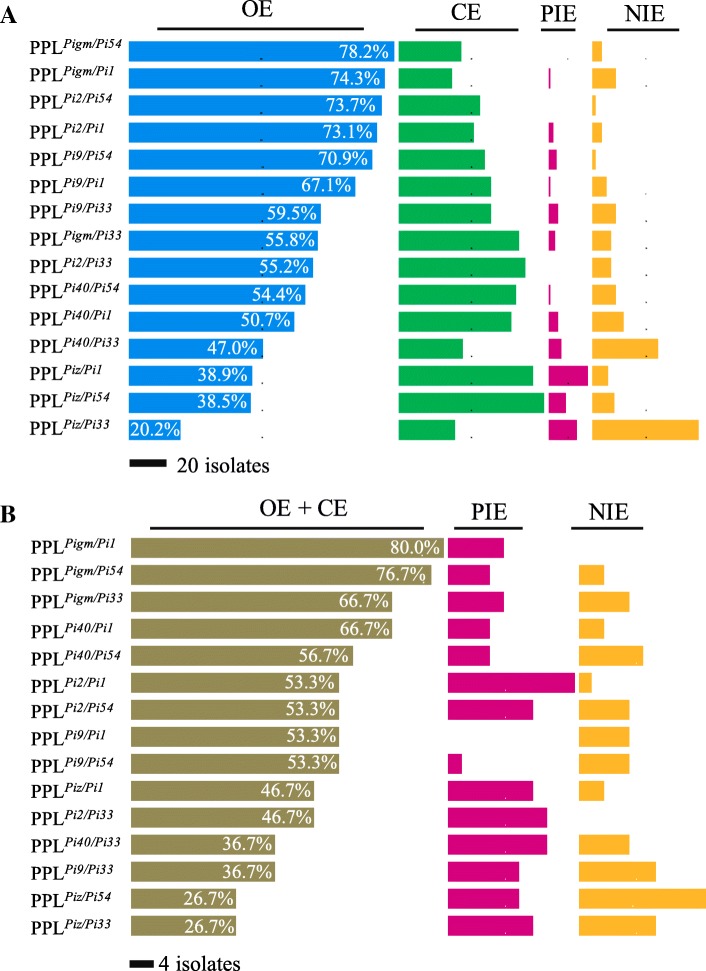
Here a set of fifteen different polygene pyramiding lines (PPLs) were constructed using marker-assisted selection (MAS). Using artificial inoculation assays at seedling and heading stage, combined with natural induction identification under multiple field environments, we evaluated systematically the resistance effects of different alleles of Piz locus (Pigm, Pi40, Pi9, Pi2 and Piz) combined with Pi1, Pi33 and Pi54, respectively, and the interaction effects between different R genes. The results showed that the seedling blast and panicle blast resistance levels of PPLs were significantly higher than that of monogenic lines. The main reason was that most of the gene combinations produced transgressive heterosis, and the transgressive heterosis for panicle blast resistance produced by most of PPLs was higher than that of seedling blast resistance. Different gene pyramiding with broad-spectrum R gene produced different interaction effects, among them, the overlapping effect (OE) between R genes could significantly improve the seedling blast resistance level of PPLs, while the panicle blast resistance of PPLs were remarkably correlated with OE and complementary effect (CE). In addition, we found that gene combinations, Pigm/Pi1, Pigm/Pi54 and Pigm/Pi33 displayed broad-spectrum resistance in artificial inoculation at seedling and heading stage, and displayed stable broad-spectrum resistance under different disease nursery. Besides, agronomic traits evaluation also showed PPLs with these three gene combinations were at par to the recurrent parent. Therefore, it would provide elite gene combination model and germplasms for rice blast resistance breeding program.
The development of PPLs and interaction effect analysis in this study provides valuable theoretical foundation and innovative resources for breeding broad-spectrum and durable resistant varieties.
广谱抗性基因聚合有助于培育对稻瘟病菌具有广谱持久抗性的品种。然而,关于这些不同来源的广谱抗性基因如何共同作用,或者实现广谱持久抗性的最佳组合是什么,相关详细信息有限。
本研究利用标记辅助选择(MAS)构建了15个不同的多基因聚合系(PPL)。通过在苗期和抽穗期进行人工接种试验,并结合多田间环境下的自然诱发鉴定,我们系统评估了Piz位点(Pigm、Pi40、Pi9、Pi2和Piz)的不同等位基因分别与Pi1、Pi33和Pi54组合后的抗性效应,以及不同抗性基因之间的互作效应。结果表明,PPL的苗期稻瘟病和穗颈瘟抗性水平显著高于单基因系。主要原因是大多数基因组合产生了超亲杂种优势,且大多数PPL产生的穗颈瘟抗性超亲杂种优势高于苗期稻瘟病抗性。不同的广谱抗性基因聚合产生了不同的互作效应,其中,抗性基因之间的重叠效应(OE)可显著提高PPL的苗期稻瘟病抗性水平,而PPL的穗颈瘟抗性与OE和互补效应(CE)显著相关。此外,我们发现基因组合Pigm/Pi1、Pigm/Pi54和Pigm/Pi33在苗期和抽穗期人工接种时表现出广谱抗性,在不同病圃条件下表现出稳定的广谱抗性。此外,农艺性状评价还表明,具有这三种基因组合的PPL与轮回亲本相当。因此,可为水稻抗稻瘟病育种计划提供优良的基因组合模式和种质资源。
本研究中PPL的构建及互作效应分析为培育广谱持久抗性品种提供了有价值的理论基础和创新资源。