Jiang Jiefeng, Mou Tongmin, Yu Huihui, Zhou Fasong
National Key Laboratory of Crop Genetic Improvement, National Center of Plant Gene Research (Wuhan), Huazhong Agricultural University, Wuhan, 430070 China.
Life Science and Technology Center, China National Seed Group Co., Ltd., Wuhan, 430206 China.
Rice (N Y). 2015 Feb 12;8:11. doi: 10.1186/s12284-015-0048-3. eCollection 2015.
Blast disease caused by the fungal pathogen Magnaporthe oryzae is one of the big problems in rice production in China, especially for high yield hybrid varieties made from a two-line system in which thermo-sensitive genic male sterile (TGMS) lines are used. In this study, we report the introgression of a rice blast resistance gene Pi2 from VE6219 into C815S, an elite rice TGMS line, leading to the development of blast resistant TGMS lines through marker assisted selection (MAS) and phenotypic selection approaches.
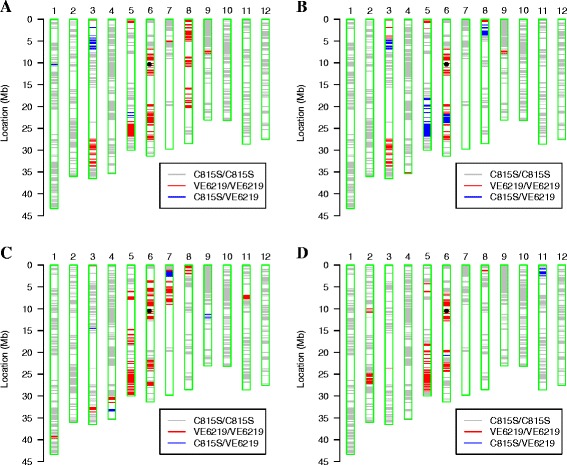
Four new TGMS lines with blast resistance gene Pi2 were developed from C815S (an elite TGMS line susceptible to the blast, used as recurrent parent) and VE6219 (a blast resistant line harboring Pi2, used as donor parent). The pathogenicity assays inoculated with 53 blast prevalent isolates in glasshouse showed that the blast resistant frequency of the four TGMS lines was 94.3%-98.1% that is equivalent to blast resistant donor parent VE6219. The field evaluation of the new lines and hybrids made from them at a blast epidemic site also showed high resistant levels against the blast. The genetic background of the newly developed TGMS lines were examined using a whole-genome single nucleotide polymorphism (SNP) array (RICE6K) that turned out more than 83% of the genomic markers were derived from the recurrent parent. The critical temperature points of fertility-sterility alteration of the new TGMS lines were between 22°C and 23°C of daily mean temperature, which is similar to that of C815S. The complete male sterility under natural growth conditions at Wuhan last more than 80 days. Their agronomic and grain quality traits meet the requirement for two-line hybrid rice production.
The broad-spectrum and durable rice blast resistant gene Pi2 was introgressed into the elite TGMS line C815S background. The newly developed TGMS lines can be practically used for two-line hybrid rice breeding and must play an important role in sustainable rice production in China.
由真菌病原体稻瘟病菌引起的稻瘟病是中国水稻生产中的重大问题之一,对于使用温敏核不育(TGMS)系的两系法高产杂交品种而言尤为如此。在本研究中,我们报道了将水稻抗稻瘟病基因Pi2从VE6219导入优良水稻TGMS系C815S,通过标记辅助选择(MAS)和表型选择方法培育出抗稻瘟病的TGMS系。
以C815S(一个对稻瘟病敏感的优良TGMS系,用作轮回亲本)和VE6219(一个携带Pi2的抗稻瘟病系,用作供体亲本)为材料,培育出了四个带有抗稻瘟病基因Pi2的新TGMS系。温室中用53个稻瘟病流行菌株接种的致病性测定表明,这四个TGMS系的抗稻瘟病频率为94.3%-98.1%,与抗稻瘟病供体亲本VE6219相当。在稻瘟病流行地点对新系及其杂交种进行的田间评估也显示出对稻瘟病的高抗性水平。使用全基因组单核苷酸多态性(SNP)阵列(RICE6K)对新培育的TGMS系的遗传背景进行检测,结果表明超过83%的基因组标记来自轮回亲本。新TGMS系育性转换的临界温度点在日平均温度22°C至23°C之间,与C815S相似。在武汉自然生长条件下,完全雄性不育持续80多天。它们的农艺和品质性状符合两系杂交水稻生产的要求。
广谱且持久的水稻抗稻瘟病基因Pi2被导入优良TGMS系C815S背景中。新培育的TGMS系可实际用于两系杂交水稻育种,必将在中国水稻可持续生产中发挥重要作用。