Department of Health Sciences and Interdisciplinary Research Center of Autoimmune Diseases (IRCAD), "A. Avogadro" University of Piemonte Orientale (UPO), Novara, Italy.
Biocenter, Division for Experimental Pathophysiology and Immunology, Laboratory of Autoimmunity, Medical University of Innsbruck, Innsbruck, Austria.
J Immunol Res. 2016;2016:7675437. doi: 10.1155/2016/7675437. Epub 2016 Dec 20.
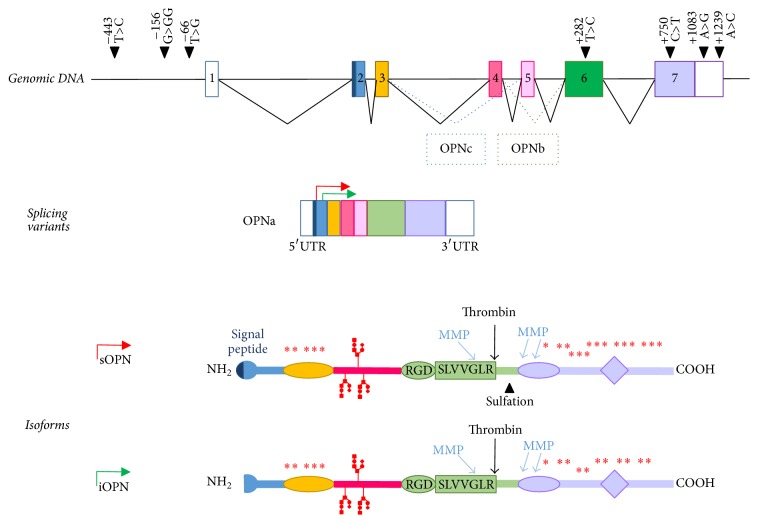
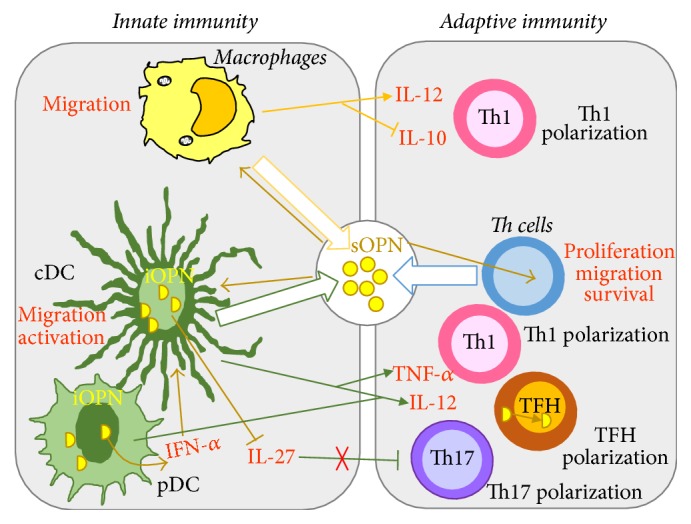
Osteopontin (OPN) regulates the immune response at multiple levels. Physiologically, it regulates the host response to infections by driving T helper (Th) polarization and acting on both innate and adaptive immunity; pathologically, it contributes to the development of immune-mediated and inflammatory diseases. In some cases, the mechanisms of these effects have been described, but many aspects of the OPN function remain elusive. This is in part ascribable to the fact that OPN is a complex molecule with several posttranslational modifications and it may act as either an immobilized protein of the extracellular matrix or a soluble cytokine or an intracytoplasmic molecule by binding to a wide variety of molecules including crystals of calcium phosphate, several cell surface receptors, and intracytoplasmic molecules. This review describes the OPN structure, isoforms, and functions and its role in regulating the crosstalk between innate and adaptive immunity in autoimmune diseases.
骨桥蛋白 (OPN) 在多个层面上调节免疫反应。在生理上,它通过驱动辅助性 T 细胞 (Th) 极化并作用于先天免疫和适应性免疫来调节宿主对感染的反应;在病理上,它有助于免疫介导和炎症性疾病的发展。在某些情况下,这些作用的机制已经被描述,但 OPN 功能的许多方面仍然难以捉摸。这部分归因于 OPN 是一种具有多种翻译后修饰的复杂分子,它可以作为细胞外基质的固定蛋白或可溶性细胞因子,或者通过与包括磷酸钙晶体、几种细胞表面受体和细胞内分子在内的多种分子结合而作为细胞内分子发挥作用。这篇综述描述了 OPN 的结构、异构体和功能,以及它在调节自身免疫性疾病中先天免疫和适应性免疫之间的串扰中的作用。