a Genetics Unit , IRCCS "Centro S. Giovanni di Dio" Fatebenefratelli , Brescia , Italy.
b Departments of Psychiatry and of Neuroscience and Physiology , SUNY Upstate Medical University , Syracuse , NY , USA ; Department of Biomedicine, K.G. Jebsen Centre for Research on Neuropsychiatric Disorders, University of Bergen, Bergen, Norway.
World J Biol Psychiatry. 2018 Mar;19(2):80-100. doi: 10.1080/15622975.2017.1282175. Epub 2017 Feb 24.
Elucidating the biological mechanisms involved in attention-deficit/hyperactivity disorder (ADHD) has been challenging. Relatively unexplored is the fact that these mechanisms can differ with age.
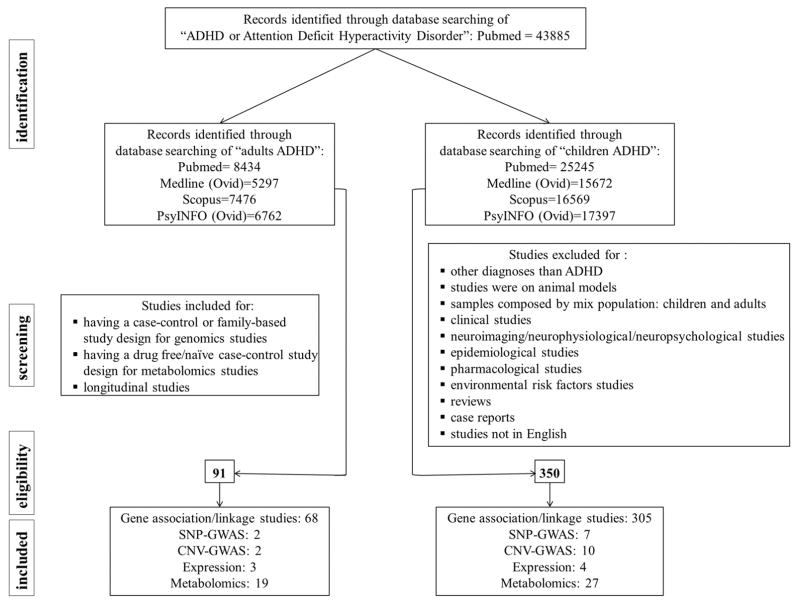
We present an overview on the major differences between children and adults with ADHD, describing several studies from genomics to metabolomics performed in ADHD children and in adults (cADHD and aADHD, respectively). A systematic search (up until February 2016) was conducted.
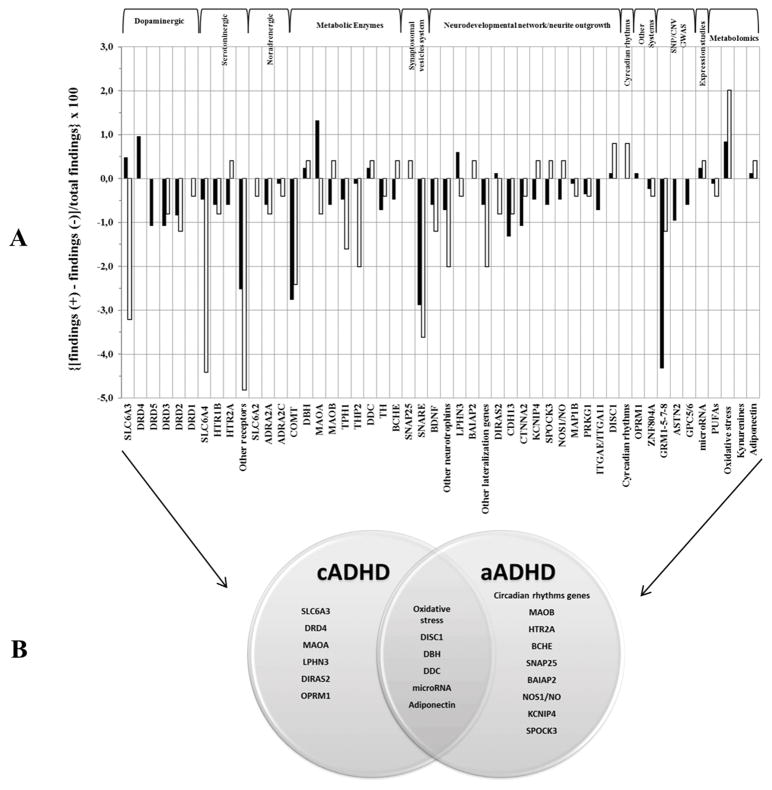
From a PRISMA flow-chart, a total of 350 and 91 genomics and metabolomics studies were found to be elligible for cADHD and aADHD, respectively. For children, associations were found for genes belonging to dopaminergic (SLC6A3, DRD4 and MAOA) and neurodevelopmental (LPHN3 and DIRAS2) systems and OPRM1 (Yates corrected P = 0.016; OR = 2.27 95%CI: 1.15-4.47). Studies of adults have implicated circadian rhythms genes, HTR2A, MAOB and a more generic neurodevelopmental/neurite outgrowth network (BCHE, SNAP25, BAIAP2, NOS1/NO, KCNIP4 and SPOCK3; Yates corrected P = 0.007; OR = 3.30 95%CI: 1.33-8.29). In common among cADHD and aADHD, the most significant findings are for oxidative stress proteins (MAD, SOD, PON1, ARES, TOS, TAS and OSI), and, in the second level, DISC1, DBH, DDC, microRNA and adiponectin.
Through a convergent functional genomics, this review contributes to clarification of which genetic/biological mechanisms differ with age. The effects of some genes do not change throughout the lifetime, whereas others are linked to age-specific stages. Additional research and further studies are needed to generate firmer conclusions that might someday be useful for predicting the remission and persistence of the disorder. Despite the limitations, some of these genes/proteins could be potential useful biomarkers to discriminate cADHD from aADHD.
阐明注意缺陷多动障碍(ADHD)的生物学机制一直具有挑战性。相对较少被探索的是,这些机制可能因年龄而异。
我们介绍了儿童和成人 ADHD 之间的主要差异概述,描述了在 ADHD 儿童和成人(分别为 cADHD 和 aADHD)中进行的从基因组学到代谢组学的几项研究。进行了系统搜索(截至 2016 年 2 月)。
从 PRISMA 流程图中,共发现 350 项和 91 项基因组学和代谢组学研究分别适合 cADHD 和 aADHD。对于儿童,与多巴胺能(SLC6A3、DRD4 和 MAOA)和神经发育(LPHN3 和 DIRAS2)系统以及 OPRM1 相关的基因发现了关联(Yates 校正 P = 0.016;OR = 2.27 95%CI:1.15-4.47)。成人研究表明涉及昼夜节律基因、HTR2A、MAOB 和更通用的神经发育/神经突生长网络(BCHE、SNAP25、BAIAP2、NOS1/NO、KCNIP4 和 SPOCK3;Yates 校正 P = 0.007;OR = 3.30 95%CI:1.33-8.29)。在 cADHD 和 aADHD 之间共同的是,最显著的发现是氧化应激蛋白(MAD、SOD、PON1、ARES、TOS、TAS 和 OSI),其次是 DISC1、DBH、DDC、microRNA 和脂联素。
通过收敛性功能基因组学,本综述有助于阐明哪些遗传/生物学机制随年龄而变化。一些基因的作用不会随时间而改变,而另一些则与特定年龄阶段相关。需要进一步的研究来得出更确定的结论,这些结论有朝一日可能有助于预测该疾病的缓解和持续存在。尽管存在局限性,但这些基因/蛋白质中的一些可能是区分 cADHD 和 aADHD 的潜在有用生物标志物。