Benmira Amir M, Perez-Martin Antonia, Coudray Sarah, Schuster Iris, Aichoun Isabelle, Laurent Jérémy, Bereski-Reguig Fethi, Dauzat Michel
aVascular Medicine and Laboratory, Nîmes University Hospital, Nîmes, France bBiomedical Engineering Laboratory, Faculty of Technology, Aboubekr Belkaid University, Tlemcen, Algeria cResearch Unit (Female characteristics of dysfunctions of vascular interfaces), Montpellier University, Montpellier, France.
J Hypertens. 2017 May;35(5):1002-1010. doi: 10.1097/HJH.0000000000001252.
Noninvasive blood pressure (BP) measurement is essential for the study of human physiology but automatic oscillometric devices only estimate SBP and DBP using various, undisclosed algorithms, precluding standardization and interchangeability. We propose a novel approach by tracking, during pneumatic cuff deflation, the time interval from the foot to the apex of the systolic peak of the oscillometric signal, which reaches a maximum concomitant with the first Korotkoff sound.
In 145 study participants and patients (group 1), we measured the systolic brachial artery blood pressure by Korotkoff sound recording, conventional oscillometry, and our fully automated systolic peak foot-to-apex time interval (SFATI) technique. In 35 other patients (group 2), we compared SFATI with intra-arterial measurement.
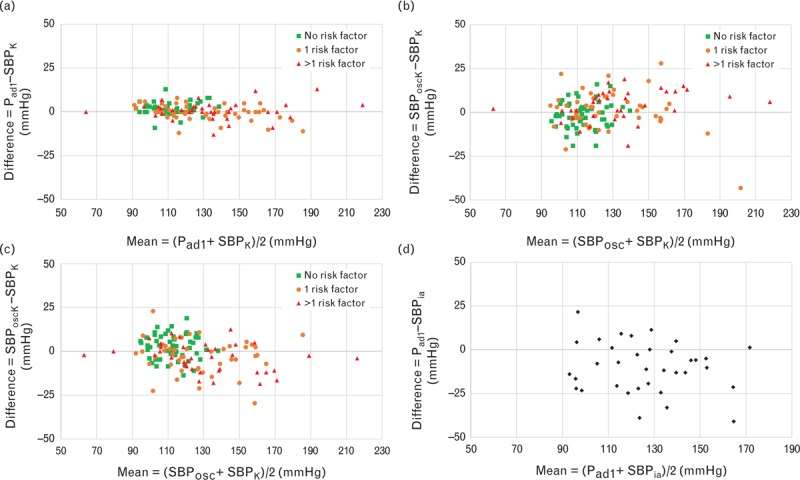
In group 1, the concordance correlation coefficient was 0.989 and 0.984 between SFATI and Korotkoff sounds, 0.884 and 0.917 between oscillometry and Korotkoff sounds, and 0.882 and 0.919 between SFATI and oscillometry, respectively, on the left and right arm. In group 2, it was 0.72 between SFATI and intra-arterial measurement, 0.67 between oscillometry and intra-arterial measurement, and 0.92 between SFATI and Korotkoff sounds. In 40 study participants, the reproducibility study yielded a concordance coefficient of 0.95 for SFATI and 0.94 for Korotkoff sounds.
SFATI BP measurement shows an excellent concordance with the auscultatory technique, offering a major improvement over current oscillometric techniques and allowing standardization.
无创血压测量对于人体生理学研究至关重要,但自动示波法设备仅使用各种未公开的算法来估计收缩压和舒张压,这妨碍了标准化和互换性。我们提出了一种新方法,即在气袖放气过程中,追踪示波信号收缩期峰值从起始点到顶点的时间间隔,该时间间隔在第一柯氏音出现时达到最大值。
在145名研究参与者和患者(第1组)中,我们通过柯氏音记录、传统示波法以及我们的全自动收缩期峰值起始点到顶点时间间隔(SFATI)技术测量肱动脉收缩压。在另外35名患者(第2组)中,我们将SFATI与动脉内测量进行了比较。
在第1组中,左臂和右臂的SFATI与柯氏音之间的一致性相关系数分别为0.989和0.984,示波法与柯氏音之间为0.884和0.917,SFATI与示波法之间为0.882和0.919。在第2组中,SFATI与动脉内测量之间为0.72,示波法与动脉内测量之间为0.67,SFATI与柯氏音之间为0.92。在40名研究参与者中,重复性研究得出SFATI的一致性系数为0.95,柯氏音为0.94。
SFATI血压测量与听诊技术显示出极佳的一致性,相较于当前的示波法技术有重大改进,并实现了标准化。