Stiegel Stephanie, Entling Martin H, Mantilla-Contreras Jasmin
University of Hildesheim, Institute of Biology and Chemistry, Ecology and Environmental Education Group, Hildesheim, Germany.
University of Koblenz-Landau, Department of Ecosystem Analysis, Landau, Germany.
PLoS One. 2017 Jan 18;12(1):e0169741. doi: 10.1371/journal.pone.0169741. eCollection 2017.
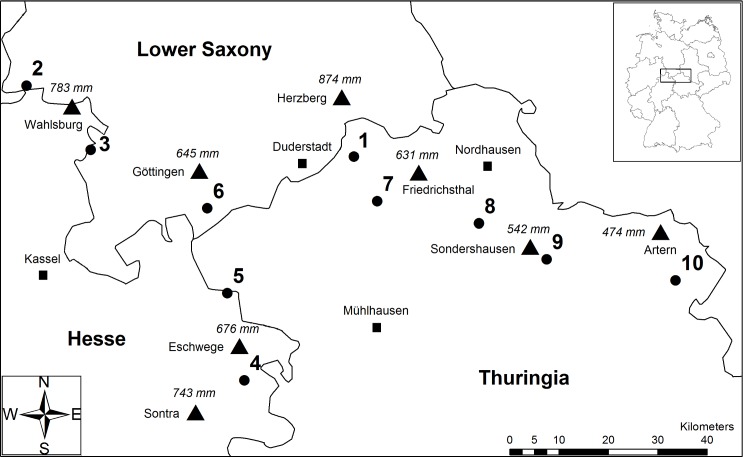
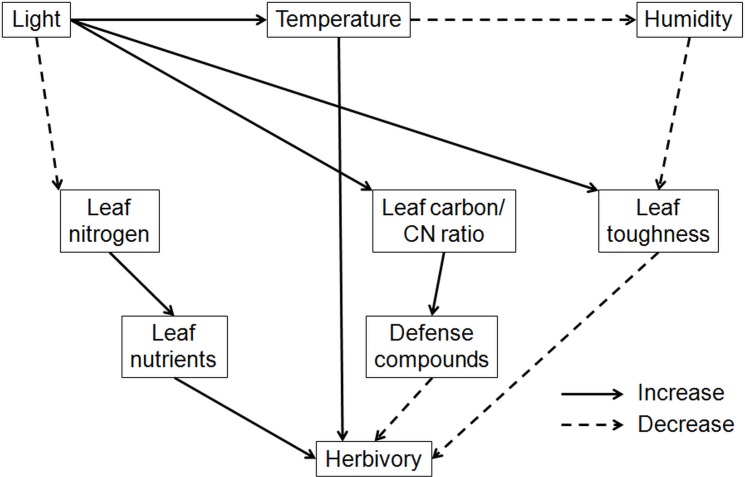
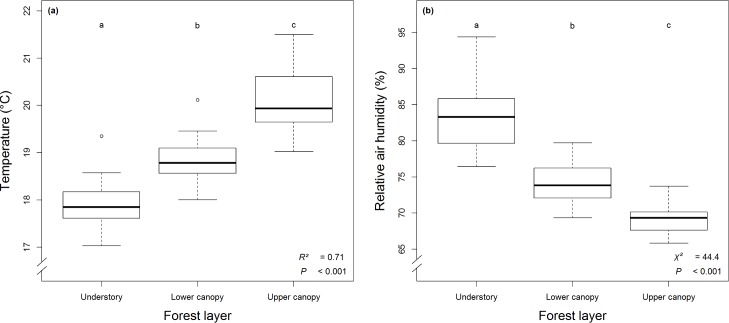
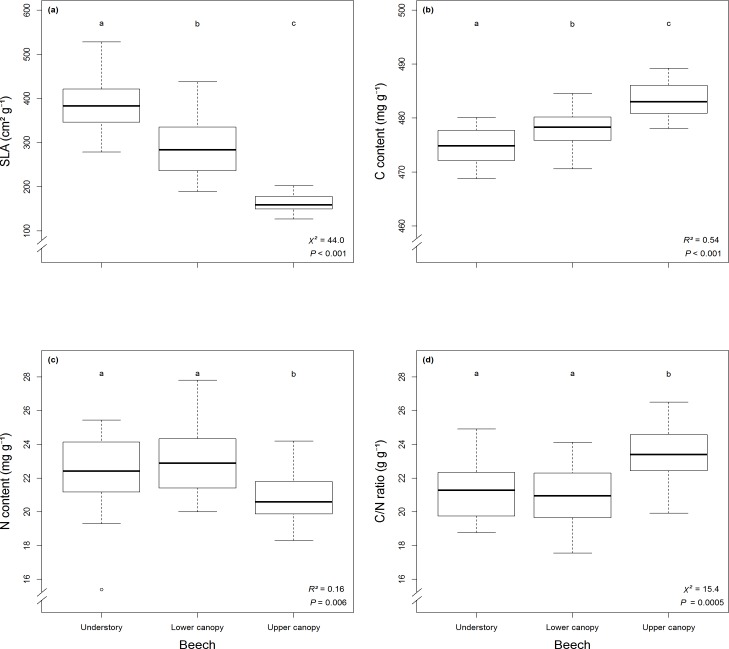
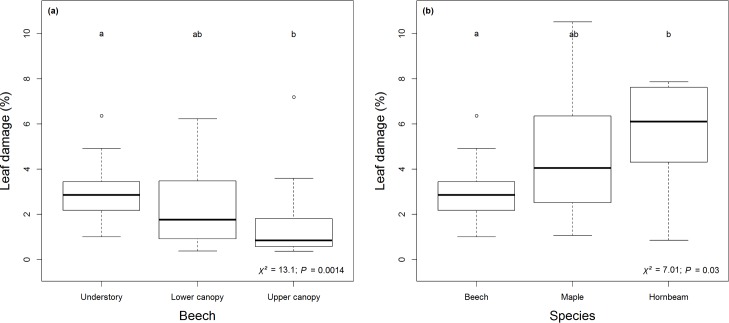
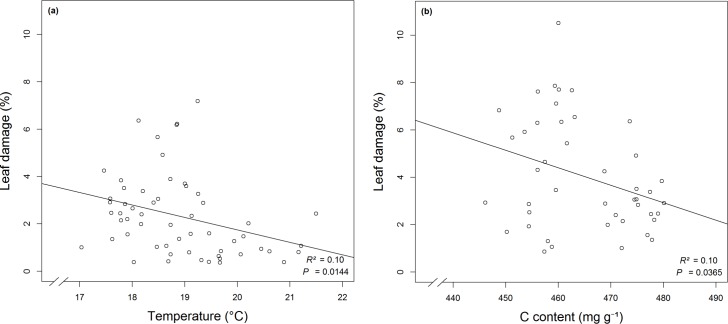
Microclimate in different positions on a host plant has strong direct effects on herbivores. But little is known about indirect effects due to changes of leaf traits. We hypothesized that herbivory increases from upper canopy to lower canopy and understory due to a combination of direct and indirect pathways. Furthermore, we hypothesized that herbivory in the understory differs between tree species in accordance with their leaf traits. We investigated herbivory by leaf chewing insects along the vertical gradient of mixed deciduous forest stands on the broad-leaved tree species Fagus sylvatica L. (European beech) with study sites located along a 140 km long transect. Additionally, we studied juvenile Acer pseudoplatanus L. (sycamore maple) and Carpinus betulus L. (hornbeam) individuals within the understory as a reference of leaf traits in the same microclimate. Lowest levels of herbivory were observed in upper canopies, where temperatures were highest. Temperature was the best predictor for insect herbivory across forest layers in our study. However, the direction was opposite to the generally known positive relationship. Herbivory also varied between the three tree species with lowest levels for F. sylvatica. Leaf carbon content was highest for F. sylvatica and probably indicates higher amounts of phenolic defense compounds. We conclude that the effect of temperature must have been indirect, whereby the expected higher herbivory was suppressed due to unfavorable leaf traits (lower nitrogen content, higher toughness and carbon content) of upper canopy leaves compared to the understory.
寄主植物不同位置的微气候对食草动物有强烈的直接影响。但对于因叶片性状变化而产生的间接影响却知之甚少。我们假设,由于直接和间接途径的综合作用,食草率从树冠上层到下层以及林下会增加。此外,我们假设林下的食草率会因树种的叶片性状不同而有所差异。我们沿着落叶阔叶林垂直梯度,对阔叶树种欧洲山毛榉(Fagus sylvatica L.)上的食叶昆虫的食草情况进行了调查,研究地点位于一条140公里长的样带上。此外,我们还研究了林下的青杄(Acer pseudoplatanus L.)和欧洲鹅耳枥(Carpinus betulus L.)幼树,作为相同微气候下叶片性状的参考。在温度最高的树冠上层观察到最低的食草率。在我们的研究中,温度是不同森林层次昆虫食草情况的最佳预测指标。然而,其趋势与普遍认为的正相关关系相反。三种树种之间的食草率也有所不同,欧洲山毛榉的食草率最低。欧洲山毛榉的叶片碳含量最高,这可能表明其酚类防御化合物含量较高。我们得出结论,温度的影响一定是间接的,与林下相比,树冠上层叶片不利的叶片性状(较低的氮含量、较高的韧性和碳含量)抑制了预期中较高的食草率。