Luo Jun-Yu, Zhang Shuai, Peng Jun, Zhu Xiang-Zhen, Lv Li-Min, Wang Chun-Yi, Li Chun-Hua, Zhou Zhi-Guo, Cui Jin-Jie
Key Laboratory of Crop Physiological Ecology and Production Management, Ministry of Agriculture, and Department of Agronomy, Nanjing Agricultural University, Nanjing, Jiangsu, China.
State Key Laboratory of Cotton Biology, Institute of Cotton Research, Chinese Academy of Agricultural Sciences, Anyang, Henan, China.
PLoS One. 2017 Jan 18;12(1):e0170379. doi: 10.1371/journal.pone.0170379. eCollection 2017.
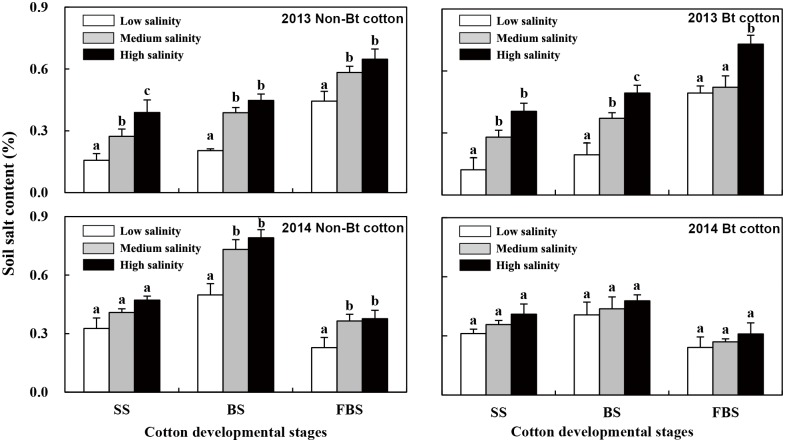
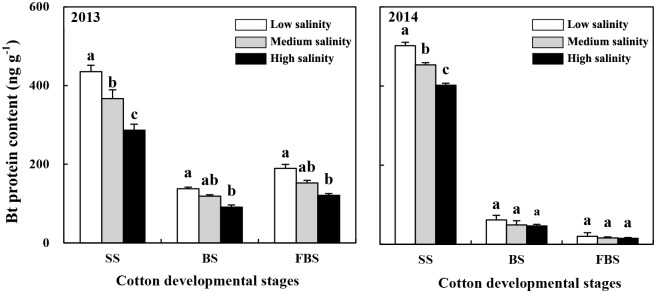
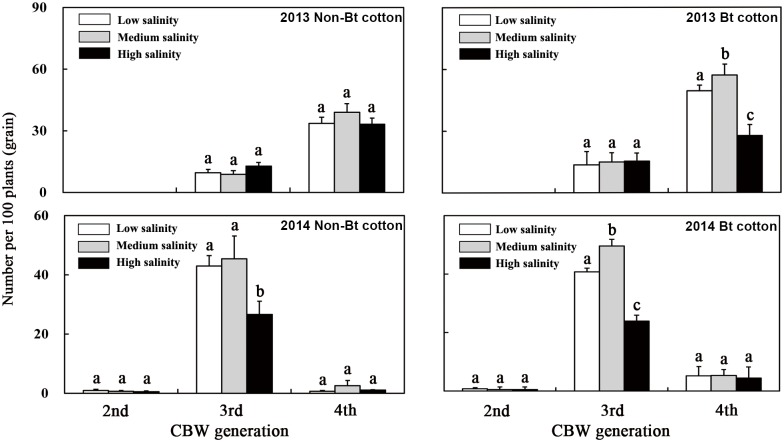
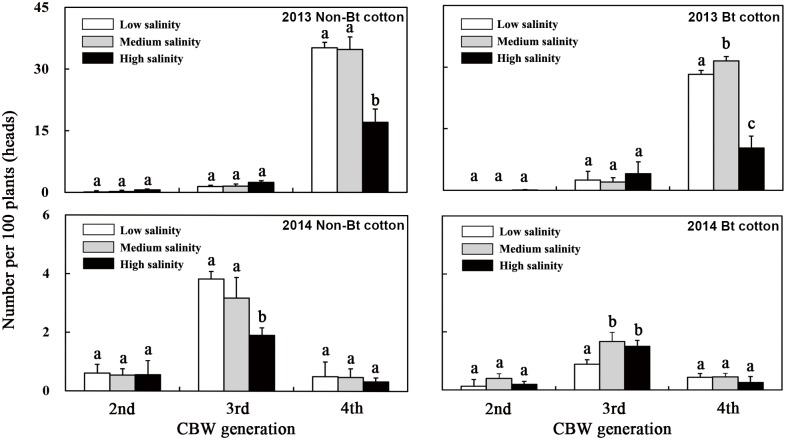
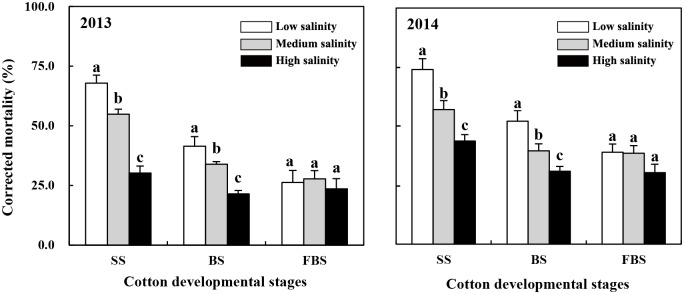
An increasing area of transgenic Bacillus thuringiensis (Bt) cotton is being planted in saline-alkaline soil in China. The Bt protein level in transgenic cotton plants and its control efficiency can be affected by abiotic stress, including high temperature, water deficiency and other factors. However, how soil salinity affects the expression of Bt protein, thus influencing the control efficiency of Bt cotton against the cotton bollworm (CBW) Helicoverpa armigera (Hübner) in the field, is poorly understood. Our objective in the present study was to investigate the effects of soil salinity on the expression of Bt toxin (Cry1Ac) and the control efficiency of Helicoverpa armigera in field-grown transgenic Bt cotton using three natural saline levels (1.15 dS m-1 [low soil-salinity], 6.00 dS m-1 [medium soil-salinity] and 11.46 dS m-1 [high soil-salinity]). We found that the Bt protein content in the transgenic Bt cotton leaves and the insecticidal activity of Bt cotton against CBW decreased with the increasing soil salinity in laboratory experiments during the growing season. The Bt protein content of Bt cotton leaves in the laboratory were negatively correlated with the salinity level. The CBW populations were highest on the Bt cotton grown in medium-salinity soil instead of the high-salinity soil in field conditions. A possible mechanism may be that the relatively high-salinity soil changed the plant nutritional quality or other plant defensive traits. The results from this study may help to identify more appropriate practices to control CBW in Bt cotton fields with different soil salinity levels.
中国转基因苏云金芽孢杆菌(Bt)棉花的种植面积在盐碱地中不断增加。转基因棉花植株中的Bt蛋白水平及其防治效果可能会受到非生物胁迫的影响,包括高温、缺水等因素。然而,土壤盐分如何影响Bt蛋白的表达,进而影响Bt棉花在田间对棉铃虫(CBW)棉铃虫(Hübner)的防治效果,目前尚不清楚。我们在本研究中的目的是利用三种自然盐度水平(1.15 dS m-1[低土壤盐度]、6.00 dS m-1[中土壤盐度]和11.46 dS m-1[高土壤盐度]),研究土壤盐分对田间种植的转基因Bt棉花中Bt毒素(Cry1Ac)表达及棉铃虫防治效果的影响。我们发现,在生长季节的实验室实验中,转基因Bt棉花叶片中的Bt蛋白含量以及Bt棉花对棉铃虫的杀虫活性随着土壤盐分的增加而降低。实验室中Bt棉花叶片的Bt蛋白含量与盐度水平呈负相关。在田间条件下,中盐度土壤种植的Bt棉花上的棉铃虫种群数量最高,而不是高盐度土壤。一个可能的机制可能是相对高盐度的土壤改变了植物的营养质量或其他植物防御特性。本研究结果可能有助于确定在不同土壤盐度水平的Bt棉田中防治棉铃虫的更合适方法。