Lo Hsin-Yi, Li Tsai-Chung, Yang Tse-Yen, Li Chia-Cheng, Chiang Jen-Huai, Hsiang Chien-Yun, Ho Tin-Yun
Graduate Institute of Chinese Medicine, China Medical University, 91 Hsueh-Shih Road, Taichung, 40402, Taiwan.
Graduate Institute of Biostatistics, China Medical University, Taichung, 40402, Taiwan.
BMC Complement Altern Med. 2017 Jan 18;17(1):53. doi: 10.1186/s12906-017-1578-6.
Diabetes is a serious chronic metabolic disorder. Trichosanthes kirilowii Maxim. (TK) is traditionally used for the treatment of diabetes in traditional Chinese medicine (TCM). However, the clinical application of TK on diabetic patients and the hypoglycemic efficacies of TK are still unclear.
A retrospective cohort study was conducted to analyze the usage of Chinese herbs in patients with type 2 diabetes in Taiwan. Glucose tolerance test was performed to analyze the hypoglycemic effect of TK. Proteomic approach was performed to identify the protein constituents of TK. Insulin receptor (IR) kinase activity assay and glucose tolerance tests in diabetic mice were further used to elucidate the hypoglycemic mechanisms and efficacies of TK.
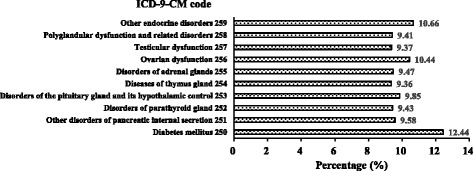
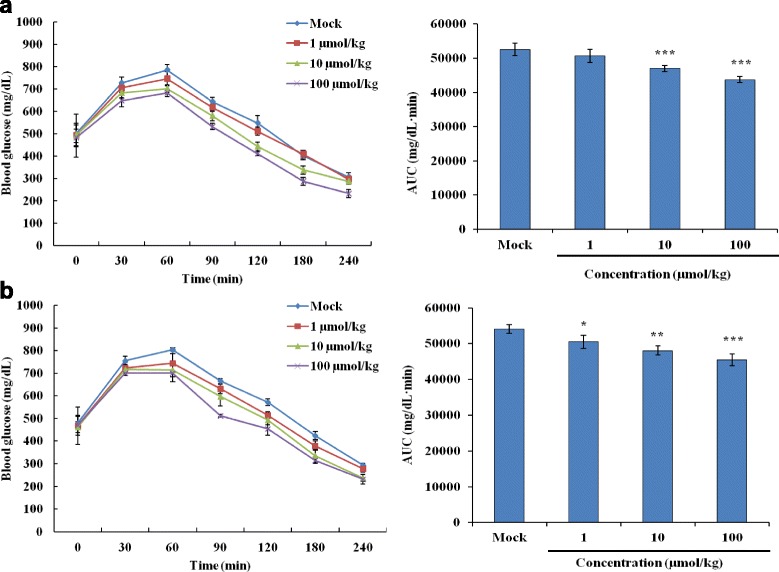
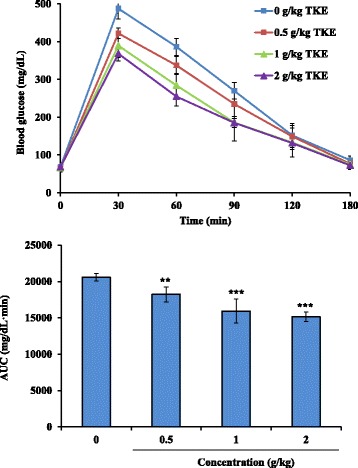
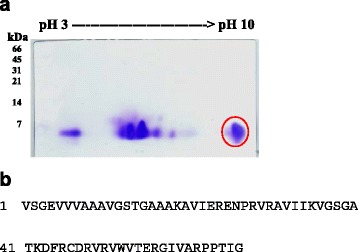
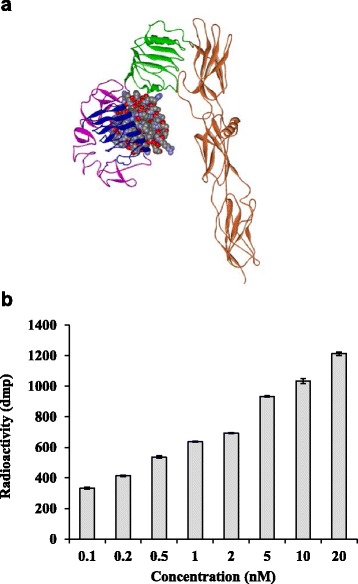
By a retrospective cohort study, we found that TK was the most frequently used Chinese medicinal herb in type 2 diabetic patients in Taiwan. Oral administration of aqueous extract of TK displayed hypoglycemic effects in a dose-dependent manner in mice. An abundant novel TK protein (TKP) was further identified by proteomic approach. TKP interacted with IR by docking analysis and activated the kinase activity of IR. In addition, TKP enhanced the clearance of glucose in diabetic mice in a dose-dependent manner.
In conclusion, this study applied a bed-to-bench approach to elucidate the hypoglycemic efficacies and mechanisms of TK on clinical usage. In addition, we newly identified a hypoglycemic protein TKP from TK. Our findings might provide a reasonable explanation of TK on the treatment of diabetes in TCM.
糖尿病是一种严重的慢性代谢紊乱疾病。中药瓜蒌在传统中医中常用于治疗糖尿病。然而,瓜蒌在糖尿病患者中的临床应用及其降血糖疗效仍不明确。
进行一项回顾性队列研究,分析台湾2型糖尿病患者中药的使用情况。进行葡萄糖耐量试验以分析瓜蒌的降血糖作用。采用蛋白质组学方法鉴定瓜蒌的蛋白质成分。进一步通过胰岛素受体(IR)激酶活性测定和糖尿病小鼠的葡萄糖耐量试验来阐明瓜蒌的降血糖机制和疗效。
通过回顾性队列研究,我们发现瓜蒌是台湾2型糖尿病患者最常用的中药。口服瓜蒌水提取物对小鼠具有剂量依赖性的降血糖作用。通过蛋白质组学方法进一步鉴定出一种丰富的新型瓜蒌蛋白(TKP)。通过对接分析发现TKP与IR相互作用并激活IR的激酶活性。此外,TKP以剂量依赖性方式增强糖尿病小鼠的葡萄糖清除率。
总之,本研究采用从病床到实验室的方法来阐明瓜蒌在临床应用中的降血糖疗效和机制。此外,我们从瓜蒌中新鉴定出一种降血糖蛋白TKP。我们的研究结果可能为瓜蒌在中医治疗糖尿病方面提供合理的解释。