Simmons Rebecca G, Shattuck Dominick C, Jennings Victoria H
Institute for Reproductive Health, Georgetown University, Washington, DC, United States.
JMIR Res Protoc. 2017 Jan 18;6(1):e5. doi: 10.2196/resprot.6886.
Some 222 million women worldwide have unmet needs for contraception; they want to avoid pregnancy, but are not using a contraceptive method, primarily because of concerns about side effects associated with most available methods. Expanding contraceptive options-particularly fertility awareness options that provide women with information about which days during their menstrual cycles they are likely to become pregnant if they have unprotected intercourse-has the potential to reduce unmet need. Making these methods available to women through their mobile phones can facilitate access. Indeed, many fertility awareness applications have been developed for smartphones, some of which are digital platforms for existing methods, requiring women to enter information about fertility signs such as basal body temperature and cervical secretions. Others are algorithms based on (unexplained) calculations of the fertile period of the menstrual cycle. Considering particularly this latter (largely untested) group, it is critical that these apps be subject to the same rigorous research as other contraceptive methods. Dynamic Optimal Timing, available via the Dot app as a free download for iPhone and Android devices, is one such method and the only one that has published the algorithm that forms its basis. It combines historical cycle data with a woman's own personal cycle history, continuing to accrue this information over time to identify her fertile period. While Dot has a theoretical failure rate of only 3 in 100 for preventing pregnancy with perfect use, its effectiveness in typical use has yet to be determined.
The study objective is to assess both perfect and typical use to determine the efficacy of the Dot app for pregnancy prevention.
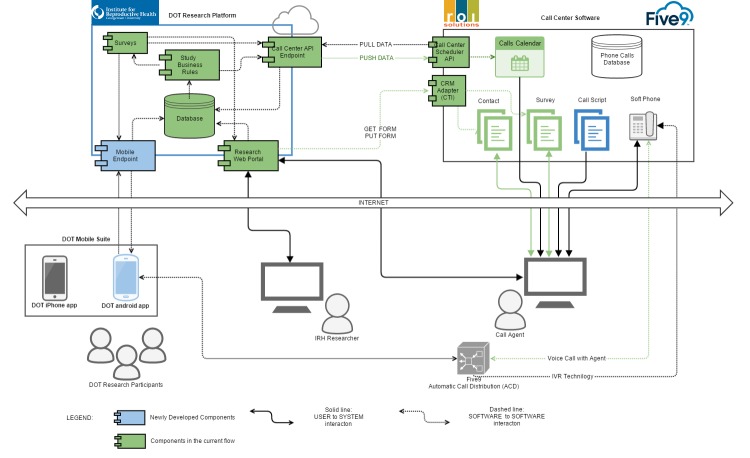
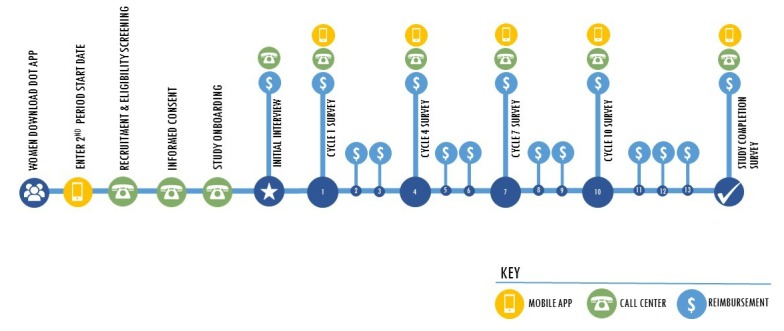
To determine actual use efficacy, the Institute for Reproductive Health is partnering with Cycle Technologies, which developed the Dot app, to conduct a prospective efficacy trial, following 1200 women over the course of 13 menstrual cycles to assess pregnancy status over time. This paper outlines the protocol for this efficacy trial, following the Standard Protocol Items: Recommendations for Intervention Trials checklist, to provide an overview of the rationale, methodology, and analysis plan. Participants will be asked to provide daily sexual history data and periodically answer surveys administered through a call center or directly on their phone.
Funding for the study was provided in 2013 under the United States Agency for International Development Fertility Awareness for Community Transformation project. Recruitment for the study will begin in January of 2017. The study is expected to last approximately 18 months, depending on recruitment. Findings on the study's primary outcomes are expected to be finalized by September 2018.
Reproducibility and transparency, important aspects of all research, are particularly critical in developing new approaches to research design. This protocol outlines the first study to prospectively test both the efficacy (correct use) and effectiveness (actual use) of a pregnancy prevention app. This protocol and the processes it describes reflect the dynamic integration of mobile technologies, a call center, and Health Insurance Portability and Accountability Act-compliant study procedures. Future fertility app studies can build on our approaches to develop methodologies that can contribute to the evidence base around app-based methods of contraception.
ClinicalTrials.gov NCT02833922; https://clinicaltrials.gov/ct2/show/NCT02833922 (Archived be WebCite at http://www.webcitation.org/6nDkr0e76).
全球约有2.22亿女性存在未满足的避孕需求;她们希望避免怀孕,但未采用避孕方法,主要原因是担心大多数现有方法的副作用。扩大避孕选择——尤其是生育力意识方法,即向女性提供有关其月经周期中若进行无保护性行为可能怀孕的日期的信息——有可能减少未满足的需求。通过手机向女性提供这些方法可以方便她们获取。事实上,已经为智能手机开发了许多生育力意识应用程序,其中一些是现有方法的数字平台,要求女性输入有关生育迹象的信息,如基础体温和宫颈分泌物。其他应用程序则是基于月经周期排卵期(无法解释)计算的算法。尤其考虑到后一类(大多未经测试)应用程序,至关重要的是这些应用程序要接受与其他避孕方法相同严格的研究。通过Dot应用程序可免费下载到iPhone和安卓设备上的动态最佳时机法就是这样一种方法,并且是唯一已公布其算法依据的方法。它将历史周期数据与女性自身的个人周期历史相结合,并随着时间不断积累这些信息以确定她的排卵期。虽然Dot在完美使用情况下预防怀孕的理论失败率仅为100分之3,但其在实际使用中的有效性尚未确定。
本研究的目的是评估完美使用和实际使用情况,以确定Dot应用程序预防怀孕的效果。
为确定实际使用效果,生殖健康研究所正与开发Dot应用程序的周期技术公司合作,进行一项前瞻性效果试验,在13个月经周期内跟踪1200名女性,以评估随时间推移的怀孕状况。本文按照标准方案项目:干预试验建议清单概述了该效果试验的方案,以提供原理、方法和分析计划的概述。将要求参与者提供每日性史数据,并定期回答通过呼叫中心或直接在其手机上进行的调查。
该研究的资金于2013年在美国国际开发署社区转型生育力意识项目下提供。该研究的招募工作将于2017年1月开始。根据招募情况,该研究预计持续约18个月。预计该研究主要结果的定论将于2018年9月得出。
可重复性和透明度是所有研究的重要方面,在开发新的研究设计方法时尤为关键。本方案概述了第一项前瞻性测试预防怀孕应用程序效果(正确使用)和有效性(实际使用)的研究。本方案及其描述的过程反映了移动技术、呼叫中心和符合《健康保险流通与责任法案》的研究程序的动态整合。未来的生育应用程序研究可以借鉴我们的方法来开发有助于基于应用程序的避孕方法证据基础的方法。
ClinicalTrials.gov NCT02833922;https://clinicaltrials.gov/ct2/show/NCT02833922(存档于http://www.webcitation.org/6nDkr0e76的WebCite)