Czernek Liliana, Düchler Markus
Department of Bioorganic Chemistry, Centre of Molecular and Macromolecular Studies, Polish Academy of Sciences, Sienkiewicza 112, 90-363, Lodz, Poland.
Arch Immunol Ther Exp (Warsz). 2017 Aug;65(4):311-323. doi: 10.1007/s00005-016-0453-3. Epub 2017 Jan 18.
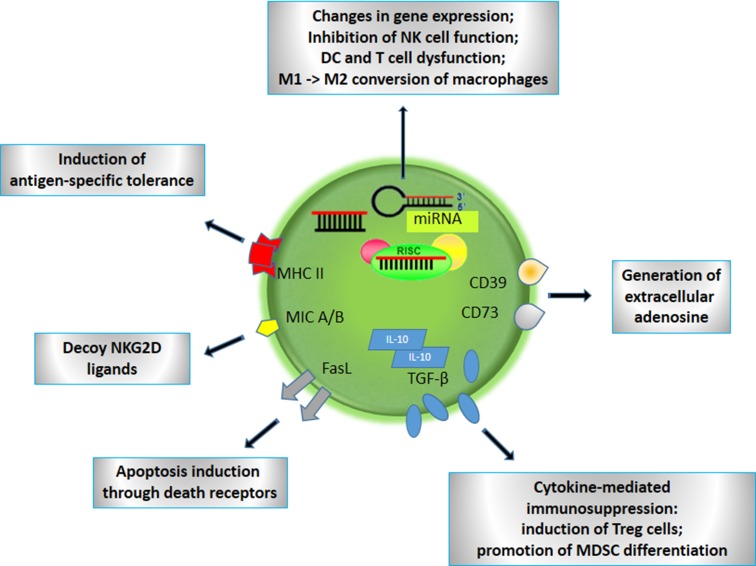
Extracellular vesicles, including exosomes, constitute an important element of intercellular communication by carrying a variety of molecules from producer to target cells. The transport of mRNA and miRNA can directly modulate gene expression in the target cells. The miRNA content in exosomes is characteristic for the cell from which the vesicles were derived enabling the usage of exosomes as biomarkers for the diagnosis various diseases, including cancer. Cancer-derived exosomes support the survival and progression of tumors in many ways and also contribute to the neutralization of the anti-cancer immune response. Exosomes participate in all known mechanisms by which cancer evades the immune system. They influence the differentiation and activation of immune suppressor cells, they modulate antigen presentation, and are able to induce T-cell apoptosis. Although cancer-derived exosomes mainly suppress the immune system and facilitate tumor progression, they are also important sources of tumor antigens with potential clinical application in stimulating immune responses. This review summarizes how exosomes assist cancer to escape immune recognition and to acquire control over the immune system.
细胞外囊泡,包括外泌体,通过将多种分子从产生细胞携带至靶细胞,构成细胞间通讯的重要元素。mRNA和miRNA的转运可直接调节靶细胞中的基因表达。外泌体中的miRNA含量对于其来源细胞具有特征性,这使得外泌体可用作包括癌症在内的多种疾病诊断的生物标志物。癌症来源的外泌体在许多方面支持肿瘤的存活和进展,也有助于中和抗癌免疫反应。外泌体参与癌症逃避免疫系统的所有已知机制。它们影响免疫抑制细胞的分化和激活,调节抗原呈递,并能够诱导T细胞凋亡。尽管癌症来源的外泌体主要抑制免疫系统并促进肿瘤进展,但它们也是肿瘤抗原的重要来源,在刺激免疫反应方面具有潜在的临床应用价值。本综述总结了外泌体如何协助癌症逃避免疫识别并获得对免疫系统的控制。