Sonawane Kalyani, Suk Ryan, Chiao Elizabeth Y, Chhatwal Jagpreet, Qiu Peihua, Wilkin Timothy, Nyitray Alan G, Sikora Andrew G, Deshmukh Ashish A
From University of Florida, Gainesville, Florida; Baylor College of Medicine and The University of Texas Health Science Center at Houston School of Public Health, Houston, Texas; Harvard Medical School, Boston, Massachusetts; and Weill Cornell Medicine, New York, New York.
Ann Intern Med. 2017 Nov 21;167(10):714-724. doi: 10.7326/M17-1363. Epub 2017 Oct 17.
The burden of human papillomavirus (HPV)-positive oropharyngeal squamous cell carcinoma (OPSCC) is disproportionately high among men, yet empirical evidence regarding the difference in prevalence of oral HPV infection between men and women is limited. Concordance of oral and genital HPV infection among men is unknown.
To determine the prevalence of oral HPV infection, as well as the concordance of oral and genital HPV infection, among U.S. men and women.
Nationally representative survey.
Civilian noninstitutionalized population.
Adults aged 18 to 69 years from NHANES (National Health and Nutrition Examination Survey), 2011 to 2014.
Oral rinse, penile swab, and vaginal swab specimens were evaluated by polymerase chain reaction followed by type-specific hybridization.
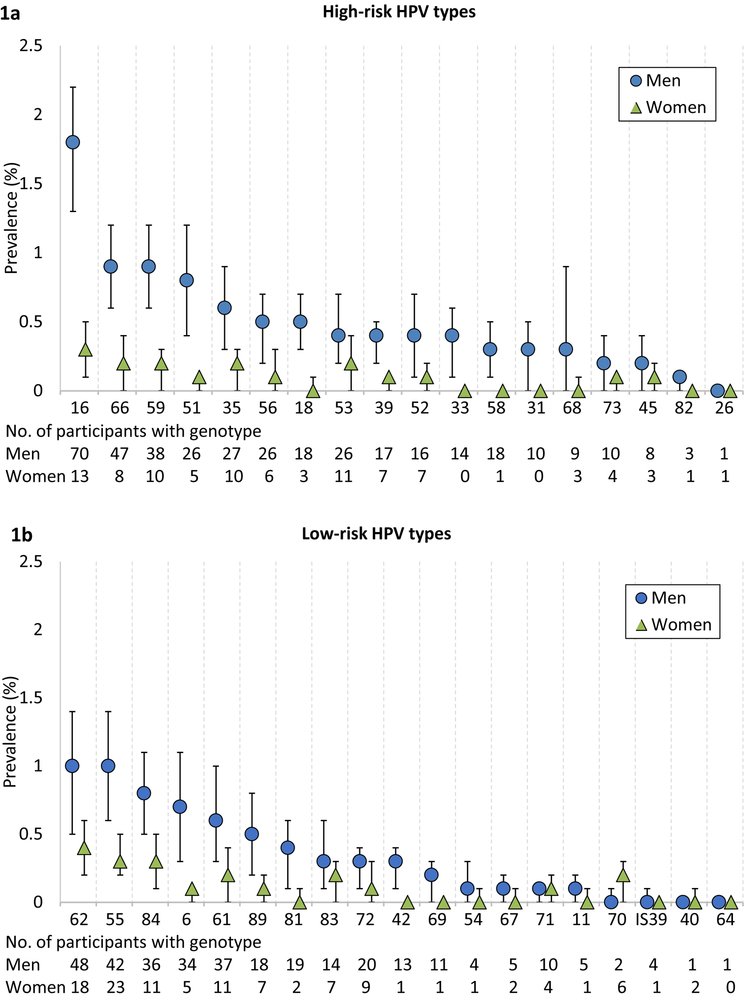
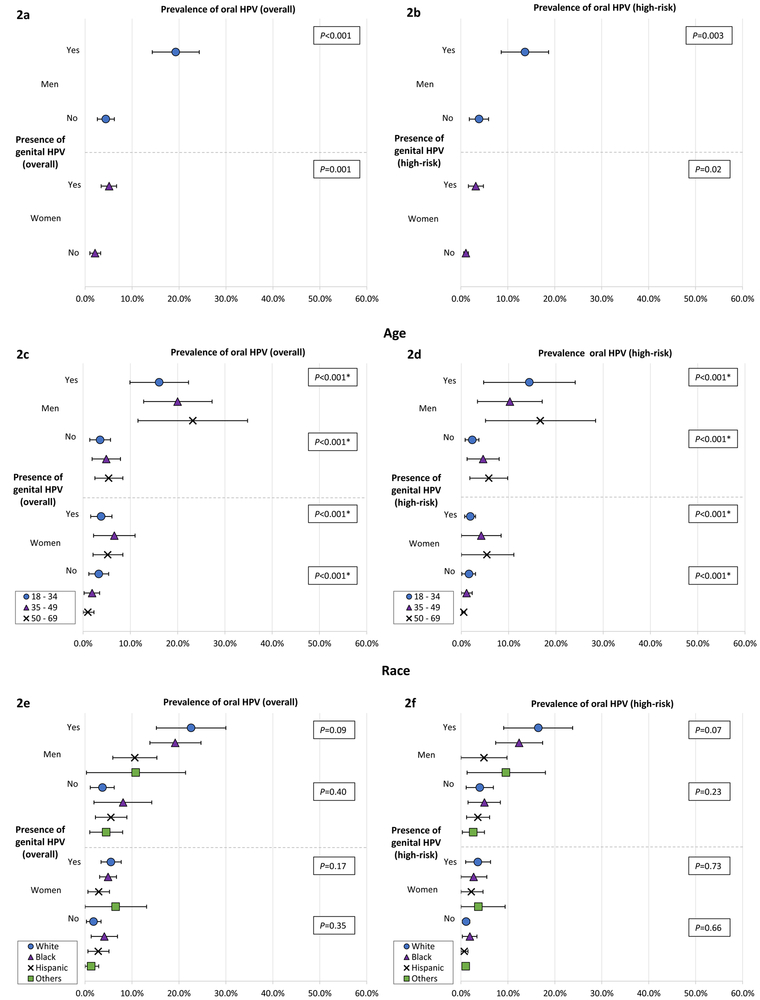
The overall prevalence of oral HPV infection was 11.5% (95% CI, 9.8% to 13.1%) in men and 3.2% (CI, 2.7% to 3.8%) in women (equating to 11 million men and 3.2 million women nationwide). High-risk oral HPV infection was more prevalent among men (7.3% [CI, 6.0% to 8.6%]) than women (1.4% [CI, 1.0% to 1.8%]). Oral HPV 16 was 6 times more common in men (1.8% [CI, 1.3% to 2.2%]) than women (0.3% [CI, 0.1% to 0.5%]) (1.7 million men vs. 0.27 million women). Among men and women who reported having same-sex partners, the prevalence of high-risk HPV infection was 12.7% (CI, 7.0% to 18.4%) and 3.6% (CI, 1.4% to 5.9%), respectively. Among men who reported having 2 or more same-sex oral sex partners, the prevalence of high-risk HPV infection was 22.2% (CI, 9.6% to 34.8%). Oral HPV prevalence among men with concurrent genital HPV infection was 4-fold greater (19.3%) than among those without it (4.4%). Men had 5.4% (CI, 5.1% to 5.8%) greater predicted probability of high-risk oral HPV infection than women. The predicted probability of high-risk oral HPV infection was greatest among black participants, those who smoked more than 20 cigarettes daily, current marijuana users, and those who reported 16 or more lifetime vaginal or oral sex partners.
Sexual behaviors were self-reported.
Oral HPV infection is common among U.S. men. This study's findings provide several policy implications to guide future OPSCC prevention efforts to combat this disease.
National Cancer Institute.
人乳头瘤病毒(HPV)阳性口咽鳞状细胞癌(OPSCC)在男性中的负担过高,但关于男性和女性口腔HPV感染患病率差异的实证证据有限。男性口腔和生殖器HPV感染的一致性尚不清楚。
确定美国男性和女性口腔HPV感染的患病率以及口腔和生殖器HPV感染的一致性。
具有全国代表性的调查。
非机构化平民人口。
2011年至2014年美国国家健康与营养检查调查(NHANES)中18至69岁的成年人。
通过聚合酶链反应随后进行型特异性杂交评估口腔冲洗液、阴茎拭子和阴道拭子标本。
男性口腔HPV感染的总体患病率为11.5%(95%CI,9.8%至13.1%),女性为3.2%(CI,2.7%至3.8%)(相当于全国1100万男性和320万女性)。高危口腔HPV感染在男性中(7.3%[CI,6.0%至8.6%])比女性中(1.4%[CI,1.0%至1.8%])更普遍。口腔HPV 16在男性中(1.8%[CI,1.3%至2.2%])比女性中(0.3%[CI,0.1%至0.5%])常见6倍(170万男性对27万女性)。在报告有同性伴侣的男性和女性中,高危HPV感染的患病率分别为12.7%(CI,7.0%至18.4%)和3.6%(CI,1.4%至5.9%)。在报告有2个或更多同性口交伴侣的男性中,高危HPV感染的患病率为22.2%(CI,9.6%至34.8%)。同时患有生殖器HPV感染的男性口腔HPV患病率比没有生殖器HPV感染的男性高4倍(19.3%)。男性高危口腔HPV感染的预测概率比女性高5.4%(CI,5.1%至5.8%)。高危口腔HPV感染的预测概率在黑人参与者、每天吸烟超过20支的人、当前大麻使用者以及报告有16个或更多终身阴道或口交伴侣的人中最高。
性行为为自我报告。
口腔HPV感染在美国男性中很常见。本研究结果为指导未来预防OPSCC以对抗这种疾病的努力提供了若干政策启示。
美国国立癌症研究所。