Jordan Kelsey H, Beverly Hery Chloe M, Zhang Xiaochen, Paskett Electra D
Division of Population Sciences, Comprehensive Cancer Center, The Ohio State University, Columbus, OH, United States.
Division of Epidemiology, College of Public Health, The Ohio State University, Columbus, OH, United States.
Front Oncol. 2022 Mar 29;12:848628. doi: 10.3389/fonc.2022.848628. eCollection 2022.
The oral-cervical human papillomavirus (HPV) infection/cancer relationship is not well established. Oral-cervical HPV studies were reviewed to assess dual-site occurrence, HPV type concordance, and study quality/deficiencies.
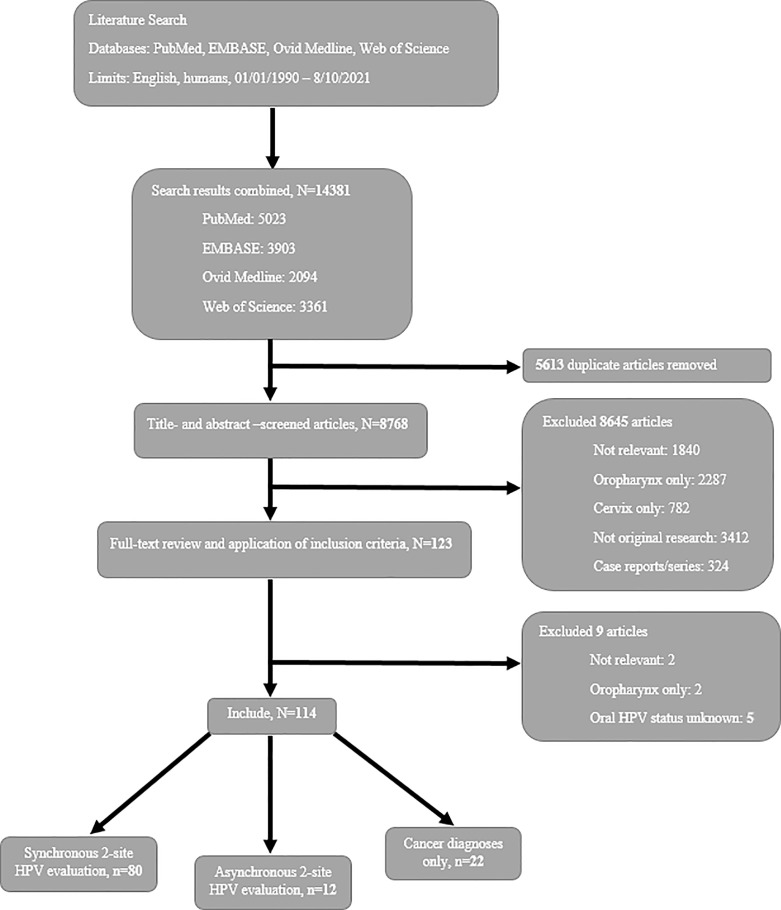
PubMed, EMBASE, Ovid Medline, and Web of Science were searched between 1/1/1990 and 8/10/2021 for studies investigating HPV infections/cancers and type concordance between the oral cavity/oropharynx and cervix. Dual-site and concordant HPV infection rates were summarized as percentages; cancer diagnoses studies were summarized using standardized incidence ratios (SIR). The Quality Assessment Tool for Quantitative Studies (QATQS) evaluated study methodology.
One hundred fourteen papers were identified. Most were cross-sectional (n=79, 69%), involved synchronous dual-site HPV testing (n=80, 70%), did not report HPV type concordance (n=62, 54%), and achieved moderate methodological QATQS ratings (n=81, 71%). The overall dual-site infection rate averaged 16%; the HPV type concordance rate averaged 41%, among those dually-infected women. Most HPV-related cancer diagnoses studies reported increased secondary cancer risk, with SIRs generally ranging from 1.4 to 29.4 for secondary cervical cancer after primary oral cancer and from 1.4 to 6.3 for secondary oral cancer after primary cervical cancer.
CONCLUSION/IMPACT: Oral-cervical HPV infections/cancers remain understudied. Future research should use stronger methodologies and HPV concordance analyses to better understand oral-cervical HPV epidemiology.
口腔-宫颈人乳头瘤病毒(HPV)感染与癌症之间的关系尚未完全明确。对口腔-宫颈HPV相关研究进行综述,以评估双部位感染的发生率、HPV型别一致性以及研究质量/缺陷。
检索1990年1月1日至2021年10月8日期间的PubMed、EMBASE、Ovid Medline和Web of Science数据库,查找调查HPV感染/癌症以及口腔/口咽与宫颈之间HPV型别一致性的研究。双部位和一致性HPV感染率以百分比形式汇总;癌症诊断研究使用标准化发病比(SIR)进行汇总。采用定量研究质量评估工具(QATQS)评估研究方法。
共识别出114篇论文。大多数为横断面研究(n = 79,69%),涉及同步双部位HPV检测(n = 80,70%),未报告HPV型别一致性(n = 62,54%),且研究方法的QATQS评分中等(n = 81,71%)。总体双部位感染率平均为16%;在双重感染的女性中,HPV型别一致率平均为41%。大多数HPV相关癌症诊断研究报告继发性癌症风险增加,原发性口腔癌后继发性宫颈癌的SIR通常在1.4至29.4之间,原发性宫颈癌后继发性口腔癌的SIR在1.4至6.3之间。
结论/影响:口腔-宫颈HPV感染/癌症仍研究不足。未来的研究应采用更强大的方法和HPV一致性分析,以更好地了解口腔-宫颈HPV流行病学。