Parente Cynara Carvalho, Bezerra Fernando S M, Parente Plutarco I, Dias-Neto Raimundo V, Xavier Samanta C C, Ramos Alberto N, Carvalho-Costa Filipe A, Lima Marli M
Faculdade de Medicina, Universidade Federal do Ceará/Sobral, Sobral, Ceará, Brazil.
Faculdade de Farmácia, Odontologia e Enfermagem, Universidade Federal do Ceará, Fortaleza, Ceará, Brazil.
PLoS One. 2017 Jan 19;12(1):e0170278. doi: 10.1371/journal.pone.0170278. eCollection 2017.
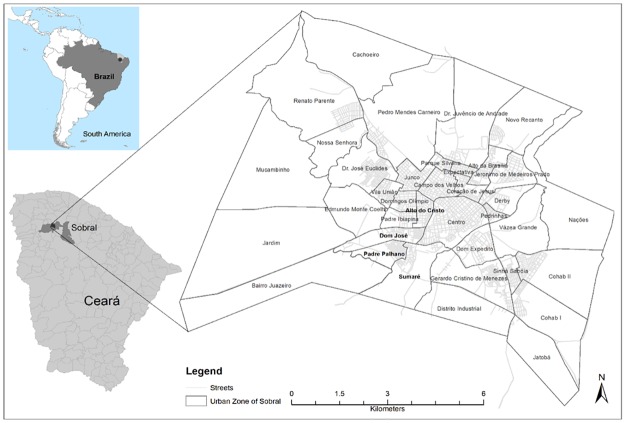
The aim of this work was to explore the potential risk of vector-borne Chagas disease in urban districts in northeastern Brazil, by analyzing the spatiotemporal distributions and natural infection rates with Trypanosoma cruzi of triatomine species captured in recent years. The main motivation of this work was an acute human case of Chagas disease reported in 2008 in the municipality of Sobral.
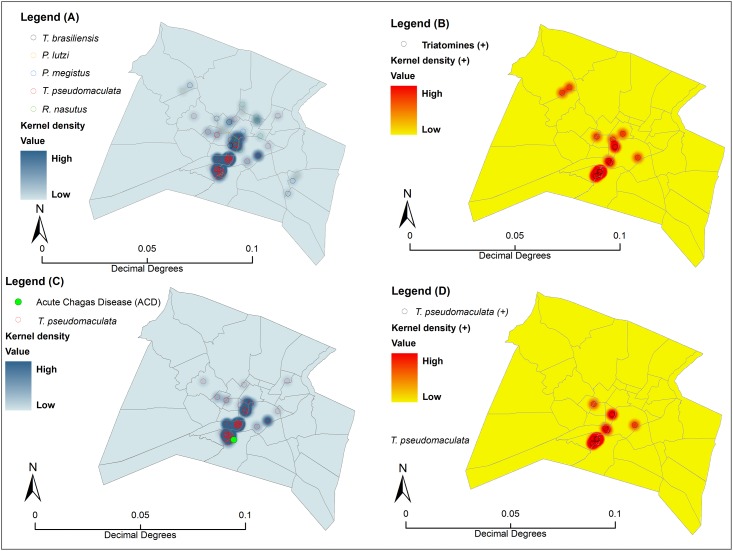
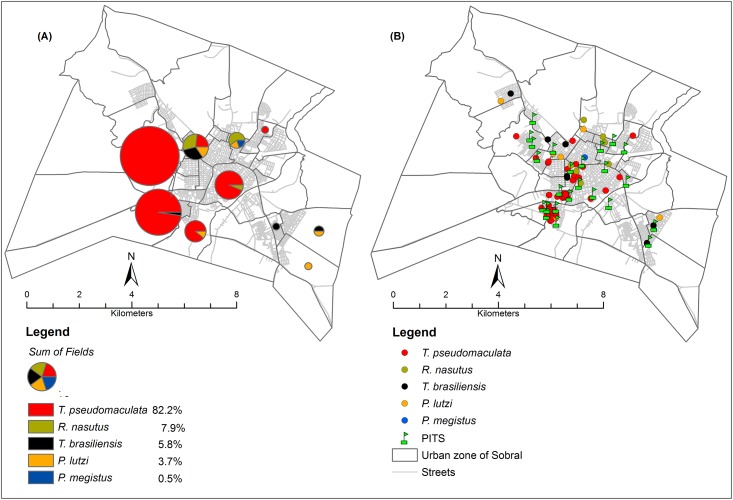
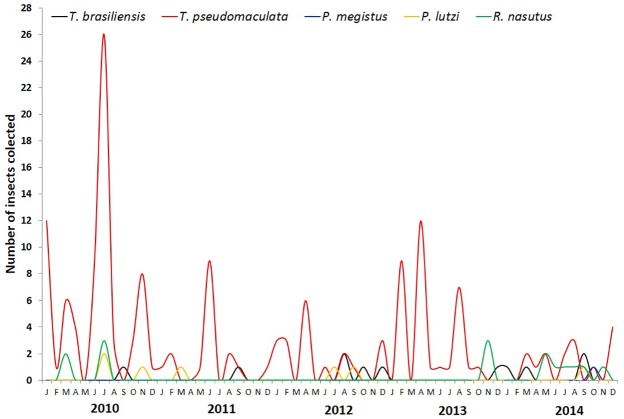
METHODOLOGY/PRINCIPAL FINDINGS: We analyzed data from community-based entomological surveillance carried out from 2010 to 2014. Triatomine natural T. cruzi infection was assessed by examination of insect feces by optical microscopy. Sites of triatomine capture were georeferenced through Google Earth and analyzed with ArcGIS. A total of 191 triatomines were collected, consisting of 82.2% Triatoma pseudomaculata, 7.9% Rhodnius nasutus, 5.8% T. brasiliensis, 3.7% Panstrongylus lutzi, and 0.5% P. megistus, with an overall natural infection index of 17.8%. Most infestations were reported in the districts of Dom José (36.2%), Padre Palhano (24.7%), and Alto do Cristo (10.6%). The overwhelming majority of insects (185/96.9%) were captured inside houses, and most insects tended to be collected in intermittent peaks. Moreover, captured triatomines tended to constitute colonies. The acute case reported in 2008 was found to be situated within a T. pseudomaculata hotspot.
The triatomine collection events carried out by dwellers were aggregated in time and space into distinct foci, suggesting that insects are intermittently and artificially introduced into the city, possibly via accidental migration from their natural reservoirs. The relatively high T. cruzi infection rate indicates considerable circulation of the parasite in these areas, increasing the risk of vector-borne Chagas disease infection. These data suggest a need to strengthen epidemiological surveillance and integrate appropriate control actions targeting triatomines, T. cruzi reservoirs, and human populations. Our data also identify Chagas disease transmission as a hazard in urban areas of Sobral.
本研究旨在通过分析近年来捕获的锥蝽种类的时空分布以及克氏锥虫自然感染率,探索巴西东北部城市地区媒介传播的恰加斯病的潜在风险。这项研究的主要动机是2008年在索布拉尔市报告的一例急性人类恰加斯病病例。
方法/主要发现:我们分析了2010年至2014年基于社区的昆虫学监测数据。通过光学显微镜检查昆虫粪便来评估锥蝽克氏锥虫的自然感染情况。通过谷歌地球对锥蝽捕获地点进行地理定位,并使用ArcGIS进行分析。共收集到191只锥蝽,其中82.2%为伪maculata锥蝽,7.9%为鼻锥蝽,5.8%为巴西锥蝽,3.7%为卢氏强棱锥蝽,0.5%为巨锥蝽,总体自然感染指数为17.8%。大多数侵扰报告发生在多姆·若泽区(36.2%)、帕德雷·帕尔哈诺区(24.7%)和阿尔托·多·克里斯托区(10.6%)。绝大多数昆虫(185/96.9%)是在房屋内捕获的,且大多数昆虫倾向于在间歇性高峰时被收集。此外,捕获的锥蝽倾向于形成群体。发现2008年报告的急性病例位于伪maculata锥蝽热点区域内。
居民进行的锥蝽收集活动在时间和空间上聚集形成不同的疫源地,这表明昆虫可能是通过从其自然宿主意外迁移而间歇性地、人为地引入城市。相对较高的克氏锥虫感染率表明该寄生虫在这些地区有相当程度的传播,增加了媒介传播恰加斯病感染的风险。这些数据表明需要加强流行病学监测,并整合针对锥蝽、克氏锥虫宿主和人群的适当控制措施。我们的数据还确定恰加斯病传播是索布拉尔市城市地区的一种危害。