Shu Xiao-Liang, Yu Ting-Ting, Kang Kai, Zhao Jian
Department of Nutrition, Jinshan Hospital, Fudan University School of Medicine, Shanghai 201508, P.R. China.
Tongji University School of Medicine, Shanghai 200092, P.R. China.
Exp Ther Med. 2016 Dec;12(6):3499-3506. doi: 10.3892/etm.2016.3799. Epub 2016 Oct 12.
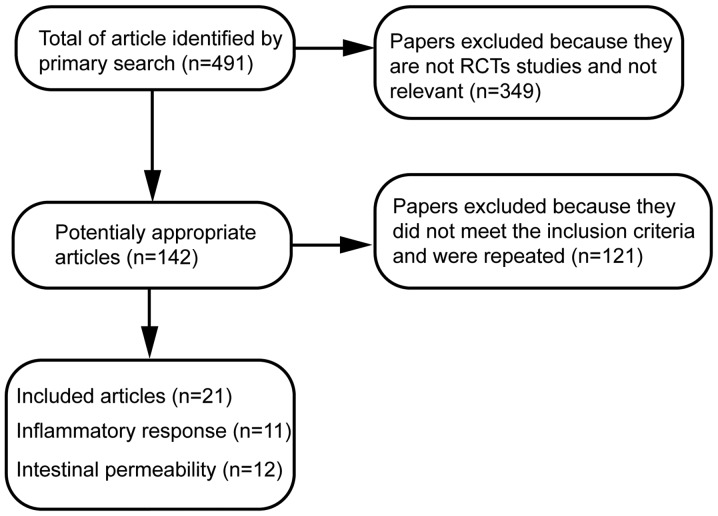
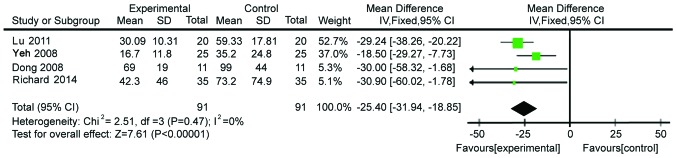
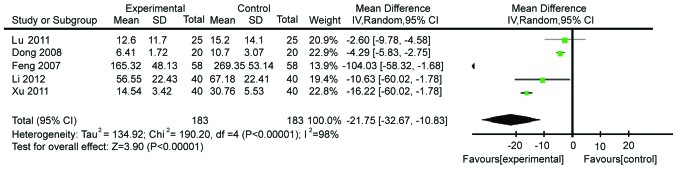
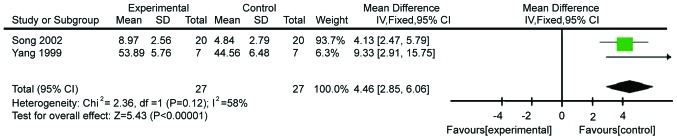
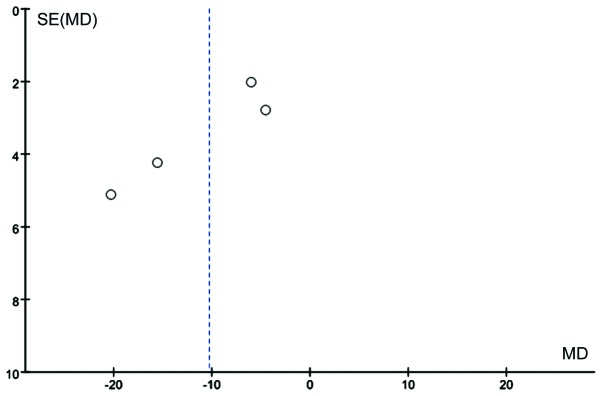
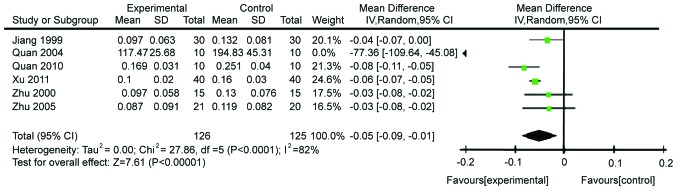
The present meta-analysis was carried out to determine whether supplementation with glutamine (Gln) would reduce the intestinal inflammatory response and mucosal permeability in patients undergoing abdominal surgery. The PubMed, EMBASE, Web of Science, and The Cochrane Library databases were searched for randomized controlled trials on the effects of supplementation with Gln, and published from August, 1966 to June 2014. Inclusion criteria for the meta-analysis were: i) Study design was a randomized controlled trial, ii) study included patients undergoing abdominal surgery, iii) study patients received a supplementation with Gln peptide (Ala-Gln or Gly-Gln) whereas control patients did not use any supplements, and iv) study outcomes included inflammatory markers [C-reactive protein (CRP), tumor necrosis factor-α (TNF-α), and interleukin (IL)-6, and IL-2 receptor] and markers of intestinal permeability [lactulose/mannitol, diamine oxidase, D(-)lactic acid, and endotoxin]. Qualities of controlled trials were assessed using the Jadad score. Meta-analyses were performed with fixed- or random-effect models depending on the heterogeneity of studies. There were 21 trials meeting the inclusion criteria. The meta-analysis revealed that the levels of CRP, TNF-α, and IL-6 in patients supplemented with Gln were significantly lower than those in control patients, whereas the levels of IL-2 receptor were increased by Gln supplementation. Gln also significantly decreased the lactulose/mannitol ratio, the levels of diamine oxidase and endotoxin, and tended to decrease the levels of cyclic D-lactic acid. In conclusion, Gln appears to effectively reduce the inflammatory response and intestinal mucosal permeability in patients after abdominal surgery.
本荟萃分析旨在确定补充谷氨酰胺(Gln)是否会减轻腹部手术患者的肠道炎症反应和黏膜通透性。检索了PubMed、EMBASE、Web of Science和Cochrane图书馆数据库,以查找关于补充Gln效果的随机对照试验,这些试验发表于1966年8月至2014年6月。荟萃分析的纳入标准为:i)研究设计为随机对照试验;ii)研究纳入腹部手术患者;iii)研究中的患者接受Gln肽(丙氨酰谷氨酰胺或甘氨酰谷氨酰胺)补充,而对照患者未使用任何补充剂;iv)研究结果包括炎症标志物[C反应蛋白(CRP)、肿瘤坏死因子-α(TNF-α)、白细胞介素(IL)-6和IL-2受体]以及肠道通透性标志物[乳果糖/甘露醇、二胺氧化酶、D(-)乳酸和内毒素]。使用Jadad评分评估对照试验的质量。根据研究的异质性,采用固定效应或随机效应模型进行荟萃分析。共有21项试验符合纳入标准。荟萃分析显示,补充Gln的患者中CRP、TNF-α和IL-6水平显著低于对照患者,而补充Gln会使IL-2受体水平升高。Gln还显著降低了乳果糖/甘露醇比值、二胺氧化酶和内毒素水平,并倾向于降低循环D-乳酸水平。总之,Gln似乎能有效减轻腹部手术后患者的炎症反应和肠道黏膜通透性。