
用于法医应用的大麻广泛遗传多样性
Broad-Scale Genetic Diversity of Cannabis for Forensic Applications.
作者信息
Dufresnes Christophe, Jan Catherine, Bienert Friederike, Goudet Jérôme, Fumagalli Luca
机构信息
Laboratory for Conservation Biology, Department of Ecology and Evolution, Biophore Building, University of Lausanne, Lausanne, Switzerland.
Centre Universitaire Romand de Médecine Légale, Chemin de la Vuillette 4, Lausanne, Switzerland.
出版信息
PLoS One. 2017 Jan 20;12(1):e0170522. doi: 10.1371/journal.pone.0170522. eCollection 2017.
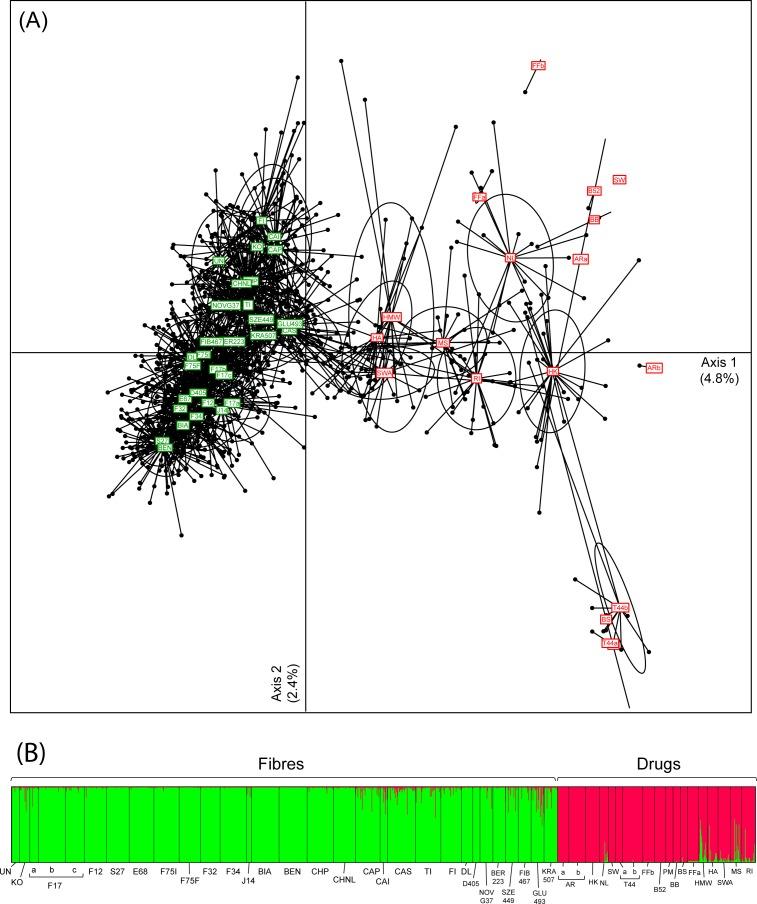
Cannabis (hemp and marijuana) is an iconic yet controversial crop. On the one hand, it represents a growing market for pharmaceutical and agricultural sectors. On the other hand, plants synthesizing the psychoactive THC produce the most widespread illicit drug in the world. Yet, the difficulty to reliably distinguish between Cannabis varieties based on morphological or biochemical criteria impedes the development of promising industrial programs and hinders the fight against narcotrafficking. Genetics offers an appropriate alternative to characterize drug vs. non-drug Cannabis. However, forensic applications require rapid and affordable genotyping of informative and reliable molecular markers for which a broad-scale reference database, representing both intra- and inter-variety variation, is available. Here we provide such a resource for Cannabis, by genotyping 13 microsatellite loci (STRs) in 1 324 samples selected specifically for fibre (24 hemp varieties) and drug (15 marijuana varieties) production. We showed that these loci are sufficient to capture most of the genome-wide diversity patterns recently revealed by NGS data. We recovered strong genetic structure between marijuana and hemp and demonstrated that anonymous samples can be confidently assigned to either plant types. Fibres appear genetically homogeneous whereas drugs show low (often clonal) diversity within varieties, but very high genetic differentiation between them, likely resulting from breeding practices. Based on an additional test dataset including samples from 41 local police seizures, we showed that the genetic signature of marijuana cultivars could be used to trace crime scene evidence. To date, our study provides the most comprehensive genetic resource for Cannabis forensics worldwide.
大麻(工业大麻和药用大麻)是一种具有标志性但颇具争议的作物。一方面,它代表着制药和农业领域不断增长的市场。另一方面,合成具有精神活性的四氢大麻酚的植物产生了世界上最广泛使用的非法药物。然而,基于形态学或生化标准难以可靠地区分大麻品种,这阻碍了有前景的产业项目的发展,并妨碍了打击毒品贩运的斗争。遗传学提供了一种合适的方法来区分药用大麻和非药用大麻。然而,法医应用需要对信息丰富且可靠的分子标记进行快速且经济实惠的基因分型,为此需要一个代表品种内和品种间变异的大规模参考数据库。在这里,我们通过对专门选择用于纤维(24个工业大麻品种)和药用(15个药用大麻品种)生产的1324个样本中的13个微卫星位点(STR)进行基因分型,为大麻提供了这样一种资源。我们表明,这些位点足以捕获最近由NGS数据揭示的全基因组多样性模式的大部分。我们发现药用大麻和工业大麻之间存在强大的遗传结构,并证明匿名样本可以可靠地归为这两种植物类型中的任何一种。纤维在遗传上似乎是同质的,而药用大麻品种内显示出低(通常是克隆的)多样性,但它们之间的遗传分化非常高,这可能是育种实践导致的。基于一个额外的测试数据集,其中包括来自41次当地警方缉获的样本,我们表明药用大麻品种的遗传特征可用于追踪犯罪现场证据。迄今为止,我们的研究为全球大麻法医鉴定提供了最全面的遗传资源。

 Zotero 插件