• 文献检索
  • 文档翻译
  • 深度研究
  • 学术资讯
  • Suppr Zotero 插件Zotero 插件
  • 邀请有礼
  • 套餐&价格
  • 历史记录
应用&插件
Suppr Zotero 插件Zotero 插件浏览器插件Mac 客户端Windows 客户端微信小程序
定价
高级版会员购买积分包购买API积分包
服务
文献检索文档翻译深度研究API 文档MCP 服务
关于我们
关于 Suppr公司介绍联系我们用户协议隐私条款
关注我们

Suppr 超能文献

核心技术专利:CN118964589B侵权必究
粤ICP备2023148730 号-1Suppr @ 2026

文献检索

告别复杂PubMed语法,用中文像聊天一样搜索,搜遍4000万医学文献。AI智能推荐,让科研检索更轻松。

立即免费搜索

文件翻译

保留排版,准确专业,支持PDF/Word/PPT等文件格式,支持 12+语言互译。

免费翻译文档

深度研究

AI帮你快速写综述,25分钟生成高质量综述,智能提取关键信息,辅助科研写作。

立即免费体验

增加健康食品激励措施的使用:一项针对低收入患者的候诊室干预措施。

Increasing Use of a Healthy Food Incentive: A Waiting Room Intervention Among Low-Income Patients.

作者信息

Cohen Alicia J, Richardson Caroline R, Heisler Michele, Sen Ananda, Murphy Ellen C, Hesterman Oran B, Davis Matthew M, Zick Suzanna M

机构信息

Robert Wood Johnson Foundation Clinical Scholars program, University of Michigan, Ann Arbor, Michigan; Department of Family Medicine, University of Michigan, Ann Arbor, Michigan; Institute for Healthcare Policy and Innovation, University of Michigan, Ann Arbor, Michigan; Ann Arbor Veterans Affairs Medical Center, Ann Arbor, Michigan.

Robert Wood Johnson Foundation Clinical Scholars program, University of Michigan, Ann Arbor, Michigan; Department of Family Medicine, University of Michigan, Ann Arbor, Michigan; Institute for Healthcare Policy and Innovation, University of Michigan, Ann Arbor, Michigan; Ann Arbor Veterans Affairs Medical Center, Ann Arbor, Michigan.

出版信息

Am J Prev Med. 2017 Feb;52(2):154-162. doi: 10.1016/j.amepre.2016.11.008.

DOI:10.1016/j.amepre.2016.11.008
PMID:28109458
原文链接:
https://pmc.ncbi.nlm.nih.gov/articles/PMC5444808/
Abstract

INTRODUCTION

Diet-related disease is disproportionately concentrated in low-income communities where fruit and vegetable consumption is far below guidelines. To address financial barriers, Double Up Food Bucks (DUFB)-a statewide healthy food incentive-matches Supplemental Nutrition Assistance Program (SNAP) funds spent at farmers markets. However, incentive use is limited. This study examined the impact of a brief waiting room-based intervention about DUFB on program utilization and produce consumption.

STUDY DESIGN

Longitudinal, repeated measures, quasi-experimental trial.

SETTING/PARTICIPANTS: SNAP-enrolled adults at a health center in a low-income, racially and ethnically diverse area of Southeast Michigan.

INTERVENTION

Participants received a brief explanation of DUFB, written program materials, a map highlighting market locations and hours, and an initial $10 market voucher. DUFB use and produce consumption were measured through four surveys over 5 months (August 2014-January 2015).

MAIN OUTCOME MEASURES

Outcome measures included DUFB use and fruit and vegetable consumption (analyses conducted in 2015-2016).

RESULTS

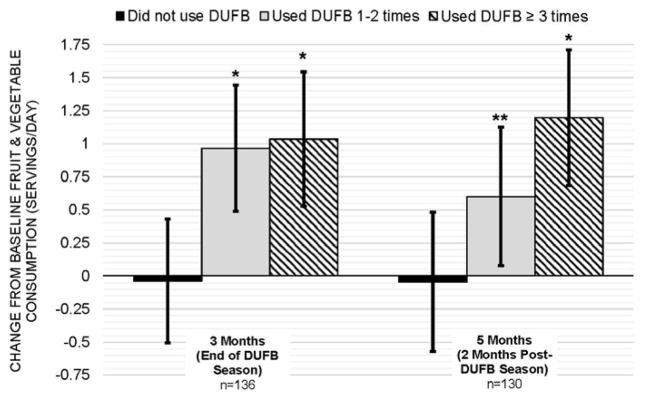
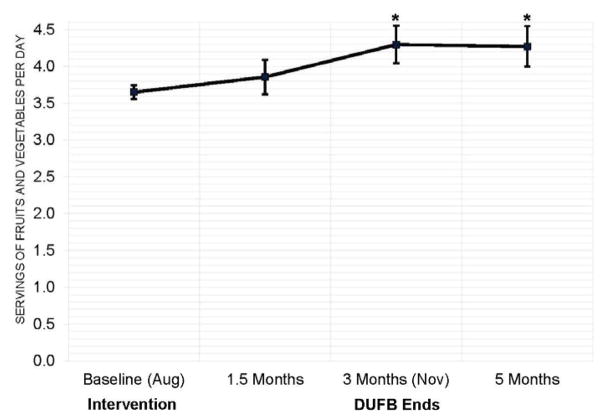
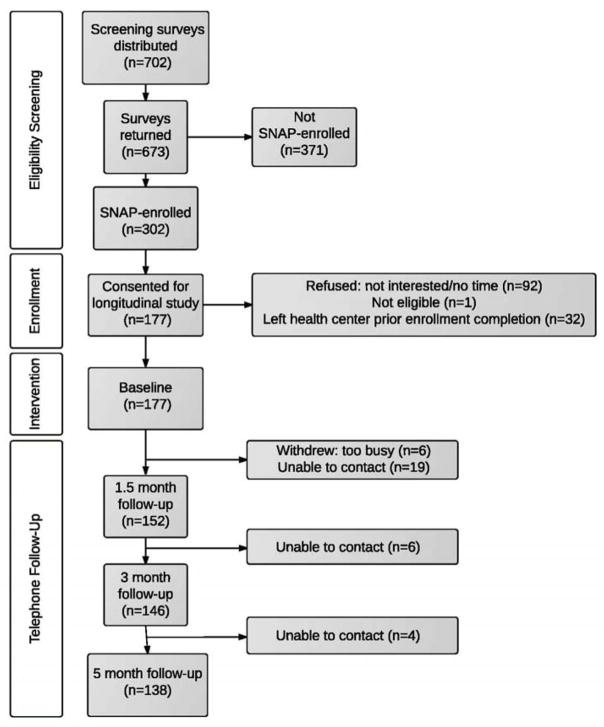
A total of 302 eligible adults were identified, and 177 (59%) enrolled. One hundred twenty-seven (72%) completed all surveys. At baseline, 57% of participants reported shopping at a farmers market within the last year; 18% had previously used DUFB. By the end of the DUFB season, participants were significantly more likely to report DUFB use than at baseline (AOR=19.2, 95% CI=10.3, 35.5, p<0.001), with 69% of participants reporting use of DUFB at least once, and 34% reporting use of DUFB three or more times. Adjusted fruit and vegetable consumption increased from baseline by 0.65 servings/day (95% CI=0.37, 0.93, p<0.001) at 3 months, and remained 0.62 servings/day (95% CI=0.32, 0.92, p<0.001) higher than baseline 2 months post-DUFB season.

CONCLUSIONS

A brief clinic-based intervention was associated with a nearly fourfold increase in uptake of a SNAP incentive program, as well as clinically and statistically significant increases in produce consumption. Results suggested sustained behavior change even once the financial incentive was no longer available. Providing information about healthy food incentives is a low-cost, easily implemented intervention that may increase produce consumption among low-income patients.

摘要

引言

与饮食相关的疾病在低收入社区中极为集中,这些社区的水果和蔬菜消费量远低于指导标准。为消除经济障碍,“双倍食品券”(DUFB)——一项全州范围的健康食品激励计划——会对在农贸市场使用的补充营养援助计划(SNAP)资金进行匹配。然而,激励措施的使用有限。本研究考察了一项在候诊室进行的关于DUFB的简短干预对该计划利用率和农产品消费的影响。

研究设计

纵向、重复测量、准实验性试验。

地点/参与者:密歇根州东南部一个低收入、种族和民族多样化地区的健康中心登记参加SNAP的成年人。

干预措施

参与者收到了关于DUFB的简要说明、书面计划材料、一张突出显示市场位置和营业时间的地图,以及一张初始的10美元市场代金券。通过在5个月(2014年8月至2015年1月)内进行的四项调查来测量DUFB的使用情况和农产品消费情况。

主要结局指标

结局指标包括DUFB的使用情况以及水果和蔬菜的消费量(分析于2015 - 2016年进行)。

结果

共确定了302名符合条件的成年人,其中177人(59%)登记参加。127人(72%)完成了所有调查。在基线时,57%的参与者报告在过去一年内在农贸市场购物;18%的人此前使用过DUFB。到DUFB季节结束时,参与者报告使用DUFB的可能性比基线时显著更高(比值比=19.2,95%置信区间=10.3,35.5,p<0.001),69%的参与者报告至少使用过一次DUFB,34%的参与者报告使用过三次或更多次。调整后的水果和蔬菜消费量在3个月时比基线增加了0.65份/天(95%置信区间=0.37,0.93,p<0.001),在DUFB季节结束后2个月仍比基线高0.62份/天(95%置信区间=0.32,0.92,p<0.001)。

结论

一项简短的基于诊所的干预与SNAP激励计划的参与率几乎增加四倍相关,同时在农产品消费方面也有临床和统计学上的显著增加。结果表明,即使经济激励不再存在,行为改变仍能持续。提供关于健康食品激励措施的信息是一种低成本、易于实施的干预措施,可能会增加低收入患者的农产品消费量。
https://cdn.ncbi.nlm.nih.gov/pmc/blobs/91a7/5444808/7c6f5f94f840/nihms859311f3.jpg
https://cdn.ncbi.nlm.nih.gov/pmc/blobs/91a7/5444808/d10e2c3c957c/nihms859311f1.jpg
https://cdn.ncbi.nlm.nih.gov/pmc/blobs/91a7/5444808/69793f061a35/nihms859311f2.jpg
https://cdn.ncbi.nlm.nih.gov/pmc/blobs/91a7/5444808/7c6f5f94f840/nihms859311f3.jpg
https://cdn.ncbi.nlm.nih.gov/pmc/blobs/91a7/5444808/d10e2c3c957c/nihms859311f1.jpg
https://cdn.ncbi.nlm.nih.gov/pmc/blobs/91a7/5444808/69793f061a35/nihms859311f2.jpg
https://cdn.ncbi.nlm.nih.gov/pmc/blobs/91a7/5444808/7c6f5f94f840/nihms859311f3.jpg

相似文献

1
Increasing Use of a Healthy Food Incentive: A Waiting Room Intervention Among Low-Income Patients.增加健康食品激励措施的使用:一项针对低收入患者的候诊室干预措施。
Am J Prev Med. 2017 Feb;52(2):154-162. doi: 10.1016/j.amepre.2016.11.008.
2
Facilitators and Barriers to Supplemental Nutrition Assistance Program Incentive Use: Findings From a Clinic Intervention for Low-Income Patients.补充营养援助计划激励措施的使用的促进因素和障碍:一项针对低收入患者的诊所干预措施的研究结果。
Am J Prev Med. 2019 Apr;56(4):571-579. doi: 10.1016/j.amepre.2018.11.010. Epub 2019 Feb 21.
3
Higher Fruit and Vegetable Intake Is Associated with Participation in the Double Up Food Bucks (DUFB) Program.较高的水果和蔬菜摄入量与参与双加食品券(DUFB)计划有关。
Nutrients. 2021 Jul 29;13(8):2607. doi: 10.3390/nu13082607.
4
Reducing food insecurity and improving fruit and vegetable intake through a nutrition incentive program in Michigan, USA.通过美国密歇根州的一项营养激励计划减少粮食不安全状况并改善水果和蔬菜摄入量。
SSM Popul Health. 2021 Aug 17;15:100898. doi: 10.1016/j.ssmph.2021.100898. eCollection 2021 Sep.
5
Improving fruit and vegetable consumption among low-income customers at farmers markets: Philly Food Bucks, Philadelphia, Pennsylvania, 2011.提高农贸市场低收入顾客的水果和蔬菜消费:费城食品券,宾夕法尼亚州费城,2011 年。
Prev Chronic Dis. 2013 Oct 3;10:E166. doi: 10.5888/pcd10.120356.
6
Double Up Food Bucks: A Qualitative Evaluation of Usage, Impact, Barriers, and Facilitators.双倍食品券:使用情况、影响、障碍和促进因素的定性评估。
J Nutr Educ Behav. 2020 Dec;52(12):1100-1110. doi: 10.1016/j.jneb.2020.07.005. Epub 2020 Aug 27.
7
"Doubling Up" on Produce at Detroit Farmers Markets: Patterns and Correlates of Use of a Healthy Food Incentive.底特律农贸市场“加倍”供应农产品:使用健康食品激励措施的模式和关联因素。
Am J Prev Med. 2018 Feb;54(2):181-189. doi: 10.1016/j.amepre.2017.10.005. Epub 2017 Dec 12.
8
Double Up Food Bucks Participation is Associated with Increased Fruit and Vegetable Consumption and Food Security Among Low-Income Adults.双倍食品券参与度与低收入成年人增加水果和蔬菜消费及粮食安全相关。
J Nutr Educ Behav. 2019 Mar;51(3):342-347. doi: 10.1016/j.jneb.2018.08.011. Epub 2018 Oct 16.
9
A Qualitative Evaluation of Double Up Food Bucks Farmers' Market Incentive Program Access.双币食品券农贸市场激励计划准入情况的定性评估。
J Nutr Educ Behav. 2020 Jul;52(7):705-712. doi: 10.1016/j.jneb.2019.11.010. Epub 2020 Jan 8.
10
Fruit and Vegetable Incentive Programs for Supplemental Nutrition Assistance Program (SNAP) Participants: A Scoping Review of Program Structure.果蔬激励计划对补充营养援助计划(SNAP)参与者的影响:计划结构的范围综述。
Nutrients. 2020 Jun 4;12(6):1676. doi: 10.3390/nu12061676.

引用本文的文献

1
Healthcare-based food assistance programmes in the United States: a scoping review and typology.美国基于医疗保健的食品援助计划:范围综述和分类学。
J Nutr Sci. 2023 Dec 27;12:e128. doi: 10.1017/jns.2023.111. eCollection 2023.
2
Health and Economic Impacts of Implementing Produce Prescription Programs for Diabetes in the United States: A Microsimulation Study.美国实施针对糖尿病的农产品处方项目的健康和经济影响:一项微观模拟研究。
J Am Heart Assoc. 2023 Aug;12(15):e029215. doi: 10.1161/JAHA.122.029215. Epub 2023 Jul 7.
3
Mixed method evaluation of a clinic waiting room-based health education program in the Dominican Republic.

本文引用的文献

1
Scientific Report of the 2015 Dietary Guidelines Advisory Committee. Washington, DC: US Departments of Agriculture and Health and Human Services, 2015.《2015年膳食指南咨询委员会科学报告》。华盛顿特区:美国农业部和卫生与公众服务部,2015年。
Adv Nutr. 2016 Jan 15;7(1):202-4. doi: 10.3945/an.115.011684. Print 2016 Jan.
2
Moving Beyond "Food Deserts": Reorienting United States Policies to Reduce Disparities in Diet Quality.超越“食物荒漠”:重新调整美国政策以减少饮食质量差异
PLoS Med. 2015 Dec 8;12(12):e1001914. doi: 10.1371/journal.pmed.1001914. eCollection 2015 Dec.
3
Reducing Food Insecurity and Improving Fruit and Vegetable Intake Among Farmers' Market Incentive Program Participants.
多米尼加共和国基于诊所候诊室的健康教育项目的混合方法评估。
Health Educ Res. 2023 Mar 23;38(2):177-191. doi: 10.1093/her/cyad001.
4
Effectiveness of Social Needs Screening and Interventions in Clinical Settings on Utilization, Cost, and Clinical Outcomes: A Systematic Review.临床环境中社会需求筛查与干预对医疗利用、成本及临床结局的有效性:一项系统评价
Health Equity. 2022 Jun 24;6(1):454-475. doi: 10.1089/heq.2022.0010. eCollection 2022.
5
Strategies and Lessons Learned from a Home Delivery Food Prescription Program for Older Adults.为老年人提供上门送餐处方药项目的策略和经验教训。
J Nutr Gerontol Geriatr. 2022 Apr-Jun;41(3):217-234. doi: 10.1080/21551197.2022.2084204. Epub 2022 Jun 11.
6
Knowledge and attitudes of lower Michigan primary care physicians towards dietary interventions: A cross-sectional survey.密歇根州南部初级保健医生对饮食干预的认知与态度:一项横断面调查。
Prev Med Rep. 2022 Apr 13;27:101793. doi: 10.1016/j.pmedr.2022.101793. eCollection 2022 Jun.
7
Comparison of Fruit and Vegetable Prices between Farmers' Markets and Supermarkets: Implications for Fruit and Vegetable Incentive Programs for Food Assistance Program Participants.农贸市场和超市的果蔬价格比较:对食品援助计划参与者的果蔬激励计划的启示。
Nutrients. 2022 Apr 28;14(9):1842. doi: 10.3390/nu14091842.
8
Reducing food insecurity and improving fruit and vegetable intake through a nutrition incentive program in Michigan, USA.通过美国密歇根州的一项营养激励计划减少粮食不安全状况并改善水果和蔬菜摄入量。
SSM Popul Health. 2021 Aug 17;15:100898. doi: 10.1016/j.ssmph.2021.100898. eCollection 2021 Sep.
9
Higher Fruit and Vegetable Intake Is Associated with Participation in the Double Up Food Bucks (DUFB) Program.较高的水果和蔬菜摄入量与参与双加食品券(DUFB)计划有关。
Nutrients. 2021 Jul 29;13(8):2607. doi: 10.3390/nu13082607.
10
Identification of factors related to food insecurity and the implications for social determinants of health screenings.识别与食物不安全相关的因素及其对健康筛查社会决定因素的影响。
BMC Public Health. 2021 Jul 16;21(1):1410. doi: 10.1186/s12889-021-11465-6.
减少农贸市场激励计划参与者的粮食不安全状况并提高其水果和蔬菜摄入量。
J Nutr Educ Behav. 2016 Jan;48(1):70-76.e1. doi: 10.1016/j.jneb.2015.10.003. Epub 2015 Nov 17.
4
The Complex Relationship Between Diet And Health.饮食与健康之间的复杂关系。
Health Aff (Millwood). 2015 Nov;34(11):1813-20. doi: 10.1377/hlthaff.2015.0606.
5
Promoting Food Security for All Children.促进所有儿童的粮食安全。
Pediatrics. 2015 Nov;136(5):e1431-8. doi: 10.1542/peds.2015-3301.
6
Contribution of food prices and diet cost to socioeconomic disparities in diet quality and health: a systematic review and analysis.食品价格和饮食成本对饮食质量和健康方面社会经济差异的影响:一项系统综述与分析
Nutr Rev. 2015 Oct;73(10):643-60. doi: 10.1093/nutrit/nuv027. Epub 2015 Aug 25.
7
Impacts of a farmers' market incentive programme on fruit and vegetable access, purchase and consumption.农贸市场激励计划对水果和蔬菜获取、购买及消费的影响。
Public Health Nutr. 2015 Oct;18(15):2712-21. doi: 10.1017/S1368980015001056. Epub 2015 Apr 29.
8
Addressing social determinants of health at well child care visits: a cluster RCT.在儿童保健访视中解决健康的社会决定因素:一项群组 RCT 研究。
Pediatrics. 2015 Feb;135(2):e296-304. doi: 10.1542/peds.2014-2888. Epub 2015 Jan 5.
9
Trends in dietary quality among adults in the United States, 1999 through 2010.美国成年人饮食质量趋势,1999 年至 2010 年。
JAMA Intern Med. 2014 Oct;174(10):1587-95. doi: 10.1001/jamainternmed.2014.3422.
10
Forging a pediatric primary care-community partnership to support food-insecure families.建立儿科初级保健与社区的伙伴关系以支持粮食不安全家庭。
Pediatrics. 2014 Aug;134(2):e564-71. doi: 10.1542/peds.2013-3845.