
13价肺炎球菌结合疫苗在蒙古国的成本效益
Cost-effectiveness of 13-valent pneumococcal conjugate vaccination in Mongolia.
作者信息
Sundaram Neisha, Chen Cynthia, Yoong Joanne, Luvsan Munkh-Erdene, Fox Kimberley, Sarankhuu Amarzaya, La Vincente Sophie, Jit Mark
机构信息
Saw Swee Hock School of Public Health, National University of Singapore, 12 Science Drive 2, #10-01, Singapore 117549, Singapore.
Mongolian National University of Medical Sciences, S. Zorig St-3, P.O. Box 48/111, Ulaanbaatar 14210, Mongolia.
出版信息
Vaccine. 2017 Feb 15;35(7):1055-1063. doi: 10.1016/j.vaccine.2016.12.070. Epub 2017 Jan 18.
OBJECTIVE
The Ministry of Health (MOH), Mongolia, is considering introducing 13-valent pneumococcal conjugate vaccine (PCV13) in its national immunization programme to prevent the burden of disease caused by Streptococcus pneumoniae. This study evaluates the cost-effectiveness and budget impact of introducing PCV13 compared to no PCV vaccination in Mongolia.
METHODS
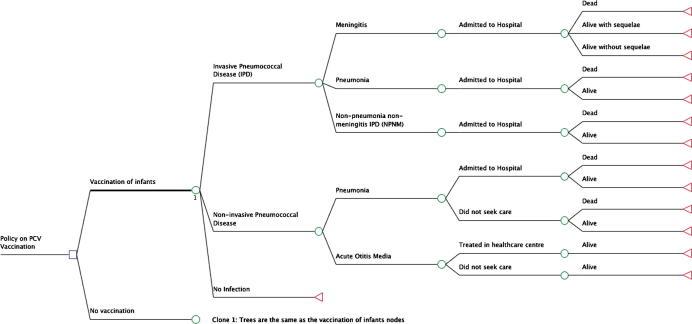
The incremental cost-effectiveness ratio (ICER) of introducing PCV13 compared to no PCV vaccination was assessed using an age-stratified static multiple cohort model. The risk of various clinical presentations of pneumococcal disease (meningitis, pneumonia, non-meningitis non-pneumonia invasive pneumococcal disease and acute otitis media) at all ages for thirty birth cohorts was assessed. The analysis considered both health system and societal perspectives. A 3+0 vaccine schedule and price of US$3.30 per dose was assumed for the baseline scenario based on Gavi, the Vaccine Alliance's advance market commitment tail price.
RESULTS
The ICER of PCV13 introduction is estimated at US$52 per disability-adjusted life year (DALY) averted (health system perspective), and cost-saving (societal perspective). Although indirect effects of PCV have been well-documented, a conservative scenario that does not consider indirect effects estimated PCV13 introduction to cost US$79 per DALY averted (health system perspective), and US$19 per DALY averted (societal perspective). Vaccination with PCV13 is expected to cost around US$920,000 in 2016, and thereafter US$820,000 every year. The programme is likely to reduce direct disease-related costs to MOH by US$440,000 in the first year, increasing to US$510,000 by 2025.
CONCLUSION
Introducing PCV13 as part of Mongolia's national programme appears to be highly cost-effective when compared to no vaccination and cost-saving from a societal perspective at vaccine purchase prices offered through Gavi. Notwithstanding uncertainties around some parameters, cost-effectiveness of PCV introduction for Mongolia remains robust over a range of conservative scenarios. Availability of high-quality national data would improve future economic analyses for vaccine introduction.
目的
蒙古卫生部正在考虑将13价肺炎球菌结合疫苗(PCV13)纳入其国家免疫规划,以预防肺炎链球菌所致疾病负担。本研究评估了在蒙古引入PCV13相较于不接种PCV疫苗的成本效益和预算影响。
方法
采用年龄分层的静态多队列模型评估引入PCV13相较于不接种PCV疫苗的增量成本效益比(ICER)。评估了30个出生队列各年龄段肺炎球菌疾病(脑膜炎、肺炎、非脑膜炎非肺炎侵袭性肺炎球菌疾病和急性中耳炎)各种临床表现的风险。分析同时考虑了卫生系统和社会视角。基于全球疫苗免疫联盟(Gavi)的预市场承诺尾价,基线情景假设采用3+0疫苗接种程序,每剂价格为3.30美元。
结果
引入PCV13的ICER估计为每避免一个伤残调整生命年(DALY)52美元(卫生系统视角),且具有成本节约效果(社会视角)。尽管PCV的间接影响已有充分记录,但在不考虑间接影响的保守情景下,估计引入PCV13每避免一个DALY的成本为79美元(卫生系统视角),每避免一个DALY的成本为19美元(社会视角)。预计2016年PCV13疫苗接种成本约为92万美元,此后每年为82万美元。该计划可能在第一年使卫生部与疾病直接相关的成本降低44万美元,到2025年增至51万美元。
结论
与不接种疫苗相比,将PCV13纳入蒙古国家计划似乎具有很高的成本效益,且从社会视角来看,按照Gavi提供的疫苗采购价格,引入该疫苗具有成本节约效果。尽管某些参数存在不确定性,但在一系列保守情景下,蒙古引入PCV的成本效益依然稳健。高质量国家数据的可得性将改善未来引入疫苗的经济分析。

 Zotero 插件