Philips Ryan T, Chakravarthy V Srinivasa
Computational Neuroscience Laboratory, Department of Biotechnology, Indian Institute of Technology Madras Chennai, India.
Front Neural Circuits. 2017 Jan 5;10:109. doi: 10.3389/fncir.2016.00109. eCollection 2016.
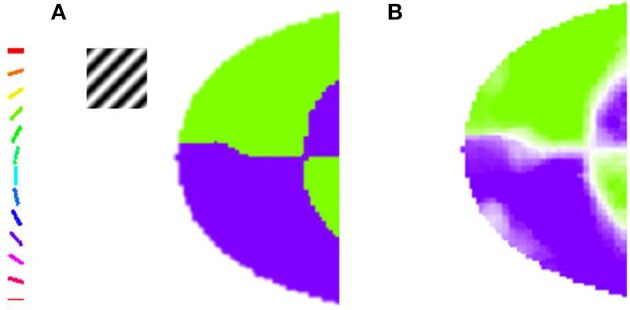
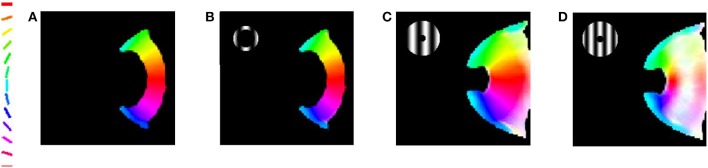
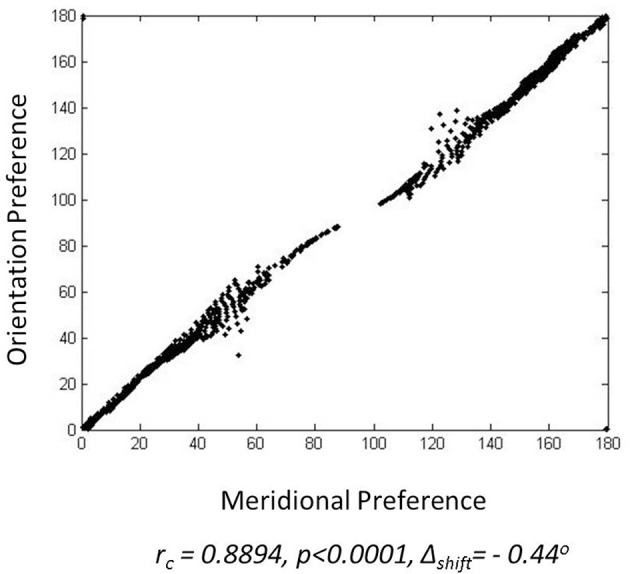
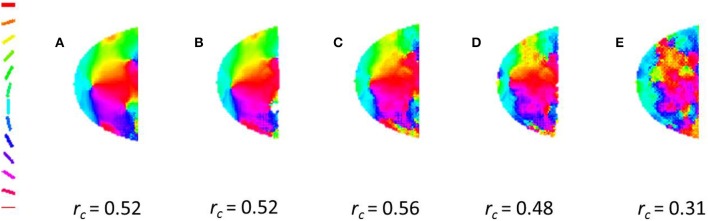
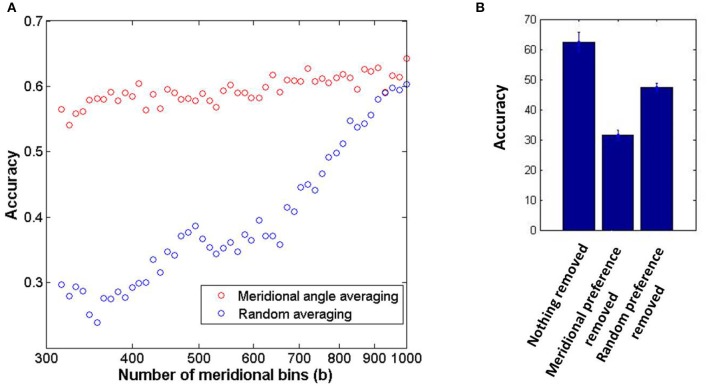
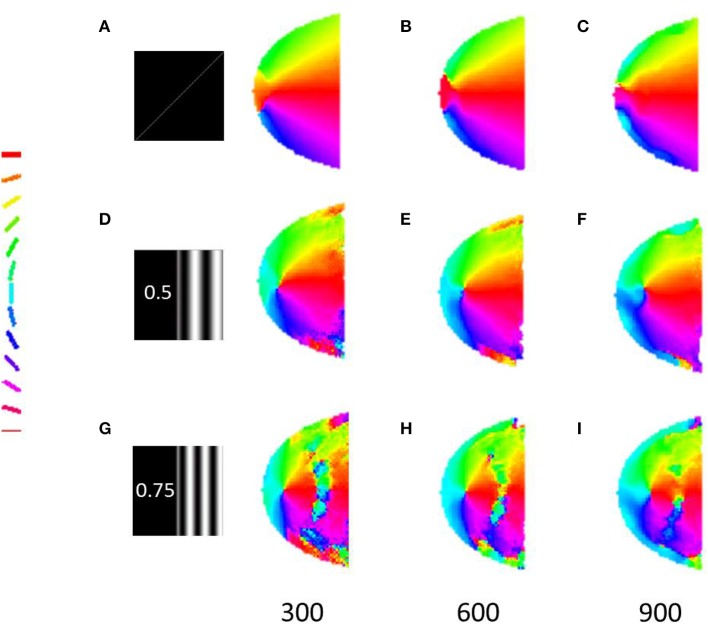
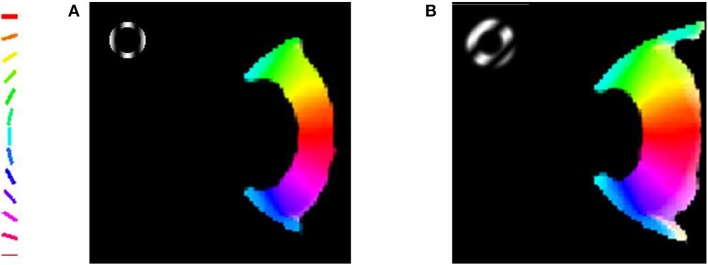
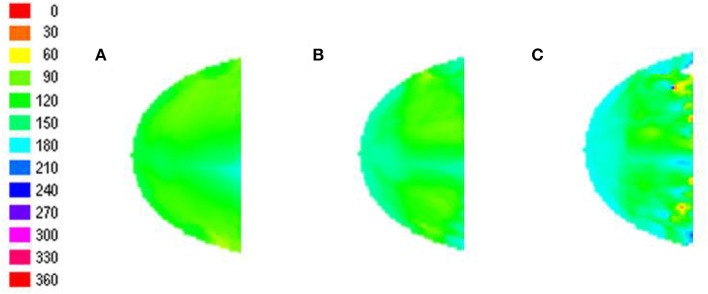
A remarkable accomplishment of self organizing models is their ability to simulate the development of feature maps in the cortex. Additionally, these models have been trained to tease out the differential causes of multiple feature maps, mapped on to the same output space. Recently, a Laterally Interconnected Synergetically Self Organizing Map (LISSOM) model has been used to simulate the mapping of eccentricity and meridional angle onto orthogonal axes in the primary visual cortex (V1). This model is further probed to simulate the development of the radial bias in V1, using a training set that consists of both radial (rectangular bars of random size and orientation) as well as non-radial stimuli. The radial bias describes the preference of the visual system toward orientations that match the angular position (meridional angle) of that orientation with respect to the point of fixation. Recent fMRI results have shown that there exists a coarse scale orientation map in V1, which resembles the meridional angle map, thereby providing a plausible neural basis for the radial bias. The LISSOM model, trained for the development of the retinotopic map, on probing for orientation preference, exhibits a coarse scale orientation map, consistent with these experimental results, quantified using the circular cross correlation ( ). The between the orientation map developed on probing with a thin annular ring containing sinusoidal gratings with a spatial frequency of 0.5 cycles per degree (cpd) and the corresponding meridional map for the same annular ring, has a value of 0.8894. The results also suggest that the radial bias goes beyond the current understanding of a node to node correlation between the two maps.
自组织模型的一项显著成就在于其能够模拟皮质中特征图的发育。此外,这些模型经过训练,以梳理出映射到同一输出空间的多个特征图的不同成因。最近,一种横向互联协同自组织映射(LISSOM)模型已被用于模拟初级视觉皮质(V1)中偏心率和子午角在正交轴上的映射。该模型通过使用一个由径向(随机大小和方向的矩形条)以及非径向刺激组成的训练集,进一步探究以模拟V1中径向偏差的发育。径向偏差描述了视觉系统对与相对于注视点的该方向的角位置(子午角)相匹配的方向的偏好。最近的功能磁共振成像结果表明,V1中存在一个粗略尺度的方向图,它类似于子午角图,从而为径向偏差提供了一个合理的神经基础。经过视网膜拓扑图发育训练的LISSOM模型,在探究方向偏好时,展现出一个与这些实验结果一致的粗略尺度方向图,使用圆形互相关( )进行量化。在用每度0.5周空间频率(cpd)的正弦光栅的薄环形环探测时所发育的方向图与同一环形环的相应子午图之间的 ,其值为0.8894。结果还表明,径向偏差超出了目前对这两个图之间节点到节点相关性的理解。