Kumar Bhadra S, Khot Aditi, Chakravarthy V Srinivasa, Pushpavanam S
Computational Neuroscience Laboratory, Department of Biotechnology, Bhupat and Jyoti Mehta School of Biosciences, Indian Institute of Technology Madras, Chennai, India.
Department of Chemical Engineering, Purdue University, West Lafayette, IN, United States.
Front Comput Neurosci. 2021 Jun 15;15:638700. doi: 10.3389/fncom.2021.638700. eCollection 2021.
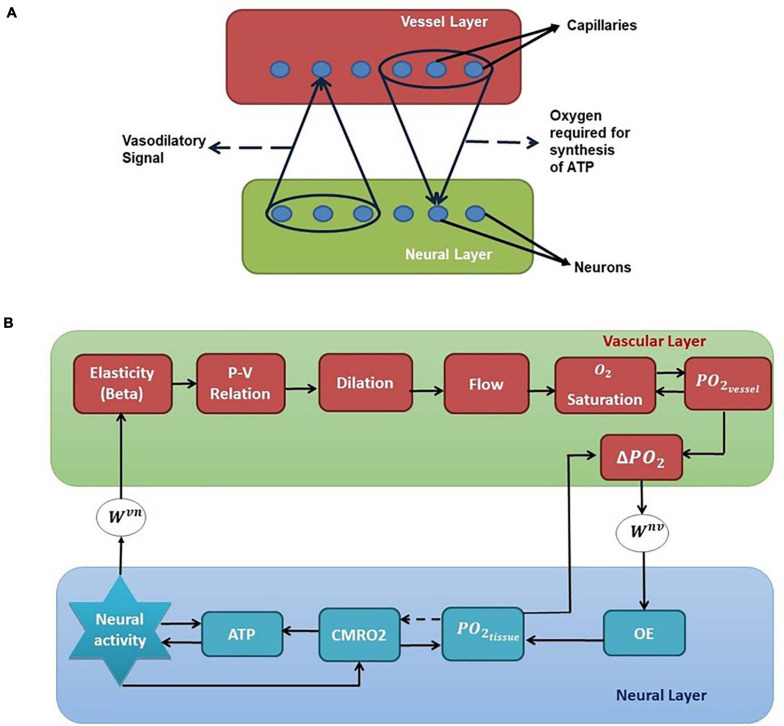
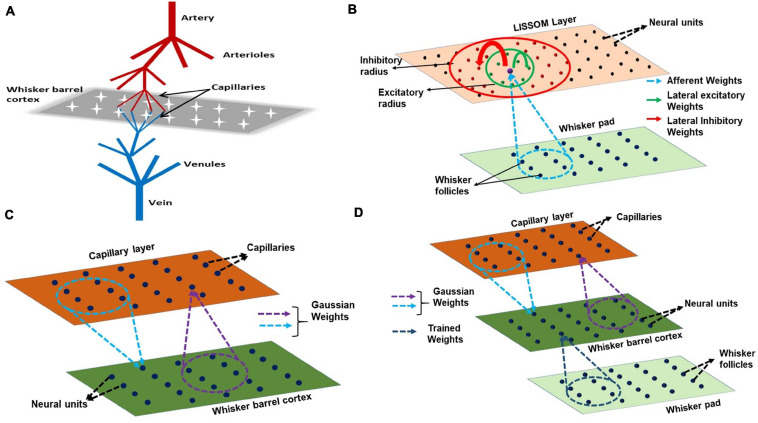
Neurovascular coupling is typically considered as a master-slave relationship between the neurons and the cerebral vessels: the neurons demand energy which the vessels supply in the form of glucose and oxygen. In the recent past, both theoretical and experimental studies have suggested that the neurovascular coupling is a bidirectional system, a loop that includes a feedback signal from the vessels influencing neural firing and plasticity. An integrated model of bidirectionally connected neural network and the vascular network is hence required to understand the relationship between the informational and metabolic aspects of neural dynamics. In this study, we present a computational model of the bidirectional neurovascular system in the whisker barrel cortex and study the effect of such coupling on neural activity and plasticity as manifest in the whisker barrel map formation. In this model, a biologically plausible self-organizing network model of rate coded, dynamic neurons is nourished by a network of vessels modeled using the biophysical properties of blood vessels. The neural layer which is designed to simulate the whisker barrel cortex of rat transmits vasodilatory signals to the vessels. The feedback from the vessels is in the form of available oxygen for oxidative metabolism whose end result is the adenosine triphosphate (ATP) necessary to fuel neural firing. The model captures the effect of the feedback from the vascular network on the neuronal map formation in the whisker barrel model under normal and pathological (Hypoxia and Hypoxia-Ischemia) conditions.
神经元需要能量,而血管以葡萄糖和氧气的形式提供能量。最近,理论和实验研究均表明,神经血管耦合是一个双向系统,是一个包含血管反馈信号的回路,该反馈信号会影响神经放电和可塑性。因此,需要一个双向连接的神经网络和血管网络的集成模型,以理解神经动力学的信息和代谢方面之间的关系。在本研究中,我们提出了一个在触须桶状皮层中的双向神经血管系统的计算模型,并研究了这种耦合对神经活动和可塑性的影响,这在触须桶状图形成中表现出来。在这个模型中,一个基于速率编码的动态神经元的具有生物学合理性的自组织网络模型,由一个利用血管生物物理特性建模的血管网络提供养分。设计用于模拟大鼠触须桶状皮层的神经层将血管舒张信号传递给血管。来自血管的反馈是以用于氧化代谢的可用氧气的形式存在的,其最终结果是为神经放电提供能量所需的三磷酸腺苷(ATP)。该模型捕捉了在正常和病理(缺氧和缺氧缺血)条件下,血管网络反馈对触须桶状模型中神经元图形成的影响。