Dearden Kirk A, Schott Whitney, Crookston Benjamin T, Humphries Debbie L, Penny Mary E, Behrman Jere R
IMA World Health, Dar es Salaam, Tanzania.
Population Studies Center, University of Pennsylvania, Philadelphia, PA, USA.
BMC Public Health. 2017 Jan 23;17(1):110. doi: 10.1186/s12889-017-4033-1.
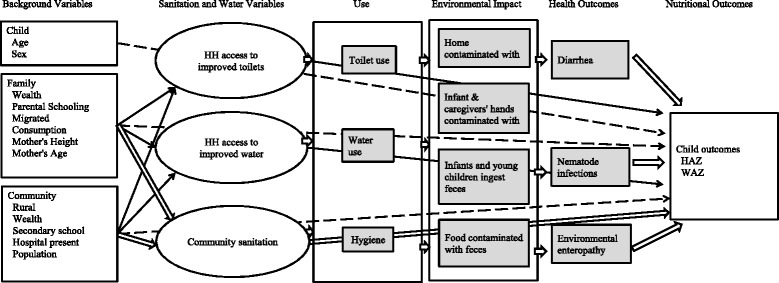
This study's purpose was to understand associations between water, sanitation, and child growth.
We estimated stunting (height-for-age Z score <-2 SD) and thinness (BMI-Z <-2 SD) risk ratios using data from 7,715 Ethiopian, Indian, Peruvian, and Vietnamese children from the Young Lives study.
In unadjusted models, household access to improved water and toilets was often associated with reduced stunting risk. After adjusting for child, household, parent, and community variables, access to improved water was usually not associated with stunting nor thinness except in Ethiopia where access to improved water was associated with reduced stunting and thinness at 1y and 5y. In contrast, in both unadjusted and adjusted models, stunting at 1y was less common among children with good toilet access than among those without access and this difference persisted when children were 5y and 8y. For example, in adjusted estimates, Vietnamese 5y olds with access to improved toilets had relative stunting risk at 8y 0.62-0.68 that of 5y olds with no access to improved toilets. Water and toilets were rarely associated with thinness.
Results from our study indicate that access to improved sanitation is more frequently associated with reduced stunting risk than access to improved water. However, additional studies are needed before drawing definitive conclusions about the impact of toilets relative to water. This study is the first to our knowledge to demonstrate the robust and persistent importance of access to improved toilets in infancy, not only during the first year but continuing into childhood. Additional longitudinal investigations are needed to determine concurrent and long-term associations of WASH with stunting and thinness.
本研究旨在了解水、环境卫生与儿童生长之间的关联。
我们使用来自“年轻生命”研究中7715名埃塞俄比亚、印度、秘鲁和越南儿童的数据,估算发育迟缓(身高别年龄Z评分<-2标准差)和消瘦(BMI-Z<-2标准差)的风险比。
在未调整的模型中,家庭获得改善水和厕所的机会通常与发育迟缓风险降低相关。在对儿童、家庭、父母和社区变量进行调整后,获得改善水的机会通常与发育迟缓或消瘦无关,除了在埃塞俄比亚,获得改善水的机会与1岁和5岁时发育迟缓和消瘦的减少相关。相比之下,在未调整和调整后的模型中,1岁时发育迟缓在有良好厕所使用机会的儿童中比没有这种机会的儿童中更不常见,并且当儿童5岁和8岁时这种差异仍然存在。例如,在调整后的估计中,5岁能使用改善厕所的越南儿童在8岁时的相对发育迟缓风险是5岁不能使用改善厕所儿童的0.62-0.68倍。水和厕所很少与消瘦相关。
我们的研究结果表明,获得改善的环境卫生比获得改善的水更常与发育迟缓风险降低相关。然而,在就厕所相对于水的影响得出明确结论之前,还需要进行更多研究。据我们所知,本研究首次证明了在婴儿期获得改善厕所的机会具有强大且持久的重要性,不仅在第一年,而且持续到儿童期。需要进行更多纵向调查以确定水、环境卫生和个人卫生与发育迟缓和消瘦的同时期和长期关联。